Wood Species
The primary properties of wood include density, compressive strength, static bending strength, modulus of elasticity, and hardness. Based on hardness, wood species are classified into hardwoods and softwoods.
|
Category |
Species |
|
Very hard |
|
|
Hard |
|
|
Medium hard |
European Walnut, Cherry, elm |
|
Soft |
Alder, pine, spruce, poplar, lime, aspen, willow |
It is important to note that this classification serves merely as a general guide. Each species comprises dozens of varieties, whose timber can vary considerably depending on climate and soil conditions. For instance, pine is classified as a softwood, while Austrian pine has mechanical properties closer to medium-hard wood.
Solid hardwoods are used in construction, flooring, furniture, stairs, and wall and ceiling panels. Oak, beech, maple, hornbeam, and walnut are versatile materials that withstand heavy mechanical loads. Alder, spruce, poplar, and other softwoods are selected for applications that do not experience heavy wear (wall panels, headboards, lamp bases).

Timber Dimensions
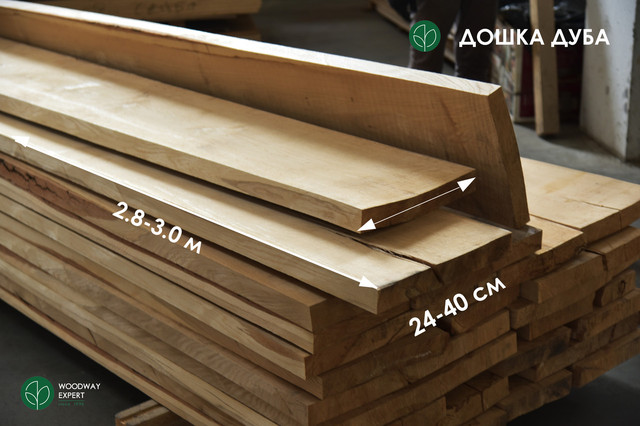
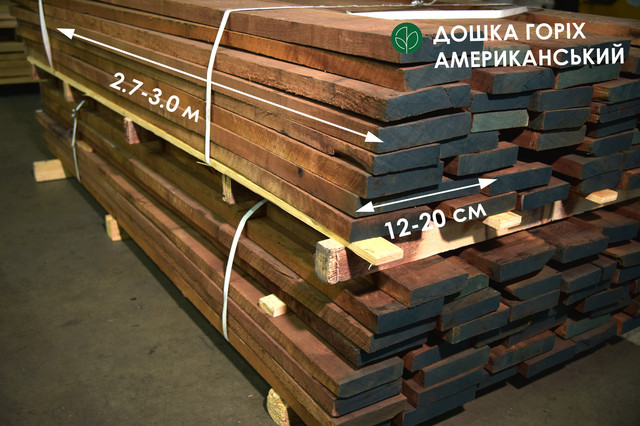
Timber is measured in cubic metres, so lumber prices are also quoted per cu m. Popular edged board dimensions include 50×150, 50 by 200, 50×200, 40 by 150, 150×50, 25×100, 200×50, and 50x150x6000. To calculate the volume of timber, multiply its length, width, and thickness. The number of edged boards per cubic metre is calculated by dividing 1 cubic metre by the volume of a single board.
Timber Moisture Content
Moisture content is the percentage ratio of moisture weight to oven-dry wood weight. This parameter determines the timber’s scope of application. Furniture manufacturing uses timber with 8-12% moisture content. Cladding applications require materials with 16-18% moisture levels. Flooring requires timber with 8-15% moisture content, while doors, windows, and stairs require approximately 15%.
To achieve these parameters, the timber must be dried. Freshly felled green wood has a moisture content of 50-70%. Green timber is not used in joinery. Lumber is dried either naturally or in kilns.
1. Natural Air-Drying of Timber. Stacked timber is kept under shelters or in storage sheds. Air-drying wood outdoors is a simple and time-consuming method that produces boards with 18-22% moisture content. Drying hardwood takes months.
2. Kiln-Drying of Timber. Timber with 8-15% moisture content can be obtained through drying in specially equipped kilns. Kiln-dried lumber features superior stability due to uniform drying.
1. Natural Air-Drying of Timber. Stacked timber is kept under shelters or in storage sheds. Air-drying wood outdoors is a simple and time-consuming method that produces boards with 18-22% moisture content. Drying hardwood takes months.
2. Kiln-Drying of Timber. Timber with 8-15% moisture content can be obtained through drying in specially equipped kilns. Kiln-dried lumber features superior stability due to uniform drying.
The joinery market offers lumber of various quality grades. Grades are designated using Extra, A, B, and C markings, corresponding to Selected (prime/extra), Grade 1 (I), Grade 2 (II), and Grade 3 (III).
· Extra (extra). This category includes select boards with parallel faces and square-cut ends. Sound knots are among the permitted defects. This premium-grade lumber is used for bespoke furniture and decorative interior trim.
· I (A). High-grade lumber that permits more sound knots than Extra grade. End checks are also permitted. Furniture, parquet flooring, panels, and decorative items represent only a partial list of Grade 1 timber applications.
· II (B). Grade 2 permits various knot types, stains, wormholes, and resin pockets. These boards are used for battens, pallets, and various structures.
· III (C). Grade 3 timber is used for decking, crating, packaging, and temporary structures. The surface may exhibit fungal staining, knots, wormholes, and resin pockets.
The price of edged timber is also influenced by order volume and shipping costs. Large factories manufacturing furniture, doors, and interior elements purchase timber in bulk, whereas craft workshops prefer buying lumber by the piece or in small batches.