
Order
Place order
Clear the whole list?
The “Sliced American Cherry Veneer” category holds 2 items in the WoodWay Expert warehouse. In stock: thicknesses 0.6 mm; grades Extra, 1.
Sliced and sawn veneer faces furniture fronts, doors, wall panels and worktops, giving solid-wood looks at a sensible cost.
Wood is a natural material: shade and figure vary from batch to batch. Ask our manager for current pricing and stock — we will calculate volume and delivery across Ukraine; dispatched from our warehouse.
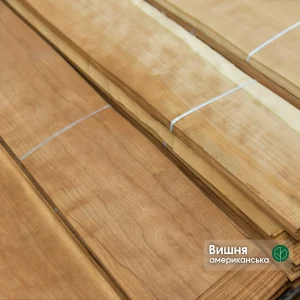
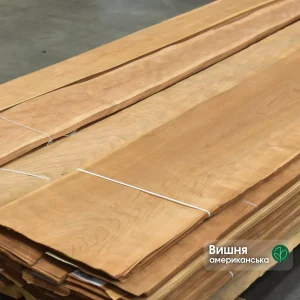
Sliced American cherry veneer is a premium facing material chosen for crafting bespoke furniture and luxury interior decoration.
Our warehouse programme offers cherry veneer with the following specifications:
Natural cherry veneer is suitable for projects in Baroque, Gothic, Neoclassical, Art Deco, and Retro styles. We partner with both wholesale and retail clients, supplying materials starting from 1 bundle. The price is indicated per square metre; the cost of a bundle is calculated based on its total square metreage and grade. We ship across Ukraine, and self-pickup from our warehouse is also available.
American cherry differs significantly from its European counterparts across several parameters.
When working with American cherry veneer, we recommend applying varnishes with UV filters to slow colour changes. Alternatively, select wax finishes to accentuate the natural ageing of the timber.
Choosing between natural veneer and Fine-Line involves compromising between uniqueness and predictability. While both materials consist of wood, their operational and visual characteristics differ substantially.
| Parameter | Natural American Cherry Veneer | Fine-Line |
|---|---|---|
| Origin | 100% solid wood | Fast-growing species (poplar, ayous) |
| Texture | Unique natural pattern, annual rings | Repetitive, artificially created pattern |
| Colour change | Darkens under UV rays | Stable colour (due to dyeing) |
| Composition | Pure timber without foreign additives | Timber + up to 15–20% glue compounds and pigments |
| Eco-friendliness | Maximum (E1 class) | Depends on the quality of the glue used |
| Maintainability | High (tolerates repeated sanding) | Low (due to brittleness and porosity) |
Each sheet of natural cherry veneer boasts a unique texture, featuring medullary rays, knots, and intertwined fibres. Fine-line is a reconstructed veneer produced by dyeing, gluing into blocks, and slicing peeled veneer. The surface of this material displays a templated pattern devoid of flaws.
For premium-segment products, where status and natural beauty are valued, natural veneer is the definitive choice. Fine-line is suitable for the mass production of budget furniture or door leaves, where ensuring 100% uniformity across a batch is crucial.
Veneer grade classification is a sheet quality assessment system based on the analysis of visual characteristics and structural integrity. For American cherry, determining the grade is particularly important due to the species’ specific features. These include the presence of gum pockets and medullary rays.
This is the highest quality material for furniture fascias and decorative wall panels. The veneer is uniform in colour and features a clear, symmetrical pattern. Black knots, cracks, and sapwood are entirely excluded.
A minimal number of gum pockets (up to 1-2 mm in length) are permitted, which are a natural hallmark of genuine cherry.
This is the most sought-after grade for the mass production of furniture and doors. Minor shade variations between sheets within a single bundle are possible.
Sound, intergrown knots up to 3-5 mm, a small number of gum streaks, and minimal sapwood along the sheet edges (no more than 5-10% of the width) are acceptable.
This material showcases the natural characteristics of the timber. It is utilised for finishing concealed furniture elements and creating projects in rustic, eco, or country styles. It exhibits pronounced natural colour contrast and texture heterogeneity.
Large gum pockets, sapwood, dark spots, and knots exceeding 5-10 mm in diameter are permitted. Slight surface roughness after slicing is also possible.
| Assessment Criterion | Grade 1 | Grade 2 | Grade 3 |
|---|---|---|---|
| Gum pockets | Solitary (up to 2 mm) | Up to 10 mm | Unrestricted |
| Sapwood (light stripe) | Not permitted | Up to 10% of area | Up to 30% of area |
| Sound knots | Absent | Up to 5 mm | Up to 20 mm |
| Colour variations | Minimal | Moderate | High |
American cherry (Prunus serotina), also known as black cherry, is among the most valuable broadleaved species in North America. The tree is distinguished by exceptional decorative properties, making it a benchmark material for crafting luxury furniture. The primary commercial forests are concentrated in the eastern United States and parts of Canada.
American cherry is prized for its stability and workability. This dense (560–580 kg/m³) timber is quite strong. Brinell hardness varies between 3.0 and 3.2.
Wear resistance is moderate. The timber withstands loads well but requires a protective coating when used on horizontal surfaces, such as worktops or flooring. Black cherry exhibits excellent flexibility parameters.
Following steam treatment, the solid wood becomes plastic, enabling the production of bent-glued elements with complex forms. The heartwood colour ranges from intense reddish-brown to golden. The sapwood is narrow and creamy-white in colour.
Under the influence of UV rays, the timber darkens. The fibres are generally straight, and the texture is fine and uniform with a distinct silky lustre. The pores are scattered and small.
A characteristic feature is black gum pockets (tiny dashes), which are not considered defects but rather confirm the naturalness of the species. It is easily planed and routed. Following sanding, an almost mirror-like surface is achieved.
A gradual increase in abrasive grit is recommended. It readily accepts all types of adhesives. It holds screws and nails perfectly, although pre-drilling is recommended to prevent splitting.
By choosing to partner with WoodWay Expert, you gain not only high-quality timber materials but also expert support. We have identified 7 key arguments in favour of collaborating with us:
We have been working with Ukrainian manufacturers of furniture, doors, and interior decor for over 30 years. Our team is ready to handle tasks of any scale—contact us!
We have developed a collaboration system that accommodates the operational specifics of both large-scale furniture factories and craft workshops. We offer the following options:
Our timber depot features over 25 varieties of sliced veneer. Send us an inquiry or technical specification, and we will select suitable options for you.
The quantity of veneer in a bundle depends on the length and width of the sheets. Typically, one bundle contains 24 or 32 sheets. The average area of a bundle ranges from 10 to 25 sq.m. At WoodWay Expert, veneer is sold starting from 1 bundle.
You must add 30–50% to the net area of the fascias for allowances and pattern matching. If complex book-matching is planned, the material reserve can reach 70% due to the necessity of mirroring the fibres.
The most popular thickness in Ukraine is 0.6 mm. This is the standard for veneering MDF and chipboard, which permits high-quality sanding.
American cherry is a light-sensitive species. Due to its high natural resin content, it oxidises under the influence of ultraviolet light. Over the first 6–12 months, the colour shifts from light pink to deep red-brown. This is a natural process that verifies the material’s authenticity.
No, small black dashes or specks are gum pockets, a characteristic biological feature of Prunus serotina. In 1st grade (A) veneer, their quantity is minimal, but their presence is a mark of naturalness, unlike perfectly “clean” artificial fine-line.
Everything depends on the design. A radial cut is suitable for minimalist interiors and creating uniform surfaces. A tangential cut is chosen for classic furniture, where highlighting the natural wood grain is essential.
American cherry typically boasts a more saturated colour leaning towards red and greater stability following drying. European cherry is often lighter and features a less pronounced texture.
PVA-based adhesives (D3 class) are suitable for cold or hot veneering. It is vital to adhere to the veneering technology and the adhesive manufacturer’s recommendations.