
Order
Place order
Clear the whole list?
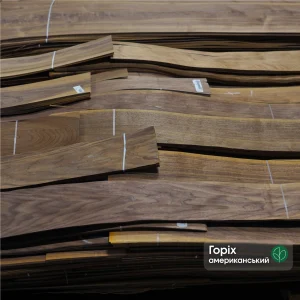
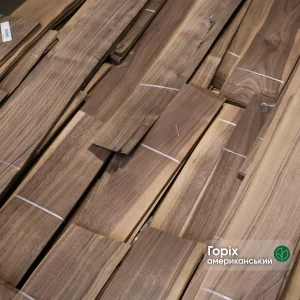
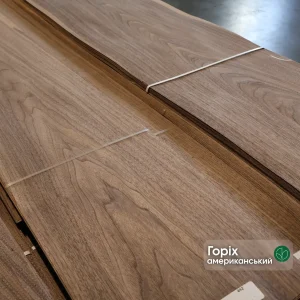
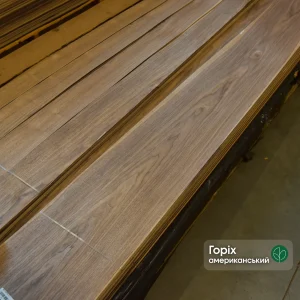
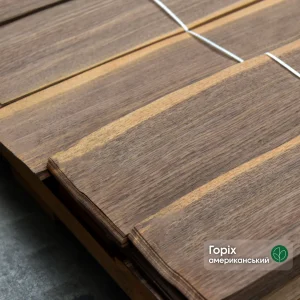
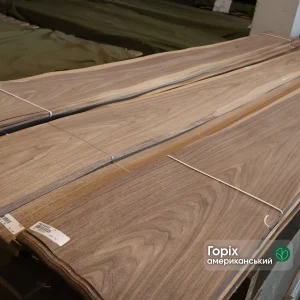
Natural American walnut sliced veneer is an elite facing material derived from black walnut (Juglans nigra) timber. Thanks to its unique deep shade and distinct texture, this veneer holds a leading position in premium design and luxury furniture manufacturing.
Natural American walnut sliced veneer is an elite facing material derived from black walnut (Juglans nigra) timber. Thanks to its unique deep shade and distinct texture, this veneer holds a leading position in premium design and luxury furniture manufacturing. Our catalogue features American walnut veneer with the following parameters:
Natural walnut veneer represents a rational use of forest resources. From one cubic metre of solid wood, up to 850 square metres of 0.55 mm thick veneer can be produced. It also offers the opportunity to achieve a premium finish with a lighter construction weight.
We sell facing material in bundles. The price per bundle depends on the grade and square metreage. Orders can be collected from our warehouse via self-pickup. Delivery across Ukraine is also available.
Both materials look visually similar, but their structure, physical-mechanical properties, and performance potential are fundamentally different. Discover the differences between natural veneer and fine-line below.
| Characteristic | Natural American Walnut Veneer | Fine-line Veneer (Walnut Effect) |
|---|---|---|
| Origin and technological structure | A slice of Juglans nigra timber. Each sheet retains a unique wood grain. | A reconstituted product made by pressing peeled softwood veneer. Sheets are dyed thoroughly, glued into blocks, and sliced at an angle to imitate the walnut pattern. |
| Density | 610–640 kg/m³ (high). Repairable material that allows for sanding. | 400–450 kg/m³ (low). Limited repairability due to the risk of sanding through. |
| Aesthetic differences | The main advantage of natural walnut is the uniqueness of its pattern, texture, and colour. | Fine-line is chosen for perfect pattern repeatability. It ensures identical cabinet doors for large projects but looks ‘flatter’ without a delicate natural lustre. |
| Processing features | Natural walnut gradually lightens in sunlight, fading to a honey shade. A 0.6 mm sliced veneer provides a margin for delicate restoration. | Due to its loose structure, fine-line absorbs 25-40% more varnish and primer than dense natural walnut. It is sensitive to overheating during sanding and can clog abrasive belts with glue residue. |
Choose natural American walnut sliced veneer if you are creating designer furniture, premium doors, or interiors that value naturalness, durability, and eco-friendliness. If minimising cutting waste, pattern uniformity, and the lowest possible price per square metre are priorities, opt for fine-line.
The veneer grade determines material quality based on visual characteristics and natural features. Grade classification allows manufacturers to optimise costs by using premium sheets for fascias and technical ones for internal components. Sorting American walnut veneer is specific because the species features a sharp contrast between the dark heartwood and light sapwood.
This is a select material for manufacturing luxury furniture, wall panels, and doors. It features a highly uniform ‘chocolate’ shade. Sapwood is virtually absent or constitutes no more than 5% of the sheet’s area.
The surface is clean. Occasional ‘pin knots’ (up to 1 mm in diameter) are permitted, with a maximum of one per linear metre. Cracks, rot, or chemical staining are entirely excluded.
This is the optimal choice for serial furniture production in the mid-to-high price segment, where the natural look of wood is valued. A moderate amount of sapwood is permitted (up to 20% of the area), creating a characteristic contrasting pattern. Slight variations in fibre colour are possible.
Sound knots up to 5–8 mm in diameter and small fibre curls may be present. Through-cracks and insect damage are not permitted.
This grade is used for internal finishing, substrates, furniture back panels, or items in rustic, eco, loft, and country styles. It features a significant sapwood content (over 30-40%), pronounced texture heterogeneity, and medullary rays.
Intergrown and partially intergrown knots, mineral streaks, and minor end cracks (up to 15 cm) that can be removed during cutting are permitted. When working with American walnut, it is important to understand that Grade 2 often looks more ‘alive’ due to the heartwood and sapwood contrast. If the project involves a clear oil finish, Grade 2 material can be a winning design choice whilst offering substantial budget savings.
There are three main types of timber slicing, each forming a specific grain pattern and offering different stability levels.
The knife passes perpendicular to the growth rings, through the log’s centre. The texture consists of parallel straight lines running the full length of the sheet. The pattern is highly minimalist and uniform.
Quarter-cut veneer is the most stable. The expansion and contraction coefficient during moisture changes is minimal. Application: Products for minimalist interiors and large wall panels where achieving an ‘endless’ line effect is important.
The cut is made tangentially to the growth rings, maximising the natural beauty of the walnut. A characteristic pattern of arches or ‘cathedrals’ forms in the centre of the sheet. The lines become straighter towards the edges.
The material is decorative but less stable compared to the quarter cut. Sheets are typically wider. Application: Traditional furniture, doors, and accent fascias where the wood grain acts as a central decorative element.
This is an intermediate cut where the angle between the knife and the growth rings is approximately 45°. The straight lines of the quarter cut transition smoothly into gentle curves. The pattern looks softer and more natural, lacking the strict graphic nature of the quarter cut and the pronounced ‘cathedrals’ of the flat cut.
It is the golden mean in terms of stability and useful raw material yield. Application: A versatile option for furniture production that allows for easy matching of veneer bundles.
Black or American walnut (Juglans nigra) is considered the ‘gold standard’ among North American hardwoods. The species’ natural habitat covers the eastern United States and southern regions of Canada. The highest quality raw material comes from the Midwest (Ohio, Indiana, Iowa), where climatic conditions promote slow growth and a dense timber structure.
American walnut is a medium-density hardwood (650 kg/m³) but boasts high bending strength and impact toughness. Its Brinell hardness is 3.7 – 4.0. The heartwood has a rich colour ranging from light brown to deep chocolate with a purple or greyish undertone. The sapwood is narrow and creamy-white. Industrial veneer production often uses steaming to blend the sapwood and heartwood colours.
Pores are clearly visible. The grain is usually straight, but wavy sections or curls are frequently found, creating decorative effects like moiré or ‘bird’s eye’. The timber is excellent to work with using both hand and machine tools. Feed speeds should be reduced when working with wavy grains to avoid tear-out.
Gluing performance is excellent. Solid wood holds screws and nails well. Walnut is easily sanded and accepts all types of oils, waxes, and varnishes. Due to its fine porosity, the timber requires less primer compared to oak.
Partnering with WoodWay Expert goes beyond standard timber procurement. We build relationships focused on the actual needs of furniture manufacturers, joinery workshops, and design studios. Here are 7 reasons why furniture makers, architects, interior designers, and craftsmen across Ukraine choose to work with us:
Choosing WoodWay Expert means receiving not just a material, but a service that minimises production risks and saves manufacturing time. A systematic approach to veneer storage, selection, and processing ensures predictable results in every project.
We have structured the selection and purchasing process for facing materials to be convenient for clients with varying requirements. Furniture companies or private craftsmen can order veneer to suit their schedule, location, and project needs.
Regardless of the chosen order format, clients receive dedicated support at every stage: from material selection to dispatch. We strive to ensure transparent communication and precise order picking so every delivery meets the project’s technical demands.
We have structured the selection and purchasing process for facing materials to be convenient for clients with varying requirements. Furniture companies or private craftsmen can order veneer to suit their schedule, location, and project needs.
Regardless of the chosen order format, clients receive dedicated support at every stage: from material selection to dispatch. We strive to ensure transparent communication and precise order picking so every delivery meets the project’s technical demands.