

Order
Place order
Clear the whole list?
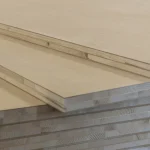
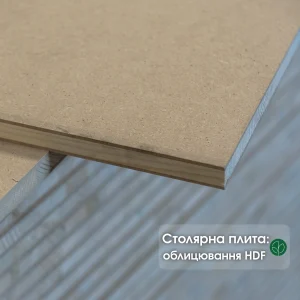
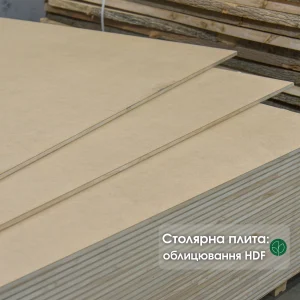
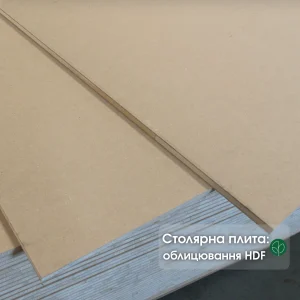
HDF-faced blockboard is a highly stable structural material featuring a solid pine core covered with high-density fiberboard. Its perfectly smooth surface is ready for painting, laminating, or veneering.
Our catalog includes panels with thicknesses of 13 mm, 18 mm, and 38 mm, available in 2500×1250 mm, 2800×2070 mm, and 2100×900 mm formats. You can purchase starting from just 1 board. Pick up your order directly from our Kyiv warehouse or arrange for nationwide delivery via trusted transport companies. Contact our managers for a detailed consultation.
In the furniture industry and interior design, there is a growing demand for materials that combine the strength of natural wood with the stability of modern composites. HDF-faced blockboard is an engineered panel designed to tackle the most demanding manufacturing tasks. Its multi-layered, meticulously crafted structure ensures outstanding performance.
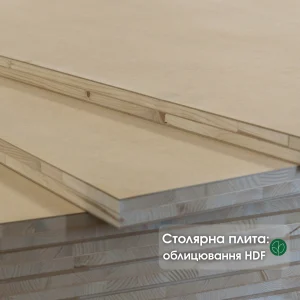
The core of the blockboard consists of edge-glued wooden strips or battens. Pine wood is most commonly used for the core, providing an optimal balance of weight and strength. A crucial technological aspect is cutting the strips to a width of 25 mm. This approach relieves internal tension in the wood, minimizing the risk of panel warping during use. The strips are bonded together using a specialized water-resistant adhesive under high pressure.
A stabilizing layer is applied to both sides of the pine core. Rotary-cut birch or alder veneer is used for this purpose. This intermediate layer acts as reinforcement, further strengthening the structure and creating a reliable base for the final coating. The final step is the symmetrical application of HDF (High-Density Fiberboard) sheets on both sides. This creates a perfectly flat, smooth, and dense surface, completely free of knots, texture variations, or other natural defects typical of solid wood.
The premium quality of the finished material relies on strict adherence to the manufacturing process. The production of HDF-faced blockboards consists of several sequential stages, each monitored according to industry standards.
First, the raw material is prepared: softwood lumber is sawn into 25 mm thick strips. These pieces are then calibrated and sorted. The next step is gluing the strips into a single core panel using a phenol-formaldehyde-based adhesive in high-pressure presses. This guarantees a solid core with no voids.
Drying is a critical stage. This process reduces the material’s moisture to standard levels. The canonical standard for this product is Moisture content: 10–12%. This exact moisture level makes the board suitable for residential use without the risk of future shrinkage.
After drying, birch or alder veneers are glued to the core, followed by the HDF sheets. Symmetrical layering on both sides is mandatory, as it prevents panel deformation caused by differences in surface tension. The result is a stable, durable material ready for further processing.
The WoodWay Expert assortment is curated to meet the needs of both small carpentry workshops and large furniture factories. We offer panels in various thicknesses and formats, allowing you to choose the optimal option for your specific project while minimizing waste.
HDF-faced blockboard boasts a range of technical advantages that make it stand out among other panel materials. Thanks to its composite structure, it eliminates many of the drawbacks of solid wood while retaining its eco-friendliness and strength.
Dimensional stability is one of its primary benefits, achieved through symmetrical HDF facing on both sides. The material is highly resistant to cracking and warping, even with indoor climate fluctuations. Additionally, blockboard is significantly lighter than a solid wood panel of the same thickness, simplifying transportation and installation while reducing the strain on furniture hardware.
The material’s high moisture resistance complies with the strict parameters of the PN-76/D-97000 standard. This allows the boards to be used in environments with fluctuating humidity levels. Its environmental safety is confirmed by its E1 formaldehyde emission class. It can be safely used without restrictions in living rooms, bedrooms, and children’s facilities.
Its thermal and acoustic insulation properties are also worth noting. The natural wood core helps absorb sound waves and retain heat, making this material an excellent choice for wall panels and interior partitions. The perfectly smooth HDF surface is a ready-made base for painting, enameling, wrapping, covering with natural veneer, or laminating. It requires no extensive sanding or filling prior to finishing.
There is often a question about choosing between blockboard and edge-glued panels, as both feature a wooden base. However, their structure and intended use differ significantly.
An edge-glued panel consists entirely of solid wood lamellas glued together by width or length. It has no additional facing, so its surface displays the natural wood texture with all its unique characteristics. This panel requires thorough sanding and finishing with oil or varnish.
Blockboard is a composite material where a core made of an accessible wood species (pine) is covered with a stabilizing layer and a final facing (in this case, HDF). This structure makes the board lighter and more affordable than an edge-glued panel of the same size. It demonstrates superior dimensional stability, as the outer layers restrain the internal tension of the wood. The presence of HDF makes the board a versatile base for any decorative coating, whereas edge-glued panels are primarily used where the exposed grain of natural wood is desired.
Due to their high strength and flawless surface, HDF-faced blockboards are widely used in the furniture industry and construction. The material is easy to mill, saw, and drill, and it securely holds fasteners.
Panels with thicknesses of 13 mm and 18 mm are most commonly used to build furniture carcasses. They are ideal for wardrobes, closet systems, kitchen modules, cabinets, dressers, and shelving units. The smooth HDF surface allows for the creation of perfect paint-grade fronts. Once enameled, the fronts achieve a deep, uniform color with no visible wood grain.
The material is actively used in the production of interior doors and partitions. The board provides excellent sound insulation and retains its shape for decades. It is also a popular solution for creating wall panels in commercial and residential interiors.
The 38 mm thick boards are designed for heavy-duty elements. They serve as a reliable base for kitchen countertops, workshop surfaces, and bar counters. In carpentry, this format is indispensable for crafting staircase components (treads, landings) and wide window sills that must withstand significant weight and mechanical impact.
Choosing a reliable material supplier is the key to successful manufacturing. WoodWay Expert has been operating in the wood materials market for over 30 years, offering clients a carefully curated assortment and a high level of service.
We serve both wholesale and retail customers. Materials are sold starting from one board, and nationwide delivery is handled by trusted transport companies.