Construction, furniture manufacturing, machine and shipbuilding, wall, floor, and ceiling cladding production are fields where plywood is widely used. Each task requires a sheet panel of a specific thickness, size, and with specific physical and mechanical properties. In structural joinery, flexible, aircraft, and marine (water-resistant) plywood are standard choices. Read on to learn how these varieties differ and how they are manufactured.
Contents
- What wood species is plywood made from?
- What is “moisture-resistant plywood”?
- What is “aircraft plywood”?
- What is “flexible plywood”?
- How to buy plywood in Kyiv and Ukraine cost-effectively?
What Wood Species Is Plywood Made From?
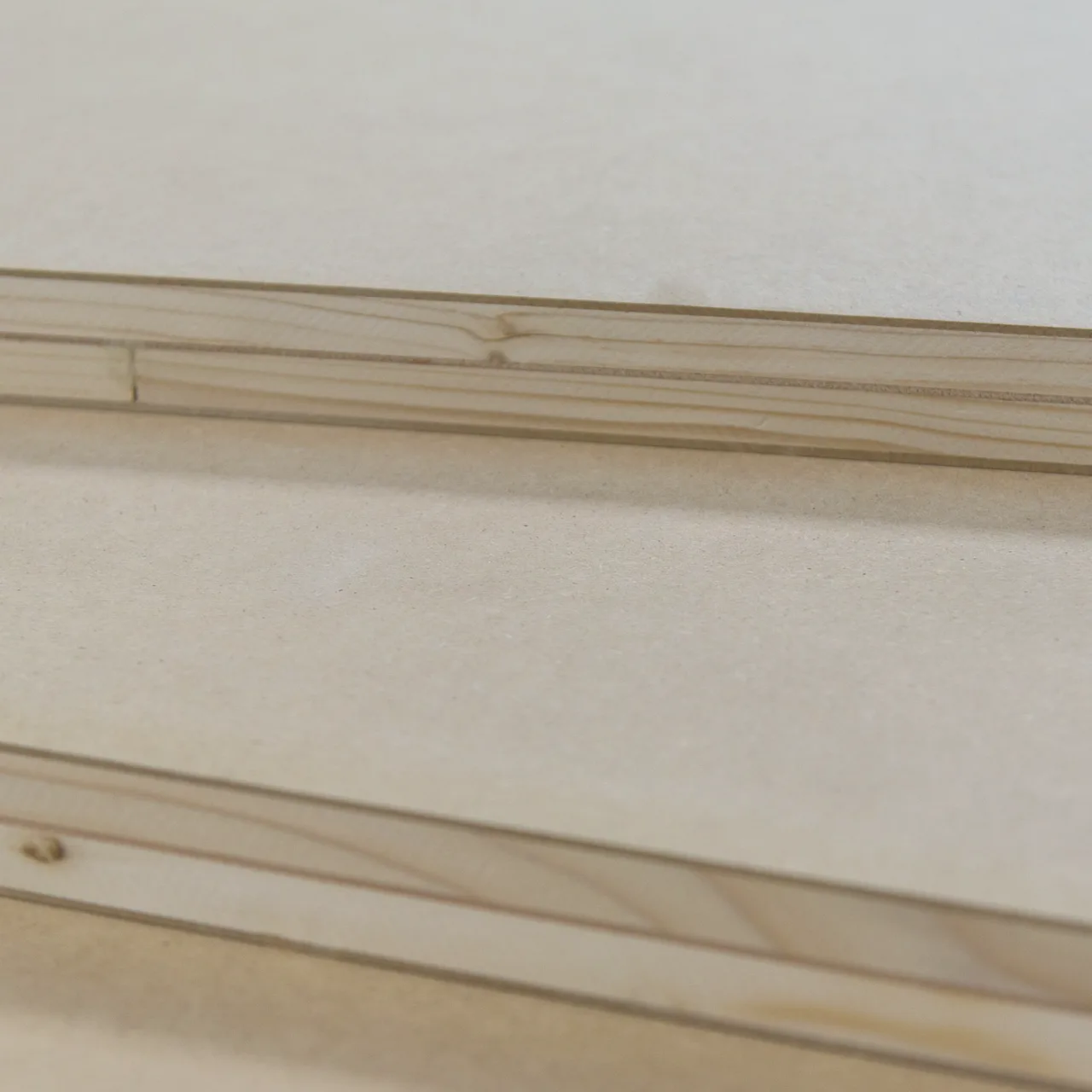
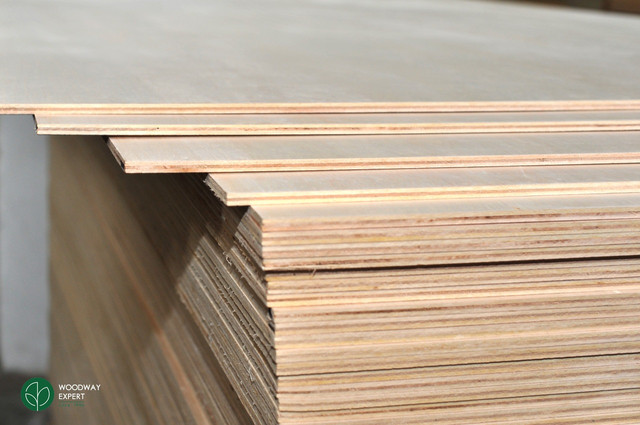
Plywood panels are manufactured from rotary-cut veneer sheets bonded with specialized adhesives. The performance characteristics of the material depend on the wood species and adhesive composition.

Plywood is produced from hardwood and softwood species. Panels made of poplar, alder, birch, and pine are widely available on the market. Birch plywood is considered the most popular choice due to its strength, wear resistance, and ease of machining. Pine plywood is less robust than birch, but significantly more affordable.
Other species worth considering when selecting plywood panels include ceiba and okoume. The ceiba tree is native to the tropics of Africa, the Americas, and Asia. This exotic timber features a uniform texture, elasticity, low weight, and easy workability. Ceiba (kapok tree, fromager) is typically used for rotary-cut veneer in lightweight or flexible plywood production.
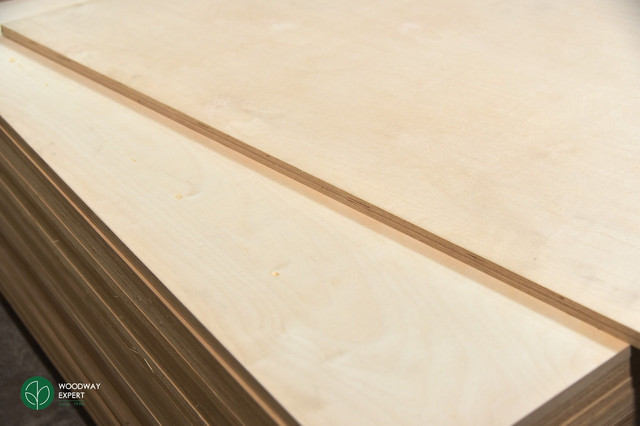
Okoume grows in Central Africa. Other trade names for the species include gabon, okoume, and gaboon mahogany. Due to its pinkish-brown tone, the timber is sometimes used as a substitute for true mahogany, although botanically okoume does not belong to the mahogany family. Okoume is an industrial hardwood capable of withstanding humidity fluctuations. The solid timber is used to produce veneer, plywood, and musical instruments.
Read also:
Difference Between Laminated and Veneered Plywood
What Is “Moisture-Resistant Plywood”?
Moisture resistance is a key characteristic of plywood that defines where the material can be used. Based on this criterion, panels are divided into two main categories: Interior and Exterior.
- Interior Birch Plywood (FK). Urea-formaldehyde resin is used to bond the veneer layers. The panels maintain dimensional stability and resist humidity fluctuations. The material is intended for indoor applications. Interior plywood is used in cabinetmaking, wall and ceiling cladding, interior doors, and decorative elements.
- Exterior Birch Plywood (FSF). The wood plies of the panel are bonded using phenol-formaldehyde adhesive. This exterior-grade plywood withstands heavy mechanical loads and direct contact with water. The material is suitable for outdoor construction, temporary structures, and partition walls.
The joinery market also includes FBS plywood designed for extreme operating conditions. Bonded with an alcohol-soluble phenol-formaldehyde resin, these panels withstand exposure to saltwater and are used in boatbuilding.
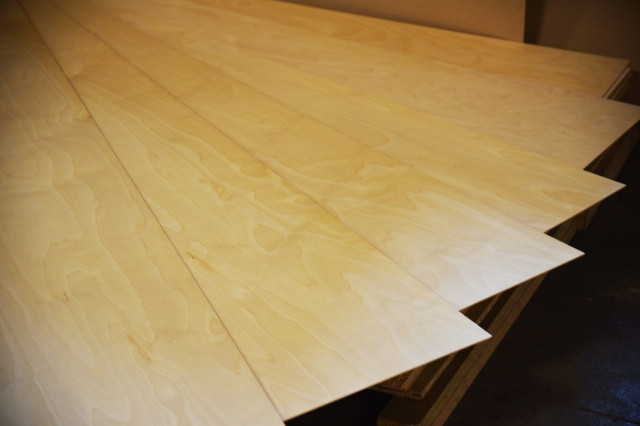
Our catalogue features Okoume marine plywood used in shipbuilding. The panels are used for building rowboats, racing and pleasure boats, canoes, and kayaks. Marine plywood is also used to build transoms, floors, and benches for inflatable boats, as well as for cladding cabin walls, ceilings, and floors.
Key properties of Okoume plywood panels include:
- high water resistance. The panels withstand direct exposure to marine saltwater and maintain dimensional stability. However, marine plywood structural components must be properly sealed with epoxy resin, fiberglass, paint, or varnish;
- strength. Okoume is a hardwood that handles substantial structural loads;
- low weight. This exotic wood is relatively light. Okoume plywood makes it possible to build components that are 20–50% lighter than birch plywood equivalents;
- elasticity. Water-resistant panels can be bent, making them ideal for forming curved parts in various structures.
We stock Okoume plywood in thicknesses of 4 mm, 6 mm, 8 mm, 10 mm, 12 mm, 15 mm, 18 mm, and 20 mm. Sheet dimensions are 2.5×1.22 m.
What Is “Aircraft Plywood”?
Manufactured from birch veneer, this plywood panel is a high-grade material characterized by high density and flexibility. Aircraft plywood thickness ranges from 1 to 16 mm. Veneer sheets pre-treated with phenol-formaldehyde resin are bonded with bakelite adhesive. Common sheet sizes are 1270×1270, 1220×1220, 1550×1550, and 1525×1525 mm.
The primary applications of this panel category are outlined in the table below:
|
Mechanical Engineering |
Aircraft plywood is used in the manufacture of aircraft, automotive bodies, and boats. |
|
Scale Modeling |
Durable and easy to machine, this material is ideal for building model airplanes, boats, and cars. |
|
Architectural Models |
Architectural studios use these thin panels to build scale presentation models for project planning. |
|
Musical Instruments |
Aircraft plywood is used to manufacture soundboards and bodies for stringed instruments, delivering consistent acoustic response. |
What Is “Flexible Plywood”?
For curved components, joiners use press-bent panels or flexible Ceiba plywood. What makes flexible plywood unique? First, its construction, and second, the properties of this exotic wood.
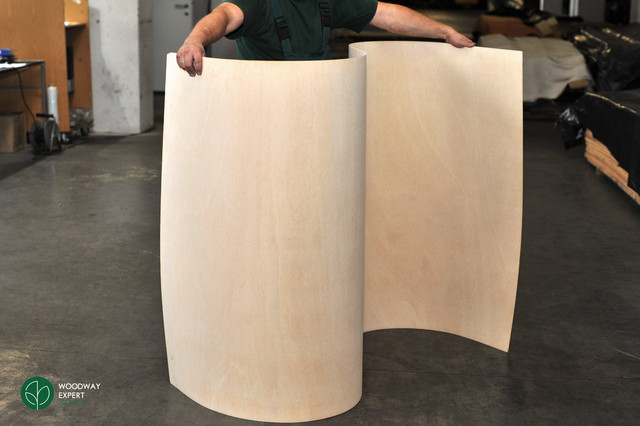
The Ceiba veneer plies are laid parallel to each other rather than cross-banded, aligning the grain direction across layers. This structure allows the plywood sheet to bend tightly without cracking, making it possible to form curved cabinet fronts, wavy modesty panels for desks and reception counters, and rounded columns or table bases.
Flexible Plywood (Ceiba) is available in:
- thicknesses. In-stock thicknesses include 3 mm, 5 mm, and 8 mm;
- bending directions. Sheets can bend along the length (Long grain, 2.50 x 1.22 m) or across the width (Cross grain, 1.22 x 2.5 m).
Beyond flexibility, the material offers dependable strength and wear resistance. Ceiba wood provides good thermal insulation, making it suitable for decorative wall and ceiling paneling while improving the indoor room climate.
How to Buy Plywood in Kyiv and Ukraine Cost-Effectively?
For over 20 years, WoodWay Expert has supplied joiners and interior fit-out contractors with high-grade, sustainable engineered wood panels. We offer:
- consistent inventory. We maintain a standing warehouse program. You can select sheets on-site at our Kyiv warehouse and sales store;
- technical selection support. Our specialists will help choose interior, exterior, marine, or aircraft plywood to match your project specifications. Detailed photos and videos are available upon request;
- wholesale and retail supply. We supply both commercial manufacturers and small joinery workshops, from single sheets to multi-pack shipments;
- commercial discount terms. Regular buyers receive volume-based pricing. Discounted and clearance batches are listed in our “Sale” section;
- warehouse pickup and nationwide delivery. Orders can be collected from our Kyiv warehouse or dispatched across Ukraine via major freight carriers.
To order birch, okoume, or ceiba plywood, submit an inquiry through the website or contact our sales department by phone. Our specialists will confirm stock, technical grades, payment options, wholesale/retail pricing, and delivery schedules. Inquire today!