
Order
Place order
Clear the whole list?
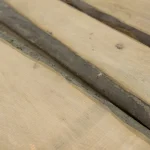
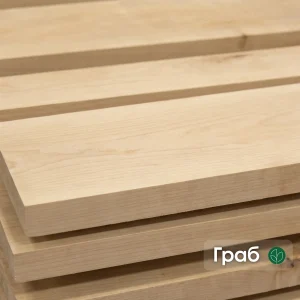
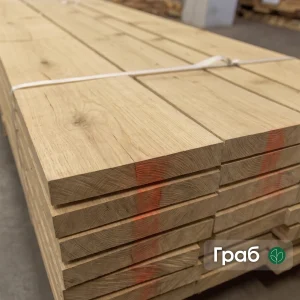
Kiln-dried Hornbeam timber is widely utilised in shipbuilding, mechanical engineering, furniture production, flooring, and staircases. Our warehouse stocks Extra (Prime) and Grade I Hornbeam boards.
Kiln-dried Hornbeam timber is widely utilised in shipbuilding, mechanical engineering, furniture production, flooring, and staircases. Our warehouse stocks Extra (Prime) and Grade I Hornbeam boards. We offer high-quality edged and unedged lumber with the following specifications:
You can select the appropriate Hornbeam board for your project personally by visiting our warehouse-store in Kyiv. Alternatively, you can purchase joinery boards by placing an order via the website basket or by calling our managers.
Sales start from a single board. Collection is available, and orders can be dispatched across Ukraine via transport companies.
Hornbeam is one of the hardest and most difficult species to process. Due to the high density and viscosity of the wood, sawing requires powerful equipment and sharp tools. Therefore, the choice between edged and unedged lumber depends not only on cost savings but also on the technical capabilities of the workshop.
This is material where the side edges have been cut, and the bark (wane) removed. The key advantage is saving equipment resources. Hornbeam is very difficult to cut. By purchasing edged boards, you receive a semi-finished product that does not require initial sizing, significantly extending the life of your saws and cutters.
For which tasks should you choose this?
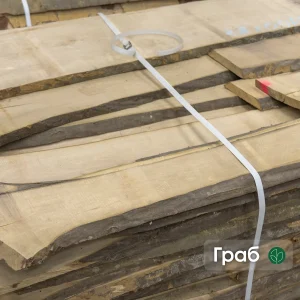
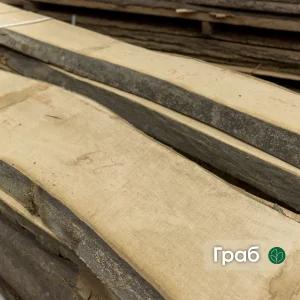
This is a board with preserved natural edges where the bark remains. The width of such a board varies along its entire length. The key advantage is low cost. The price per cubic metre of unedged Hornbeam is significantly lower. This is a profitable option if you have industrial equipment for processing and manufacturing small parts.
For which tasks should you choose this?
Choose edged board if you need speed, precision, and minimal tool wear.
Choose unedged board if you plan to cut the material into small blanks (blocks for turning) and want to minimise raw material costs.
Door frames for country houses and city apartments are created from this wear-resistant and strong solid wood. Light Hornbeam doors fit perfectly into modern, concise interiors in styles such as Minimalism, Neoclassical, Country, Loft, Eco, Eclectic, Scandi, and Modernism.
If a robust window is required, choose a Hornbeam windowsill. A properly treated wooden surface is resistant to impact, temperature changes, and humidity.
The lumber is also actively used for wall cladding. Panels, varying layouts, and boiserie not only make walls aesthetically pleasing but also help reduce noise pollution and create a comfortable microclimate in the room. Hornbeam timber is also used to produce room dividers, staircases, screens, cornices, and skirting boards.
Hornbeam furniture board is a vital material for furniture production. The hard solid wood is necessary for creating frame elements for upholstered furniture, armrests for armchairs and sofas, legs and backs of chairs, worktops, and supports for desks and coffee tables.
Commodes, wardrobes, tall cabinets, bedside tables, and sideboards feature fronts made from furniture board. Solid wood doors can be milled, sanded, stained, painted, or varnished.
Given its strength and density, Hornbeam is suitable for office furniture. This environmentally safe natural material withstands significant mechanical loads, which is why Hornbeam products are used to furnish open-plan offices, libraries, hotel rooms, shops, and spa centres.
A separate category of Hornbeam products is floor coverings. The wear-resistant wood is utilised in the production of:
Hornbeam flooring represents an ideal combination of high wear resistance, uniform wood texture, and a naturally light colour palette. This high-density timber flooring is specified for both heavy-traffic residential and demanding public premises.
Hornbeam is a species that surpasses Oak in terms of hardness and wear resistance. When choosing lumber, it is crucial to consider the grade. This defines not the physical strength (which is high in all grades), but primarily the visual characteristics and the ‘cleanliness’ of the surface.
| Grade | Visual Characteristics | Area of Use | Advantages |
|---|---|---|---|
| Extra (Prime) | The board features a uniform texture with the characteristic pearl-white or sandy colour of Hornbeam. The surface has no sharp tone variations. Knots, cracks, sapwood, or other wood features are entirely absent. | This grade is chosen for projects requiring impeccable aesthetics. It is used for manufacturing staircases, hard-wearing parquet, musical instrument parts (e.g., piano keys), and visible furniture elements in a minimalist style. | This is select material of the highest class, subject to strict visual control. The main advantages are maximum useful yield (no waste during cutting) and ease of finishing. |
| Grade 1 | On a light background, occasional single ‘live’ knots of small diameter (light, fused with the wood) are permitted. Minor natural colour variations are possible. | Production of solid worktops, kitchen fronts, door frames, wall slats, and panels. | The ‘golden mean’ for joinery workshops — material that retains high decorative properties but demonstrates the wood’s natural origin. An optimal balance of price and quality. A versatile option where ‘sterile’ uniformity is not required, but a lively wood texture is valued. |
| Grade 2 | A wide range of natural features is permitted: various types of knots, micro-cracks, and significant colour variations (dark streaks, spots). The texture is variegated and expressive. | Optimal raw material for painted products, internal frames for upholstered furniture, tool handles, sub-floors, pallets, or loft-style furniture with a rough finish. | The lowest cost whilst maintaining high physical-mechanical properties (hardness and viscosity). Allows for the creation of reliable structures whilst significantly saving the budget. |
Hornbeam (Carpinus) is common throughout Europe, Asia, and North America. Scientists have identified 41 varieties of this deciduous tree. Two types grow in Ukraine: the Oriental Hornbeam and the Common Hornbeam. Whilst the Common Hornbeam grows to 25–30 metres, the Oriental variety reaches 5–8 metres.
The characteristics of the solid wood are as follows: Hornbeam belongs to the hardwood category. Brinell hardness is 3.5–3.7, and density is 740–795 kg/m³.
In its raw state, the timber is easily processed. However, after drying, the wood becomes more viscous, which slightly complicates carving and sawing. This natural material is not prone to splitting.
Both longitudinal and transverse sections are uniform in structure. The wood grain is clearly visible, with uneven fibres. The surface is smooth and even. The colour palette is dominated by white and grey shades. Hornbeam timber may fade when exposed to the open air.
Hornbeam is considered an industrial species, hence its use in construction, shipbuilding, and automotive engineering. This strong, viscous, and heavy timber is used to create machine tool body parts, sports equipment, chopping boards, handles, and turned items.
Whether you represent a large furniture factory or work in a private workshop, WoodWay Expert ensures optimal conditions for the supply of joinery Hornbeam.
You can choose the most comfortable way to purchase lumber products:
We cooperate with proven transport services that deliver lumber to Lviv, Kharkiv, Dnipro, Odesa, Rivne, Chernihiv, and other settlements in the country.
Please note: Goods are handed over for dispatch exclusively upon full pre-payment of the order.
Whether you represent a large furniture factory or work in a private workshop, WoodWay Expert ensures optimal conditions for the supply of joinery Hornbeam.
You can choose the most comfortable way to purchase lumber products:
We cooperate with proven transport services that deliver lumber to Lviv, Kharkiv, Dnipro, Odesa, Rivne, Chernihiv, and other settlements in the country.
Please note: Goods are handed over for dispatch exclusively upon full pre-payment of the order.