
Order
Place order
Clear the whole list?
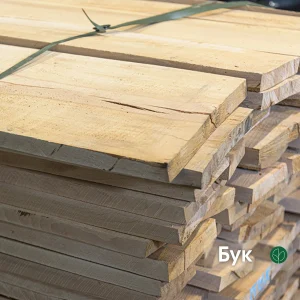
Kiln-dried beech boards are a highly machinable and cost-effective sawn timber option, widely specified in construction and interior finishing applications.
Kiln-dried beech boards are a highly machinable and cost-effective sawn timber option, widely specified in construction and interior finishing applications. The following beech lumber specifications are available in stock:
Orders can be collected personally or dispatched across Ukraine via transport companies. Sales start from a single board. We also provide an additional rough cutting (transportation cut) service. Managers will clarify the exact price per piece for wholesale and retail buyers when placing an order.
When purchasing beech timber, correctly choosing between edged and unedged lumber is a key factor in profitability. The effective scope of use for these board types differs significantly.
Edged Beech Board is material where the bark has been completely removed from the side edges. This is the optimal choice for the serial production of furniture panels, worktops, stair treads, and parquet.
The higher price per cubic metre is compensated by time savings. The craftsman does not waste equipment resources on removing bark and levelling edges, moving immediately to calibration and gluing.
Choose Edged Board if you run mass production of standard items and speed of execution is a priority.
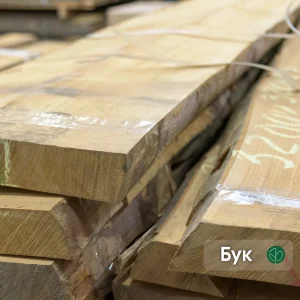
Unedged Beech Board is lumber with preserved natural edges containing bark (waney edge). It is most often used for manufacturing small details (kitchen utensils, tool handles) or elements with complex curved shapes (chair legs, curved backs).
Since beech is a technical species, unedged board is rarely bought for a “live edge” aesthetic (unlike walnut), but rather to optimise cutting. The cost per cubic metre is significantly lower (by 30–40%). This allows for substantial savings on raw materials if you are prepared to spend time on self-cutting and defect removal.
Choose Unedged Board if you need non-standard blanks or have your own facility for processing raw materials.
If your task is to quickly manufacture furniture panels or stairs, edged board is more profitable (less waste, faster work). If you are making chairs, small decor, or have specific templates, unedged board will allow you to reduce the cost price of the final product.
Furniture board made from beech is used to create practical, reliable, and aesthetic furnishings. Given its strength and wear resistance, beech is frequently applied in the production of tables, cabinets, shelving, and chairs for offices, conference halls, libraries, and other high-traffic spaces.
This hard timber responds well to processing: sawing, gluing, sanding, milling, toning, painting, and lacquering.
Various types of flooring are manufactured from edged and unedged timber. Beech wood is used to produce:
Selecting beech flooring represents an ideal balance between premium aesthetics and high mechanical performance. The appropriate choice of wood surface treatment ensures that the flooring maintains its structural integrity and pristine appearance for decades.
| Grade | Characteristics | Sphere of Use | Key Advantages |
|---|---|---|---|
| Extra | The surface is homogeneous, texture is uniform, and only insignificant natural colour variation is permitted. | This grade is chosen for items where a uniform texture is critical. Used for manufacturing furniture, staircases, parquet, door leaves, and wall cladding. | A premium material that demonstrates the optimal balance of aesthetics and cost. |
| First | Small, intergrown knots may occur on the surface. Natural colour variations are present. | Suitable for furniture, tables, staircases, wall panels, and other interior furnishings. | A more price-accessible option for products where an immaculate surface is not required. |
| Second | A larger quantity of knots (sound, semi-intergrown, loose), minor cracks, and colour variations. | Most often serves as raw material for painted products, flooring, or concealed structural elements. | Allows for reliable construction at a lower cost while maintaining physical-mechanical properties. |
Beech (Fagus) is a deciduous tree common across Europe, America, and Asia. In Ukraine, beech forests are found in the Carpathians. These trees possess a massive crown, live up to 500 years, and grow to heights of 30–40 metres.
Small, scattered pores are visible on the cut surface of the solid wood. The timber surface is smooth with a natural lustre, and the grain is straight. The sapwood of young trees is virtually indistinguishable in colour from the heartwood.
The colour palette consists of light straw, light beige, and cream tones with pink or brown flecks. In beech trees older than 80 years, the core darkens, becoming a deep red.
Timber from solid beech is durable and straightforward to work with. The primary technical advantage of beech is its exceptional ability to bend under steam. This makes it indispensable for manufacturing curved furniture, such as bentwood (Vienna) chairs.
The material lends itself perfectly to mechanical processing. It cuts easily, planes cleanly, and sands to an ideally smooth state. Thanks to its uniform density, beech absorbs stains and varnishes evenly. This allows it to effectively mimic more expensive breeds, such as walnut or cherry.
Beech belongs to the hard deciduous species. In terms of physical-mechanical properties, it is often viewed as a budget-friendly alternative to oak. The average density of the wood in a dry state is approximately 680 kg/m³. This guarantees products high strength and resistance to mechanical loads.
Beech board for furniture, windowsills, parquet, wall panels, and doors most often undergoes finishing. Painting is sometimes used, but this method hides the beauty of the natural pattern.
Beech board can be decorated using techniques such as:
Beech boards are specified for manufacturing products across various design styles: from classic and retro to Scandinavian modern and industrial loft.
WoodWay Expert offers favourable conditions for purchasing beech furniture board for both factories and individual craftsmen. Our catalogue presents detailed specifications of the timber, and the price is indicated per 1 cubic metre.
To buy beech board, choose the most convenient method for you:
We organise the dispatch of orders via reliable transport companies to any settlement in the country. You can order boards with delivery to Kharkiv, Odesa, Lviv, Dnipro, Rivne, Chernihiv, and other cities.
Shipment of timber is performed exclusively after 100% payment.
WoodWay Expert offers favourable conditions for purchasing beech furniture board for both factories and individual craftsmen. Our catalogue presents detailed specifications of the timber, and the price is indicated per 1 cubic metre.
To buy beech board, choose the most convenient method for you:
We organise the dispatch of orders via reliable transport companies to any settlement in the country. You can order boards with delivery to Kharkiv, Odesa, Lviv, Dnipro, Rivne, Chernihiv, and other cities.
Shipment of timber is performed exclusively after 100% payment.