
Order
Place order
Clear the whole list?
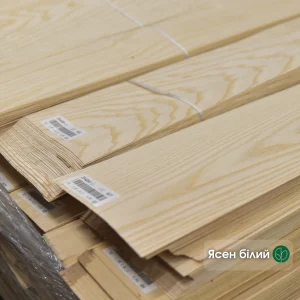
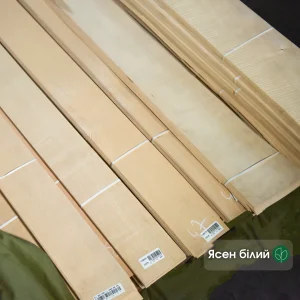
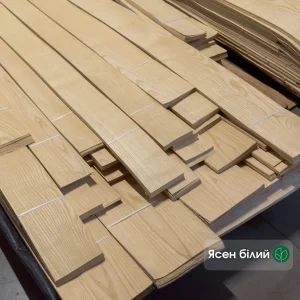
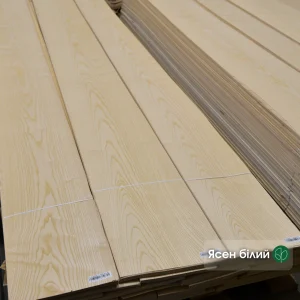
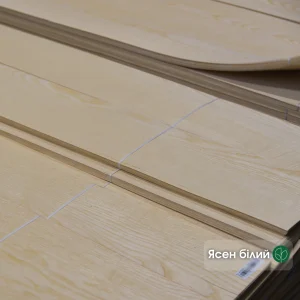
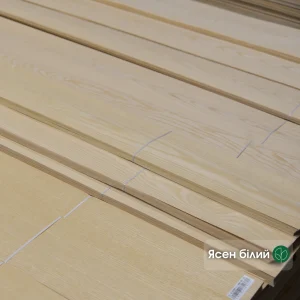
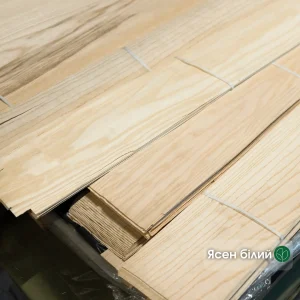
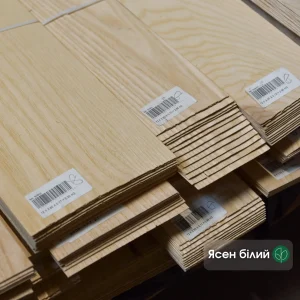
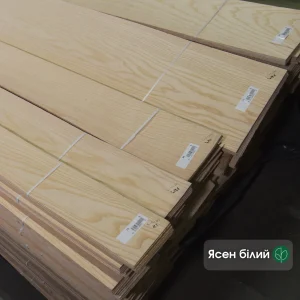
Natural sliced white ash veneer consists of thin wood sheets obtained by slicing flitches. This finishing material features adequate density and an expressive texture. Therefore, it is actively used for facing furniture, wall panels, and doors. We sell veneer starting from 1 bundle.
Natural sliced white ash veneer consists of thin wood sheets obtained by slicing flitches. This finishing material features adequate density and an expressive texture. Therefore, it is actively used for facing furniture, wall panels, and doors. We sell veneer starting from 1 bundle. To check the price for a bundle of the required dimensions, please contact our manager. Delivery across Ukraine and self-pickup are available.
We have facing material with the following parameters in stock:
Sliced veneer represents a rational use of resources. From one cubic metre of timber, manufacturers obtain an average of 850 square metres of decorative covering. This is ideal for MDF, chipboard, and plywood panels.
When selecting facing materials for furniture production, understanding the difference between natural and reconstructed veneer is vital. Although both contain wood, their performance and aesthetic characteristics differ significantly.
| Comparison Criteria | Natural White Ash Veneer | Reconstructed Veneer (Fine-line) |
|---|---|---|
| Composition | 100% solid ash (whole log slice). | Peeled veneer of softwoods (poplar, abachi), dyed and glued into blocks. |
| Texture and pattern | Each sheet features unique colour transitions and natural traits like knots and sapwood. | Artificially created repetitive pattern simulating ash. 100% identical sheets suit economy mass production but lack individuality. |
| Eco-friendliness | Maximum. | Contains 8% to 15% glue mixtures and dyes. |
| Density | High density: 670–720 kg/m³. Natural hardwood veneer resists mechanical stress. | Low density: 400-450 kg/m³. A more brittle material. |
| UV Resistance | High (with proper lacquering). | Prone to fading due to dyes in the structure. |
| Maintainability | Sanding natural ash carries a lower risk of breaking through the layer due to its density. | Fine-line can clog abrasives and delaminate when heated during sanding. Its porous structure requires 20–30% more varnishes and primers. |
For crafting bespoke furniture and premium wall panels, natural white ash veneer is the unmatched choice. Fine-line is only sensible when avoiding texture variations on large areas is critical for a strict budget.
The grading of this facing material relies on visual purity, colour consistency, and natural characteristics. The veneer is divided into three main groups. This allows you to optimise your project budget based on technical requirements.
This grade is used for the front surfaces of furniture where aesthetics are crucial. It features a complete absence of mechanical damage, cracks, and blue stain. Faint “eyes” are permitted, but no more than 1-2 per linear metre. The texture is clear, with an even, light ash hue throughout.
This is the optimal choice for surfaces undergoing tinting or for the reverse sides of components. Minor colour variations and small intergrown knots (2–5 mm) are allowed. Occasional end cracks that do not affect overall strength may occur.
The texture is less uniform than Grade 1. This is frequently utilised to create a more rustic or natural appearance for the finished item.
This material is predominantly used as a base for painting or hidden structural elements. It includes large knots, sapwood, and significant colour variations. Cracks and technical sanding flaws that do not compromise sheet integrity are acceptable.
| Parameter | Grade 1 (A) | Grade 2 (B) | Grade 3 (C) |
|---|---|---|---|
| Knots | Not allowed (occasional “eyes” permitted). | Up to 5 mm (intergrown). | Allowed (large, various types). |
| Cracks | Absent. | Up to 5% of sheet length. | Allowed. |
| Colour variation | Not allowed. | Up to 10–15% of the area. | Unlimited. |
Using natural white ash veneer provides a solid wood appearance while saving significantly on budget. Below are the key applications for this versatile facing material.
Light veneer with a textured surface is relevant in classic, ethnic, and modern interiors. Designers and craftspeople frequently choose this easy-to-work-with material.
Producing high-quality white ash veneer is a multi-stage process. Every step influences the stability and grade of the final product.
Our veneer is stored under proper conditions in our warehouse and is ready for shipment.
The texture of natural white ash depends on the cut’s orientation relative to the timber’s growth rings. Choosing a specific slicing method defines the aesthetic of the final product and influences face matching.
In radial slicing, the cut passes through the core, perpendicular to the growth rings. The texture consists of sequential, parallel straight lines. This creates a uniform and graphic pattern.
Technically, this is the most stable cut, offering minimal expansion or contraction. However, the yield is only 10–15% of the log. This scarcity leads to a higher cost for radial bundles.
The cut runs at a tangent to the growth rings, away from the log’s centre. It forms distinct patterns like cones, arches, and crowns on the surface. This is the most decorative veneer type, showcasing the solid wood’s natural beauty.
Broad tangential sheets allow for symmetrical patterns when book-matched. This material is typically chosen for cabinet furniture facades and decorative wall panels.
This intermediate type has a cut angle of 30° to 60° relative to the growth rings. It combines straight lines near the edges with slightly curved arcs in the centre.
The pattern is less strict than radial but lacks the pronounced crowns of a tangential cut. It serves as an excellent compromise for a calm background that retains a natural solid wood feel.
Biologically, both “white” and “olive” ash belong to the same species: Common Ash (Fraxinus excelsior). The difference lies in the log section used and the tree’s age, not genetics. White ash primarily consists of sapwood from younger layers near the bark.
Ash is widespread across Europe, North Africa, and Asia. In Ukraine, it covers about 5% of forested areas, mostly in the forest-steppe zone. It is classified as heavy, hard, and extremely tough timber. At 12% moisture, its average density is 690–750 kg/m³.
This places the solid wood alongside oak, but ash boasts higher tensile strength. Its Brinell hardness of 4.0–4.1 provides excellent resistance to dents. This deciduous tree is unparalleled among domestic species for absorbing impact without splitting.
Thanks to long fibres and high elasticity, steamed ash easily bends into tight radiuses. Ash surfaces resist abrasion well, making them ideal for flooring and staircases. The natural colour palette ranges from light white and straw to pale brown.
Unlike oak, ash lacks pronounced medullary rays, offering a calmer, graphic texture. Clear growth ring boundaries create characteristic arches during tangential slicing. The timber sands effortlessly to a mirror finish and accepts stains beautifully. However, clear varnishes or oils best preserve its natural aesthetic.
Our team provides timber supplies and systemic support for furniture makers and interior designers. Here is why professionals choose us.
Partnering with WoodWay Expert guarantees high-quality materials and expert technical support. Combining our stock program with production services helps reduce your operational costs.
We offer several ways to purchase our finishing materials. Clients can choose the best option based on volume, urgency, and selection preferences.
Project-specific material reservation is also available. The veneer is securely packed in stretch film and cardboard for safe transport. Whether buying in-person or remotely, you always see the exact materials before purchasing.
The most popular thickness for furniture manufacturing in Ukraine is 0.6 mm. We also stock 1.5 mm and 2.5 mm options.
Add 30–50% for allowances and trimming to the net area of the components. Complex face matching, such as diagonal stitching, results in a higher waste percentage.
The minimum order is one bundle. Wholesale deliveries are also possible.
For professional work, we recommend a PVA-based glue with a D3 moisture resistance rating by Kleiberit. Carefully control the glue amount and press pressure.
Like all natural timber, ash can develop a slight golden tint under UV exposure. We recommend using varnishes with UV filters to preserve the original colour.
Yes, it is an excellent material for refreshing surfaces. Natural veneer can completely transform the appearance of older items.
According to international standards, Grade A allows for occasional “eyes” up to 2 mm in diameter. Slight grain curvature is also permitted.
White ash veneer is made exclusively from light sapwood, providing an even, creamy-white shade and delicate texture. Coloured (olive) ash contains dark heartwood fragments, featuring contrasting olive, brown, or grey patterns.