
Order
Place order
Clear the whole list?
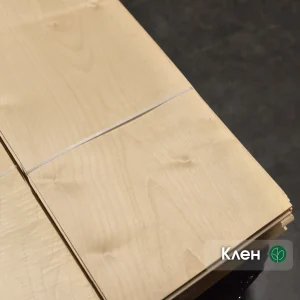
Sliced maple veneer is a facing material distinguished by its high density, light shade, and easy workability. Thin layers of wood are chosen for manufacturing cabinet furniture, partitions, and wall panels.
Sliced maple veneer is a facing material distinguished by its high density, light shade, and easy workability. Thin layers of wood are chosen for manufacturing cabinet furniture, partitions, and wall panels.
Our warehouse offers maple veneer with the following specifications:
Natural maple veneer is sold in bundles. The price of each bundle depends on the total square metreage and the grade. Self-pickup from the warehouse in Kyiv and delivery across Ukraine are available.
Understanding the difference between natural sliced maple veneer and reconstructed (fine-line) veneer is crucial. Both materials are made from wood, but their technical and operational characteristics differ significantly. Let us compare natural veneer and fine-line across several criteria:
Maple veneer requires more careful matching of patterns. Fine-line minimises waste due to its stable sheet width and length. However, sanding fine-line carries a risk of rubbing through quickly due to its lower density.
Choose natural maple veneer if you aim for high wear resistance and a unique interior using eco-friendly materials. If optimising your budget and obtaining absolutely identical surfaces is the priority, fine-line is the optimal choice.
In the woodworking industry, the veneer grade characterises the surface quality of the sheet. It is based on the quantity, size, and nature of natural wood features per unit area. These features include knots, medullary rays, and colour variations.
The classification of maple veneer is regulated by manufacturers’ internal standards and international norms. This allows raw materials to be clearly categorised by purpose. Applications range from premium fascias to hidden structural elements.
| Characteristic | Grade 1 (A) | Grade 2 (B) | Grade 3 (C) |
|---|---|---|---|
| Texture | Uniform, without sharp colour transitions. Sheets in one pack are identical in pattern. | Minor deviations in fibre direction and slight natural colour changes (false heartwood) are possible. | Knots (including loose ones, subject to restoration), full-surface colour changes, and a “marbled” structure are permitted. |
| Features | Only isolated “eyes” (pin knots) up to 0.5–1 mm in diameter are allowed, becoming virtually invisible after varnishing. Sapwood, blue stain, rot, cracks, and mechanical damage are completely excluded. | Presence of intergrown knots up to 3–5 mm in diameter (no more than 2 units per linear metre) and medullary rays characteristic of maple. | Small closed cracks may be present (up to 10–15% of the sheet area). |
| Application | Manufacturing fascias, worktops, decorative wall panels, and musical instruments. | Internal cabinet furniture parts, side panels, and fascias intended for tinting or painting, where minor nuances are covered by pigment. | Cladding of invisible furniture parts (back panels, internal partitions), base for painting, and rustic, loft, or country style products. |
Always consider the final finish when selecting a grade. Grade 1 is the best solution for transparent gloss varnish. Maple has a tendency to highlight the smallest features under light exposure.
The production process of this natural facing material consists of the following stages:
We offer high-quality facing material for projects of varying complexity. The maple veneer available at our warehouse has optimal moisture content and is stored under proper conditions.
The texture and visual characteristics of sliced maple veneer depend directly on the angle of the annual rings to the cutting plane. Choosing the right cut type is essential when designing furniture. It determines both the aesthetic appeal and the physical stability of the finished product.
In a tangential cut, the cutting plane passes tangentially to the annual rings, at a certain distance from the log’s core. It produces a pronounced pattern of cones, arches, and marbled swirls.
This is the most decorative type of veneer, showcasing the complex structure of maple. The angle of inclination of the annual rings to the veneer plane is less than 45°. It is widely used in cabinet furniture fascias and decorative wall panels. This cut is chosen when the emphasis is on the natural wood pattern.
The cut passes through the core of the log, perpendicular to the annual rings. The texture appears as parallel straight lines or stripes, evenly distributed across the sheet.
The pattern is highly minimalist and geometrically correct. The angle of inclination of the annual rings is between 90° and 60°. This veneer has the highest stability coefficient. It is less prone to swelling or shrinkage, making it vital for door leaf production.
This is an intermediate option combining characteristics of the two previous types. The texture features straight lines on one edge of the sheet, gradually transitioning into slight arcs or slanted lines on the other.
The angle of the annual rings ranges from 45° to 60°. It is the optimal choice for large cladding areas. It preserves the natural dynamic of the wood while avoiding the excessive vibrancy of a tangential cut.
Maple (Acer) belongs to the sapwood species. Industry professionals consider maple the gold standard for highly stable, light-coloured wood. Tree plantations are widespread across the temperate latitudes of the Northern Hemisphere.
The most valuable species for veneer and solid wood production are Norway maple (Acer platanoides), sycamore (Acer pseudoplatanus), and sugar maple (Acer saccharum).
This heavy, dense timber (620–720 kg/m³) is comparable to oak in hardness, scoring 3.0–3.9 on the Brinell scale. Maple withstands static loads well, absorbs impacts superbly, and resists splitting. Solid maple is highly resistant to abrasion, making it suitable for flooring and worktops.
The colour palette ranges from almost pure white (in sycamore) to cream or pale yellow. Maple lacks a clearly defined heartwood, ensuring colour uniformity across the entire cross-section.
The texture is uniform and silky, featuring narrow medullary rays that create a distinct sheen on radial cuts. Fibres are predominantly straight, but special patterns like “bird’s eye” or “curly/wavy” occasionally appear. The pores are fine, evenly distributed, and practically invisible to the naked eye, yielding a perfectly smooth surface after sanding.
The timber requires a slow drying regime. Maple is exceptionally well-suited for steam bending. After steaming, the wood becomes pliable and retains its shape beautifully.
Thanks to its high density, it sands to a mirror-like finish. However, the fine pores can make maple somewhat temperamental during tinting. Products made from solid maple are strictly intended for interior use.
Our team delivers solutions rooted in genuine expertise and a deep understanding of manufacturing processes. Here are the key reasons why furniture business representatives and private craftsmen choose WoodWay Expert:
We work with small, medium, and large businesses. We provide dedicated account management support for every order.
We have established a highly convenient procurement process for decorative coatings. It caters to the needs of both mass-production furniture factories and boutique workshops. Please utilize one of our three proven ordering methods for maple veneer:
Our team is ready to handle tasks of any scale. Get in touch—we are here to help!
The industry standard for furniture manufacturing is a thickness of 0.6 mm. Material of this thickness allows for proper sanding. It also ensures highly reliable adhesion to substrates like MDF and chipboard.
Grade A (1) consists of premium sheets with a flawless surface, entirely free of knots, ideal for front fascias. Grade AB (2) permits isolated “eyes” (pin knots) or minimal colour variations.
For both cold and hot pressing, we strongly recommend using PVA-based glues (class D3). It is crucial to carefully control the amount of glue applied.
Due to its high density and finely pored structure, maple can absorb pigment unevenly. To achieve an even tone, experts advise using wood conditioners prior to staining or applying tinted varnishes via a spray method.
This is a rare and highly prized textural anomaly (a distinctive fibre development). It manifests as tiny, swirling knots resembling a bird’s pupil. Such veneer is considered an exclusive, premium-class decorative material.
Yes, maple possesses excellent toughness. A 0.6 mm thick veneer readily conforms to the shape of curved bases.
A radial cut produces a surface pattern of parallel lines, making the material physically more stable. Conversely, a tangential cut reveals a vibrant pattern of arches and cones.