
Order
Place order
Clear the whole list?
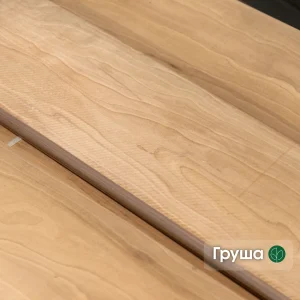
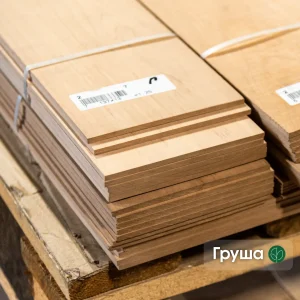
Sawn pear veneer (lamella) is a finishing timber produced through the precision sawing of solid wood. These sheets typically have a thickness of 2 to 10 mm, allowing the timber to withstand significant operational loads.
Sawn pear veneer (lamella) is a finishing timber produced through the precision sawing of solid wood. These sheets typically have a thickness of 2 to 10 mm, allowing the timber to withstand significant operational loads. Unlike sliced veneer, pear lamella maximally preserves the wood’s natural texture and colour palette. You can buy sawn veneer from 1 pack. Our sales manager will assist in calculating the pack price. Wholesale orders are available. Delivery across Ukraine is handled by carrier companies. Collection from our warehouse in Kyiv is available.
Pear is considered one of the most valuable fruit tree species. The timber features an exceptionally dense, uniform structure. It also offers a unique palette of shades, ranging from delicate pinkish-beige to deep amber.
Craftsmen highlight the following key characteristics of sawn pear veneer:
Sawn pear veneer can be easily restored if damaged. This timber is widely used to craft exclusive items for both modern and traditional interiors.
We consistently maintain a stock of timber in the most highly requested standard sizes. Within our stock programme, you can order lamella with the following dimensions:
We understand that standard timber does not suit every bespoke project. Therefore, we also accept individual orders for sawn pear veneer with custom parameters. You can order timber with these specifications:
The lead time for bespoke orders is 10 working days. The minimum order quantity is 10 m² of material from a single wood species.
Timber is classified by grades, allowing craftsmen to select the appropriate material for a specific technical task. Understanding grade differences helps achieve the desired visual effect whilst optimising the project budget.
Grade indicates the lamella’s quality, determined by the visual characteristics of the front side. Factors include knots, colour uniformity, grain direction, and sapwood. As pear is a fruit tree, its structure is often heterogeneous, which influences sorting criteria.
| Characteristics | Grade 1 | Grade 2 | Grade 3 |
|---|---|---|---|
| Features | Premium lamella with a flawless surface. | The material maintains high quality but features natural characteristics. | This lamella showcases the multifaceted texture of the solid wood. |
| Knots | Knot-free. | Occasional small ‘live’ (intergrown) knots up to a few millimetres in diameter are permitted. | Various knot types, including dark ones. Quantity and size are unregulated. |
| Texture | No cracks or sapwood. Calm texture with a harmonious grain pattern. | Uneven patterns are possible. | Heterogeneous. |
| Colour | Uniform shade across the entire area. | Minor natural colour variations. | Contrasting colour transitions. |
| Usage | Material for elite furniture facades, wall panels, and musical instruments. | Used for Scandinavian-style furniture, valuing the wood’s natural feel. | Suits rustic, loft, eco, and country interiors. Serves well as a stabilisation layer. |
Regardless of the grade, sawn pear veneer undergoes kiln drying to guarantee timber stability. Proper grade selection highlights the item’s uniqueness while maintaining a fair price per square metre.
Thick timber is used where standard sliced veneer fails due to heavy loads or future restoration needs. Due to its stability and strength, pear wood sheets are chosen for durable, flawless constructions.
Because pear has very fine pores, it hardly absorbs any dirt. This makes pear lamella products exceptionally practical for kitchen use. Wooden serving dishes, trivets, and spice organisers are particularly popular.
Producing this cladding material is a complex engineering process. It requires modern equipment and a profound understanding of wood behaviour. By strictly adhering to technology, pear lamella boasts stability, strength, and ease of processing.
Let us review the main production stages:
This multi-step production process transforms a standard board into a perfect cladding material. It is ready for various complex joinery tasks.
Pear (Pyrus communis) is a broadleaved species common in the temperate latitudes of Europe, Asia, and the Caucasus. Timber grown in forest-steppe zones offers the best density, as annual rings form evenly.
Pear is a heavy, hard, and tough wood, making the sawn veneer resistant to intense loads. The average density at 12% moisture is approximately 700−750 kg/m³. Its Brinell hardness is 3−3.5. The wood is extremely resistant to splitting.
High impact toughness allows the solid wood to be used in areas requiring impact resistance. When steamed, pear demonstrates excellent flexibility, making it useful for bentwood furniture elements. Due to its fine-pored structure, the material wears down slowly, which is critical for flooring and stairs.
The fruit wood’s colour ranges from yellowish-white to light pink. Steaming technology is frequently applied to give the wood a uniform pinkish-brown or reddish hue.
The texture is fine and uniform. Pores are practically invisible to the naked eye. Annual rings are weakly defined, creating a ‘velvety’ surface effect. The grain is mostly straight, though areas with interlocked grain occasionally occur.
Due to its high density, the wood can ‘burn’ if dull tools are used. Pear holds glue excellently and accepts all types of topcoats. Because it lacks large pores, the solid wood requires less varnish or oil compared to oak.
Our mission is to make high-quality timber accessible to furniture makers, joiners, designers, and craftsmen. We have worked with furniture factories, construction firms, and design studios for over 30 years. Clients choose to collaborate with our team for the following reasons:
We prepare bespoke commercial proposals for regular wholesale clients. Discount rates depend entirely on the purchase volume and material type.
To order finishing materials made from fruit wood, please use one of three methods:
Our team has ample experience to fulfil orders of any scale. Get in touch, and we will help bring your ideas to life!.
WoodWay Expert accepts orders for producing sawn lamella with a thickness of 2–10 mm. The minimum batch is 10 sq.m. of a single species. The production lead time is 10 working days. To order timber, call +380 (67) 180-38-13 (Viber, Telegram).
Sawn veneer (lamella) consists of thin boards, 2 to 10 mm thick, obtained by sawing solid wood. Unlike sliced veneer (0.6 mm), pear lamella retains the physical properties of solid timber. This includes high density, wear resistance, and the ability to be sanded repeatedly.
Yes, pear lamella is one of the best options for the top layer of an engineered board. The material remains exceptionally stable thanks to kiln drying to an 8–10% moisture content. The facing layer is highly resistant to wear and impact.
Pear is a hard and tough wood species. Its Brinell hardness is approximately 3.0–3.5. Lamellas measuring 4–4.5 mm thick are frequently used for cladding stair treads.
Under the influence of ultraviolet light and oxygen, the solid wood’s colour becomes deeper and more saturated. The timber may acquire rich amber or reddish tones.
Because pear has extremely fine pores and a ‘velvety’ texture, oil or wax yields a better visual effect. Varnish is recommended for high-load surfaces like floors or worktops. In such cases, opt for matte finishes to preserve the wood’s natural look.
We recommend using polyurethane (PU) or PVA glues of class D3 or higher to attach the lamella. Due to the high density of pear, it is crucial to ensure even pressure during pressing to prevent delamination.