Order
Place order
Clear the whole list?
Exotic wood veneer — rare species and treatments for statement pieces: ziricote, African blackwood, smoked oak, and eyed poplar burl. 0.6 mm thick. For furniture, panelling, and objects where the wood figure is the centrepiece.
Sliced veneer in exotic species is a natural facing material normally used in the making of designer pieces. Exotic timber and solid wood with a pronounced figure are an effective tool in interior fit-out, and one designers turn to often. Thin leaves of valuable timber make it possible to create an exclusive interior piece at a lower cost.
Woodway Expert offers quality exotic veneer, which you can buy in Kyiv and in other towns across the country. Our managers will confirm availability, price and delivery times across Ukraine when you place your order.
Natural exclusive veneer is available in the following sizes:
A thickness of 0.6 mm for sliced veneer is a technologically justified limit, the point where the physics of the wood meets the economics of production. At a cut thickness of 0.6 mm, one cubic metre yields roughly 500–600 m² of usable facing (allowing for machining tolerances). Leaves like these are pliable enough to face not only flat surfaces but curved ones as well (radiused fronts, arches). That thickness is enough to bond the slice to a panel properly without glue bleeding through, and to sand the surface before lacquering or applying an oil-wax finish.
This decorative facing material is produced from valuable timber species. Exotic timber from Africa, South America and Asia is usually a limited resource. Shipping solid timber to other continents is a complicated and not always profitable process.
To use natural resources sensibly, valuable solid timber is converted into veneer. Production uses trees grown in dedicated forestry plantations.
Thin slices of timber laid onto MDF, particle board and plywood stand up to the wear of a domestic interior. Properly finished, the material resists minor temperature fluctuations. The main particulars of veneer in the “Exotics” class are:
We work to a stock programme, so the facing material is available to buy. Individual varieties are supplied to order.
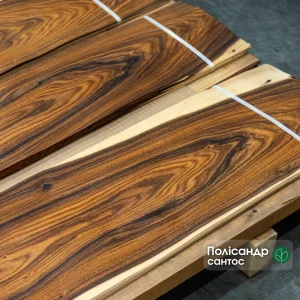
| Santos rosewood | The species grows in Madagascar, India, Peru, Pakistan and South America. The tree reaches 14-28 m in height. The colour of the timber ranges from pinkish-brown to dark brown and coppery chocolate tones. The pattern with its black veining looks striking in traditional and contemporary interiors alike. |
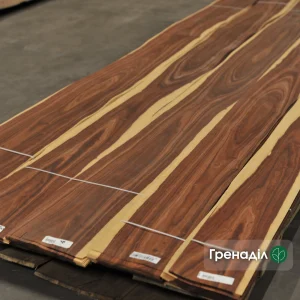
| African blackwood (grenadilla) | The tree grows in Central and South America. This exotic species is a special offer for anyone who appreciates contrast. The light straw-coloured sapwood serves as a ground for heartwood in chocolate shades with clear annual rings. |
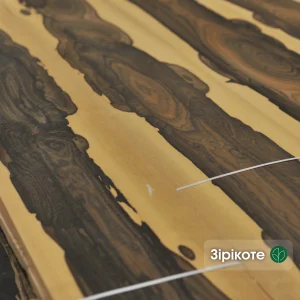
| Ziricote | The plant is found in the tropical and subtropical forests of Central America, Mexico, Guatemala, Cuba and the Caribbean islands. The veneer is notable for its fantasy figure. The palette of the heartwood holds red-brown and chocolate-black shades, while the outer part shows golden-beige tones. |
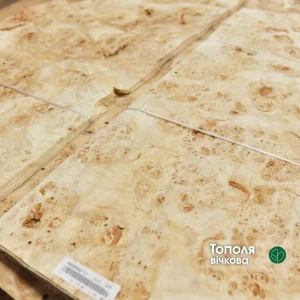
| Black poplar burl | Poplar burl veneer is one of the most decorative materials there is, marked out by a chaotic pattern of interwoven fibres. The chief feature of the texture is the many small “eyes” (dormant buds). The palette runs from cream and light gold to deep brown or black. |
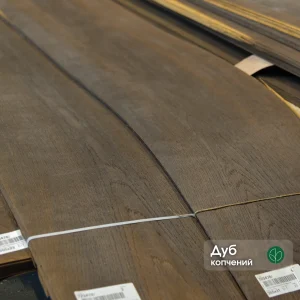
| Smoked oak | Smoked oak veneer is a material produced by a special thermal or chemical treatment that changes the colour of the timber right through its thickness. The texture of the veneer stays natural and expressive, keeping the large pores and clear annual rings characteristic of oak. The colour range runs from chocolate to almost black, often with smoky or bronze overtones. |
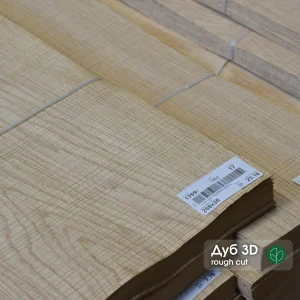
| Oak 3D, rough cut | Oak 3D Rough Cut veneer is a distinctive decorative material. Its chief feature is the coarse surface treatment, which imitates the marks left by a cross-cut saw. The surface is textured through the alternation of deep transverse scoring and the natural porous structure. The veneer keeps the palette of natural oak: from light sandy and straw shades to moderate brown tones. |
| Teak | Teak veneer is considered one of the most valuable decorative materials. Its palette is striking in its range of shades: from golden yellow and light brown to chocolate with almost black veining. The figure of the veneer usually consists of clear, straight or slightly wavy lines. The timber has a pronounced coarse-fibred structure with visible pores. |
| Olive | Olive veneer leaves are prized for their “marbled” figure. Slow growth makes the structure of the timber exceptionally dense and the grain pattern complex and chaotic. The base ground ranges from creamy yellow to golden honey, cut through by brown or almost black veining. The texture is even, with a silky sheen. |
| Sycamore maple (figured) | The texture of sycamore maple is even, with fine pores, which gives the surface exceptional smoothness and silkiness. The veneer, almost white or cream in colour, can take on warm golden shades under light. The chief ornament of sycamore is its “moiré” effect, or wavy grain reminiscent of the shimmer of silk fabric. The dense timber has a pearly sheen. |
| Zebrano | Zebrano veneer is one of the most recognisable exotic materials, and takes its name from its striped colouring. The graphic pattern consists of clear parallel or slightly wavy stripes. The colour range takes in pale gold, sandy beige, dark brown and black tones. The timber has a slightly coarse texture with interlocked grain. |
| Rustic oak (knotty) | Rustic oak veneer is a facing material that shows off the natural beauty of the tree. The chief feature of the texture is the presence of knots of various sizes and types, cracks, areas of curly grain and colour variation. The palette is formed by shades of differing intensity: from light straw and honey to deep dark brown. |
| Wenge | Wenge is called the benchmark of African exotics. The chief feature of the material is its extreme density, along with a coarse fibrous texture with a matt sheen. The dark brown, almost black veneer carries golden or chocolate veining. The figure is graphic: depending on the cut it can be linear, with fine parallel stripes, or complex, with interlocked grain. |
Natural veneer in exclusive species is used to create:
For over 30 years we have been helping manufacturers and designers deliver projects of every level of complexity. Here are the main reasons customers choose to work with us:
Our team has considerable experience in selecting veneer and is ready for jobs of any scale. Get in touch!
To order facing materials:
We offer veneer at 8-10% moisture content and dispatch orders quickly.
Exclusivity comes down to the rarity of the species (zebrano or rosewood, for example), the complexity of the figure (burls, root sections) or a unique treatment technology (Smoked, 3D Rough Cut).
The most common thickness is 0.5–0.6 mm.
The cost of the facing material is affected by complicated logistics (import from Africa, Asia or America), limited felling quotas for rare trees, and the high proportion of waste involved in obtaining a grade A or Select figure.
For timber with a high content of natural oils, polyurethane adhesives or specialised PVAs with raised adhesion are recommended, so as to avoid delamination.
Exotic species are sensitive to ultraviolet. To preserve the original shade (in sycamore maple or olive especially), lacquers with UV filters have to be used.
Oil penetrates deeper into the structure, bringing out the figure of the timber to the full. For species with a high content of tannins (oak) or resins (teak), however, it is important to be sure the finish is compatible with the natural make-up of the timber.