Natural wood is a material unmatched in its combination of tactile, environmental, and aesthetic qualities. Wood is used in construction, interior fit-outs, the furniture industry, and the manufacture of various everyday items. Solid wood tables, cabinets, wood wall panels, organizer boxes, musical instruments, tableware, sports equipment, and garden accessories can serve for decades. To ensure that wooden products satisfy their owners for as long as possible, selecting the right raw material during production is crucial. Interior items are typically manufactured from edged timber. What characteristics should be considered before purchasing timber? What factors influence the price of sawn timber? How do different timber grades differ? Read on to discover the primary criteria for selecting timber.
Contents
- Features of Edged Timber
- Key Criteria for Choosing Edged Timber
2.1 Wood Species
2.2 Timber Dimensions
2.3 Wood Moisture Content
2.4 Timber Grade - What Determines the Price of Kiln-Dried Edged Timber?
- 5 Reasons to Buy Edged Timber from WoodWay Expert
Features of Edged Timber
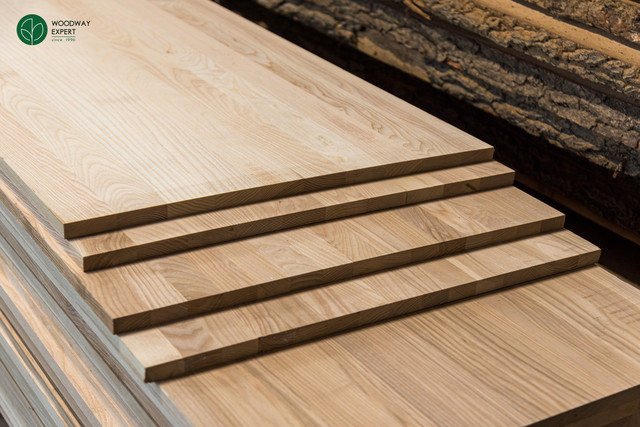
Edged timber is a flat sawn wood product with the wane removed from its side edges. At the same time, it is important to note that standard technical specifications permit a minor amount of bark on the edges. The main areas of application for this timber include the manufacture of furniture, wall and ceiling cladding, flooring, as well as architectural elements (stair components, partitions, doors, windowsills, and window frames).
Edged timber is ready to work with. The woodworker does not need to trim wane from the edges. In addition, edged timber is much more convenient to transport and store (no need to strip bark, easier to stack).
Read also: “Kiln-Dried Edged Timber: Characteristics and Manufacturing Process“
Key Criteria for Choosing Edged Timber
What do you plan to make? Answering this question helps determine the timber specifications required for a specific project. The main criteria when choosing edged timber are species, dimensions, moisture content, and grade. Let us examine them in detail.
Wood Species
The performance characteristics of the finished product depend on the properties of the wood. Key wood parameters include hardness, density, modulus of elasticity, compressive strength, and static bending strength. The hardwood category encompasses medium-hard, hard, and very hard varieties. Solid hardwood features substantial density and weight, providing high wear resistance.
- Very hard species include acacia, hornbeam, yew, and rosewood.
- Hardwoods include oak, beech, ash, cherry, maple, and elm.
- Medium-hard species include walnut, elm, and sweet cherry.
- Softwoods include alder, poplar, spruce, pine, lime, aspen, and willow.
This classification is indicative. A tree species can have dozens of varieties with differing grain structures. For example, while pine is classified as a softwood, the strength values of black pine indicate that its mechanical resistance is closer to medium-hard species. Specialists recommend taking into account the characteristics of specific subspecies when choosing a species.
Hardwood timber is used in construction, flooring production, staircases, facade cladding, and furniture. Softwood cannot withstand heavy mechanical loads, but it is excellent for carving and decorative work. Softwoods are used to produce furniture, wall panels, and various household and decorative items.
Timber Dimensions
The price of edged timber is quoted per cubic meter, and sawn timber is purchased by volume. To calculate how many cubic meters are in a single board, multiply its length, width, and thickness. Calculating the number of boards in one cubic meter is just as straightforward: divide 1 cubic meter by the volume of a single board of the given size.
Read more about calculations in the article: “Edged Timber: Advantages Compared to Unedged Timber“
Among the most common sizes of edged timber are 50×200, 40×150, 150×50, 50×200, 50×150, 25×100, 50x150x6000, and 200×50.
Wood Moisture Content
Moisture content is one of the most critical indicators of timber quality. The percentage ratio of the mass of water to the mass of dry wood determines what applications a particular board is suitable for. If you plan to manufacture furniture, select sawn timber with a moisture content of 8-12%. For exterior building cladding, boards with a moisture level of 16-18% are suitable. Flooring boards require a moisture content of 8-15%, while doors, windows, and stairs require around 15%.
Freshly felled logs have a moisture content of 50-70%. A high level of moisture in the log risks material spoilage. Unseasoned wood is unsuitable for joinery because finished items will crack and warp over time. Conversely, furniture, wood wall panels, parquet boards, and partitions made from properly dried timber will last for years.
Edged timber is seasoned using air drying or kiln drying. Air (natural) drying is a simple but lengthy process. Seasoning outdoors yields solid timber with a moisture content of 18-22%. To produce edged timber with a moisture content of 8-15%, specialized drying kilns are used. Kiln-dried timber is a high-grade product, as the multi-stage moisture evaporation process provides uniformly seasoned timber relatively quickly. The temperature regime and drying duration depend on the wood species and board thickness.
Related article: “Wood Seasoning Methods: Stages, Types, and Features“
Timber Grade
The presence and extent of defects determine the timber grade, which directly affects the price of sawn timber. In international classification, timber grades are labeled Extra, A, B, and C. These correspond to prime (select/extra), Grade 1 (I), Grade 2 (II), and Grade 3 (III).
|
Grade |
Characteristics |
|
Extra |
Prime timber with straight edges and parallel surfaces, virtually free of defects. Tight (sound) live knots are permissible. Used for furniture production, interior finishing, shipbuilding, and automotive manufacturing. |
|
A (Grade 1) |
Grade 1 timber permits a greater number of sound knots compared to Extra grade; minor end checks are allowed. Used in the manufacture of furniture, parquet, wall panels, and various interior details (door handles, organizers, decorative elements, etc.). |
|
B (Grade 2) |
Grade 2 timber may have resin pockets, wormholes (up to two per sq. m), various knots, and staining. Applications include pallet manufacturing, battens/furring strips, and structural construction. |
|
C (Grade 3) |
Grade 3 timber permits defects that do not compromise structural integrity: wormholes, loose knots, resin pockets, and fungal staining. Used for temporary structures, crates/packaging, and subflooring. |
What Determines the Price of Kiln-Dried Edged Timber?
As noted above, the cost of timber is quoted per cubic meter. Sawn timber prices depend on:
- Processing method. Manufacturing costs directly affect timber prices. Sawn timber is produced by breaking down logs on a sawmill. Unedged timber does not require edge trimming, making it simpler and cheaper to produce. Edged timber production is more labor-intensive as it involves an additional edging stage. Furthermore, higher-grade raw stock is selected for edged timber, making edged timber significantly more expensive than unedged timber. Another cost factor is seasoning. Air-dried timber is more affordable, but it has a moisture content of 18-22% and is not suitable for all applications. High-quality furniture-grade timber with 8-12% moisture is achieved through kiln drying, which ensures uniform drying and superior dimensional stability;
- Species. Hardwood edged timber (oak, hornbeam, acacia, ash, walnut, beech, maple, elm) is a versatile material suitable for flooring, wood wall panels, and furniture. Wear-resistant and durable hardwoods are priced higher than softwoods;
- Grade. The price of select Extra and Grade 1 timber is the highest, reflecting the quality of the raw timber, multi-stage processing, kiln drying, and transport.
The total price depends on the combination of these factors. Order volume should also be considered: purchasing timber wholesale offers better unit rates through bulk discounts and reduced transport costs.
5 Reasons to Buy Edged Timber from WoodWay Expert
WoodWay Expert has been supplying timber materials for nearly 30 years. Our team has supported hundreds of projects of various scales. We work with wholesale and retail buyers, offering professional service. Here are five of our main advantages:
Wide range of species and sizes. Our warehouse stocks edged timber in lengths from 2.1 m, widths from 12 cm, and thicknesses of 32-52 mm. Timber is available in the following species:
- Oak;
- Maple;
- Hornbeam;
- Acacia;
- Beech;
- Ash;
- Alder;
- European Walnut;
- American Walnut;
- Elm;
- Cherry.
Timber quality. We supply Grade 1 (I) and Extra grade edged timber. Our kiln-dried timber is used in construction and finishing work, furniture manufacturing, flooring, and wall paneling.
Proper storage conditions. Timber is stored in a heated warehouse under controlled temperature and humidity, protected from direct sunlight.
Individual timber selection. We offer timber by the piece and in bulk. You can select boards in person at our Kyiv warehouse store. Alternatively, you do not need to visit in person: our managers will select material according to your project specifications, send photos and videos of available stock, calculate volume, and provide current prices per cubic meter.
Warehouse pickup and carrier delivery. Orders can be collected from our warehouse or dispatched across Ukraine via freight carriers. Delivery lead times are confirmed during order placement.