Sawn timber is used in construction, the furniture industry, and the manufacture of various household items. Edged timber is also frequently used in renovation and finishing work. Let us look at how edged timber differs from unedged timber, what determines the cost of edged timber, and which timber to buy for a specific product.

Edged and unedged timber: differences
The primary feature distinguishing these types is the presence or absence of wane. Wane refers to the edge of a board where bark may remain after the log is sawn.
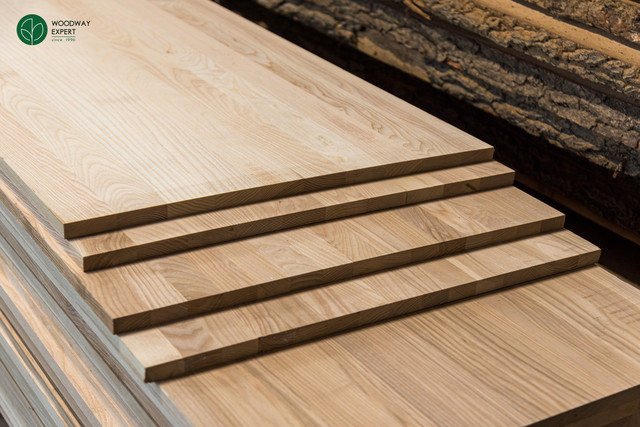
- The edges of edged timber have no wane: the bark is trimmed off the sides during sawing. At the same time, DSTU 2143-93 allows a minor amount of wane on the edges. The standard defining sawn timber products states that edged timber has sawn edges or edges with wane not exceeding the limits specified in the regulatory and technical documentation.
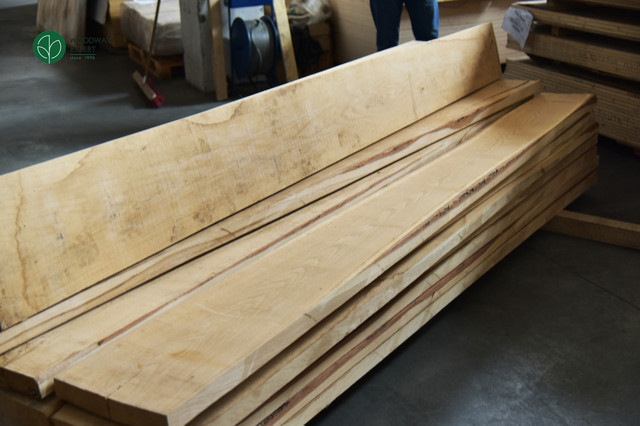
- Unedged timber is timber with bark along the full length of the side edges. The thickness of the wane is not standardized.
- Semi-edged timber, also called one-edge sawn timber, occupies an intermediate position between the two varieties. Semi-edged timber has wane on only one edge.
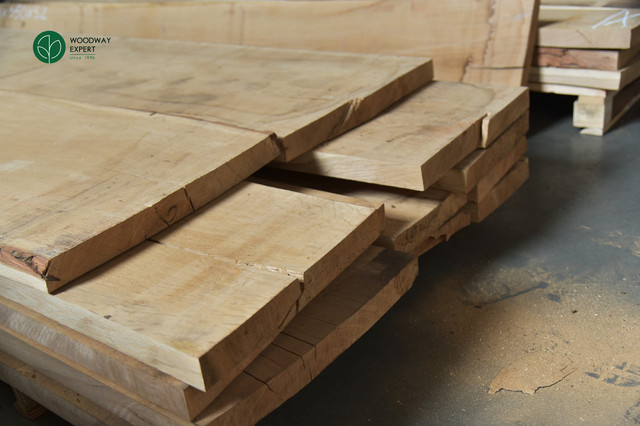
Types and uses of edged timber
Edged timber is produced from various species. We offer sawn timber in Oak, American (Black) Walnut, Beech, Ash, Elm, Acacia, Alder, Cherry, Hornbeam, Maple, and European Walnut. One of the most popular requests from our customers is dry edged Oak Timber, which can be purchased by visiting our warehouse, ordering via the website, or calling our sales managers.
The grade and species of wood determine the physical and mechanical properties of the finished product. Hard and wear-resistant species are suitable for construction work, while hard, medium-hard, and soft woods are chosen for furniture. Worktops, drawer unit and wardrobe fronts, shelves, shelving units, and other furniture items made of solid timber withstand service loads and last for years.
Kiln-dried edged timber is also an essential material for decorative interior fit-out work. Sawn timber is used for cladding ceilings, floors, and walls in residential and public spaces, as well as for making interior partitions, panels, and folding screens. Buying edged timber is the right solution for outfitting city apartments, country houses, and office spaces. An eco-friendly, aesthetic, and easy-to-machine natural material, it allows you to create products of diverse styles and structural complexity.
T&G cladding, rainscreen cladding, decking, and blockhouse siding are just a few of the materials manufactured from solid timber. Other applications for edged timber include shuttering production, roofing components, and more.
The technical properties of edged timber depend on the sawing pattern.
|
The cutting plane is offset from the center of the log. Tangential sawing yields a surface with a pronounced grain pattern. |
|
|
With this method, timber is sawn through the center of the log. The resulting sawn timber is considered optimal for construction. |
|
|
Sawing is carried out at a 45-degree angle to the center of the log. This sawing method is less wasteful, but the resulting sawn timber is not of Extra quality. |
Applications and varieties of unedged timber
Because unedged timber has wane along both edges, its grade is lower. In addition, the presence of bark affects the price of sawn timber. Unedged timber can be purchased for a wide variety of tasks. The field of application depends on the type of timber. Two varieties are available on the market:
- Joinery grade: good raw material without visible defects is used. Joinery-grade unedged timber is typically used to manufacture sub-bases and framework for interior finishing;
- Fencing grade: this category includes lower-grade timber with knots, checks, resin pockets, and staining. Fencing timber is used for perimeter fencing, garden and flower bed landscaping, as well as for battens and lathing.
Types and uses of semi-edged timber
Semi-edged sawn timber is considered a versatile solution for construction tasks. In addition, semi-edged timber is used to produce shaped joinery items. Properly edging one side broadens the material’s functionality. When choosing, it is important to inspect the wood surface quality. The price of timber in this category also depends on the presence of checks, stains, and knots.
Number of boards per cubic meter: calculation formula, examples
“I need edged timber. What is the price per piece?” To answer this inquiry, one needs to understand how sawn timber pricing is calculated. Timber prices are quoted per cubic meter. To determine the volume in cubic meters of a single piece of timber, use the formula below.
Timber volume calculation formula:
Timber thickness X timber width X timber length = m3
For example, 25x150x6000 edged timber equals 0.0225 m3
0.025 m x 0.15 m x 6 m = 0.0225 m3
To find the number of boards in one cubic meter, divide 1 m3 by the volume of an individual board.
Formula for calculating boards per cubic meter (in pieces):
1 m3 ÷ x m3 = y pcs/cu.m
For example, 1 m3 ÷ 0.0225 m3 = 44.4 pcs/cu.m
That is, one cubic meter contains 44.4 boards measuring 25x150x6000.
Advantages of dry edged timber
Edged timber is widely used in construction, joinery, and the furniture industry. Key advantages of edged sawn timber include:
- Ease of processing. The timber is ready for use and requires no preparation or wane removal.
- Transportation. Edged timber is easier to load, transport, and store in the warehouse.
- Price-to-quality ratio. You receive processed sawn timber that matches the specified grade.
- Performance properties. Solid edged timber retains its technical and physical characteristics over a long service life.
- Selection of dimensions and species. You can select sawn timber in the required thickness, width, length, and grade. Timber from various species is available on the market, including exotic hardwoods.
WoodWay Expert offers high-quality dry edged timber in:
- Oak;
- Ash;
- Acacia;
- Hornbeam;
- Maple;
- European Walnut;
- American Walnut;
- Alder;
- Cherry.
Sawn timber in Grade 1 (A, I) and Extra grade is in stock at our warehouse. Board thickness ranges from 32 to 52 mm, width from 12 cm, and length from 2.1 m. These parameters are approximate; please confirm exact dimensions of edged timber with our sales managers. Our specialists will select sawn timber according to your technical requirements, provide product specifications, and send photos and videos of timber suitable for your project. Edged timber can be purchased from us piece by piece. Our managers will advise on payment methods, confirm the current price per cubic meter of edged timber, and provide unit pricing. Self-pickup is available, as well as shipment across Ukraine via freight carriers.