Designing furniture or planning interior decoration always starts with choosing the base material. Among the variety of offers on the market, the question of choosing between three popular options often arises. At WoodWay Expert, we have been working with wood materials for over 30 years and are ready to explain the differences in detail. This guide will help you understand the technical specifications to make an informed decision for your project.
What is Blockboard
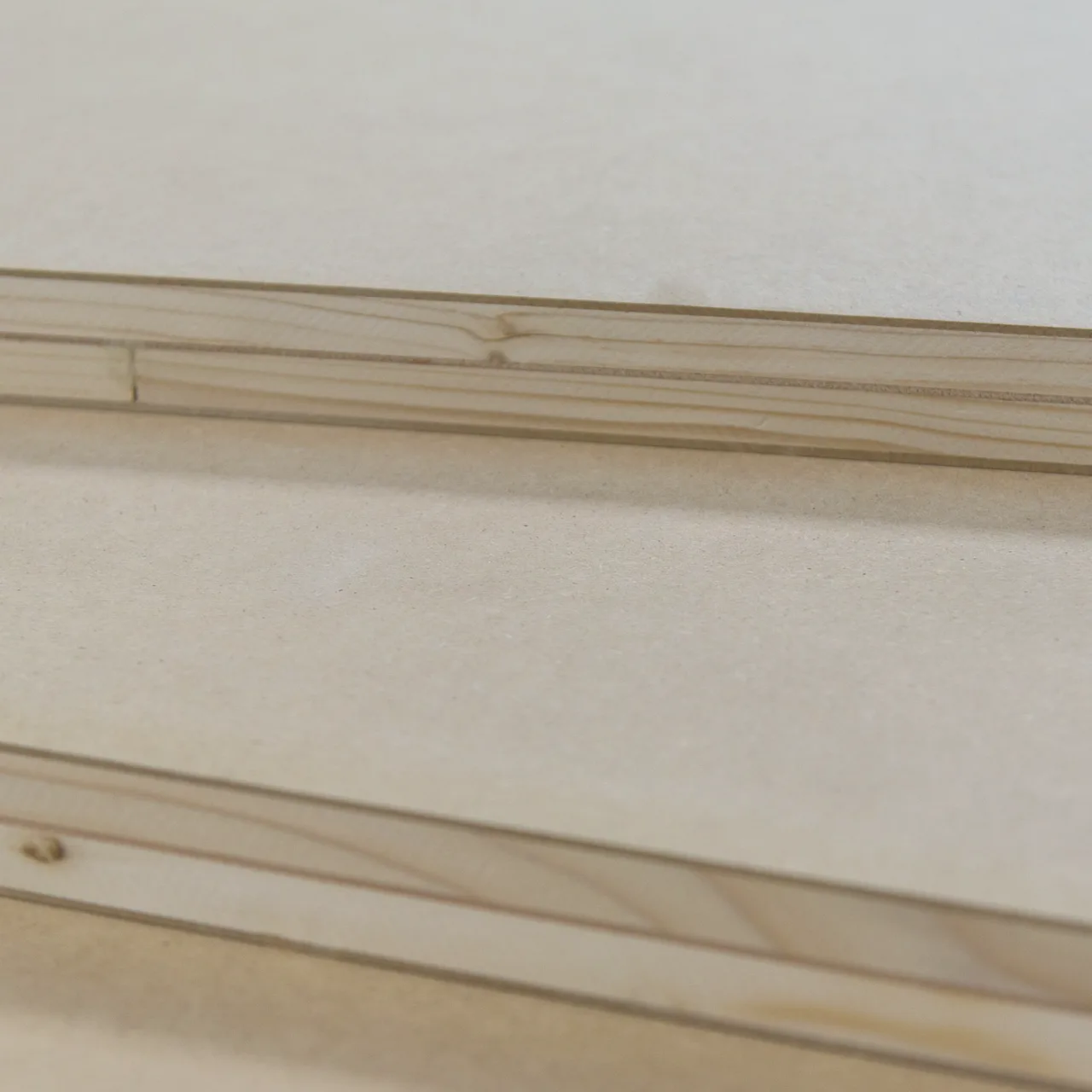
When choosing blockboards, you get a reliable panel material that combines lightness with high dimensional stability. The core of such a board consists of edge-glued wooden blocks or strips, cut to 25 mm. Pine is most commonly used for the core. The blocks are bonded using water-resistant glue under high-pressure technology.
To ensure strength, a stabilizing layer—rotary-cut birch or alder veneer—is applied to both sides of the core. Thanks to this multi-layered construction, the board is not prone to cracking or warping. The factory drying process ensures a Moisture content: 10–12%, which is optimal for interior work. The material meets the PN-76/D-97000 moisture resistance standard and has a safe E1 formaldehyde emission class. Excellent thermal and sound insulation properties are an added advantage.
The final facing determines the appearance and application scope of the material. Our assortment is divided into three main families.
Veneered Blockboards
This variety is designed for projects where the natural wood texture is essential. The front facing is sliced veneer of precious wood species. Veneered blockboards are available in trending species: oak, white ash, and American walnut. Both sides of the board are veneered. We offer materials with Grade I-II face veneer. This is a combined format where one side has superior visual characteristics, while the reverse side allows for more natural wood features.
Available thicknesses: 14, 19, and 39 mm. Sheet formats are 2500×1250 mm (area 3.125 m²) and 2800×2070 mm (area 5.8 m²). The reinforced 39 mm thick board is produced in a 2100×900 mm (1.89 m²) format. The surface is completely ready for finishing—staining, varnishing, or hard wax oil coating. The material is used to create furniture fronts, cabinets, countertops, shelves, wall panels, and staircase elements.
Ceiba(fromager)-Faced Blockboards
If you need maximum lightness and a light base for finishing, you should consider ceiba(fromager)-faced blockboards. Ceiba (fromager) is a light-colored, uniform, and very lightweight tropical wood. Rotary-cut ceiba veneer is applied on both sides, creating a smooth matte surface.
The material is available in 13 and 18 mm thicknesses. Sheet formats: 2500×1250 mm and 2800×2070 mm. Lightness is the key advantage of this family, ensuring less weight for finished structures and convenient installation. The surface is excellent for painting and varnishing, and is also suitable for further veneering or laminating. It is an ideal base for furniture cabinets and interior partitions.
HDF-Faced Blockboards
For projects requiring a perfectly smooth surface without knots or texture variations, we offer HDF-faced blockboards. HDF (High-Density Fiberboard) is applied symmetrically on both sides. This significantly increases the dimensional stability of the sheet.
Thicknesses are 13, 18, and 38 mm. Standard formats: 2500×1250 mm and 2800×2070 mm, and for the massive 38 mm board—2100×900 mm. This is a ready-made base for applying enamel, film, or painting. The 38 mm thickness is perfectly suited for heavy-duty elements like work surfaces or stairs.
What is a Solid Wood Panel
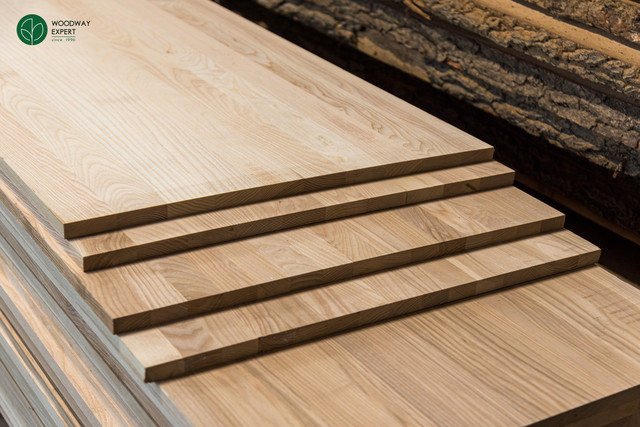
Unlike multi-layered construction, a solid wood panel consists of solid wooden lamellas glued together by width or length. This material has no inner core of a cheaper species or outer facing—it is solid wood throughout its entire thickness.
The main difference between blockboard and a solid wood panel lies in weight and stability. The panel is significantly heavier as it entirely consists of dense wood. Solid wood is also more sensitive to humidity and temperature changes, requiring careful processing and proper structural fastening to prevent warping. At the same time, the panel allows for deep surface routing and leaving exposed edges without additional edge banding.
What is Plywood
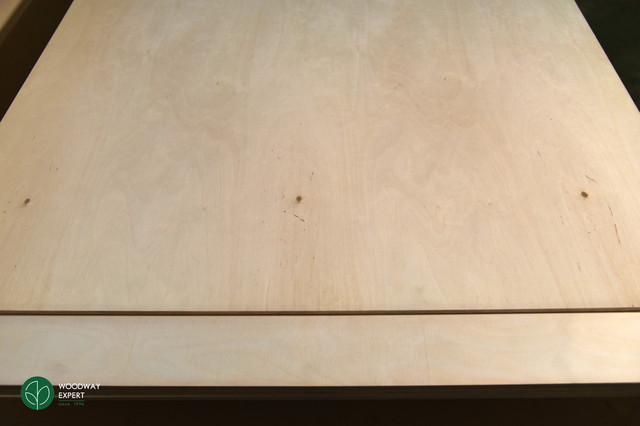
Plywood is a sheet material made by gluing together several layers of rotary-cut veneer. The grains of each subsequent layer are positioned perpendicularly to the previous one. This cross-banded structure provides the material with high bending and tensile strength.
Plywood is heavier than blockboard of the same thickness. It is often used in construction, for creating rough frames for upholstered furniture, and in specific design projects. A characteristic feature of plywood is its striped multi-layered edge, which designers sometimes leave exposed as a decorative element.
Material Comparison Table
For convenience, we have compiled the key differences between the three materials into a single table.
| Characteristic | Blockboard | Solid Wood Panel | Plywood |
|---|---|---|---|
| Construction | Pine block core + stabilizing layer + final facing. | Solid wood lamellas glued together. | Layers of rotary-cut veneer glued perpendicularly to each other. |
| Weight | The lightest among analogs due to a lightweight core. | Heavy, matches the weight of the chosen solid wood species. | Heavier than blockboard, dense structure. |
| Dimensional stability | High. Not prone to warping or cracking. | Requires proper fastening, may react to climate changes. | High strength, but large formats may have a slight bow. |
| Surface and finish | Precious wood veneer, ceiba, or smooth HDF. Ready for finishing. | Natural solid wood. Deep routing is possible. | Requires sanding or veneering for finishing work. |
| Typical applications | Cabinet furniture, lightweight fronts, wall panels, doors. | Stairs, massive countertops, windowsills, carved fronts. | Furniture frames, construction, rough-in work. |
What to Choose for Your Task
The choice of material depends on the specifics of your project. Let’s look at a few typical scenarios.
- Manufacturing lightweight fronts for painting. The best choice would be HDF-faced blockboard. It has a perfectly smooth surface on which enamel lays evenly. The lightness of the board will reduce the load on furniture hinges, extending the lifespan of the cabinets.
- Creating furniture with a natural wood texture. Choose veneered blockboards (oak, ash, walnut). You will get a product that visually does not differ from solid wood, but will be lighter and more stable during use.
- Installing massive countertops or stair treads. Both a solid wood panel and a reinforced blockboard with a thickness of 38 or 39 mm (format 2100×900 mm) will work here. The board wins due to lower weight and stability, while the panel allows for a shaped chamfer on the edge without using edge banding.
- Making frames for sofas and beds. For hidden load-bearing structures where breaking strength and the ability to securely hold fasteners are important, it is advisable to use plywood.
- Wall and ceiling decoration. For wall and ceiling panels, weight is critically important. Blockboards, ceiba(fromager)-faced or faced with precious wood veneer (13-14 mm thick), will ensure convenient installation and no excess load on the load-bearing profiles.
Brief FAQ & Custom Manufacturing
Are these materials safe for residential spaces?
Yes, the materials are safe. Blockboards are manufactured using high-quality adhesive systems and have an E1 formaldehyde emission class, allowing them to be used in bedrooms and children’s rooms.
What is lighter—blockboard or a solid wood panel?
A blockboard is significantly lighter than a solid wood panel of the corresponding thickness. This is because its core consists of light pine blocks, and in some variants, weightless ceiba veneer is used.
What is the moisture content of blockboards?
During production, the material undergoes a drying stage, achieving a Moisture content: 10–12%. This ensures that the board will not shrink or crack in the finished product.
Can I buy materials in small quantities?
We sell from 1 sheet (by the piece) and also work wholesale. You can order exactly as much material as your project requires.
Conclusion
Each of the materials discussed has its strengths. Blockboard provides a perfect balance of lightness, stability, and a variety of finishes. A solid wood panel is a classic choice for lovers of solid wood, and plywood is a reliable structural material. We provide pickup from our warehouse in Kyiv and shipping across Ukraine by carrier companies. Contact our managers for a remote consultation—we will help clarify availability, dimensions, and convenient payment methods.