Order
Place order
Clear the whole list?
The “Oak Veneer Edge Banding” category is being stocked — ask our manager for availability.
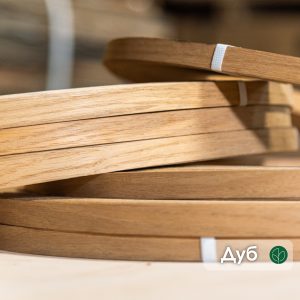
Natural veneer edging seals board edges to match the face — the part reads as solid wood.
Wood is a natural material: shade and figure vary from batch to batch. Ask our manager for current pricing and stock — we will calculate volume and delivery across Ukraine; dispatched from our warehouse.
Natural oak veneer edge banding is a material that lets you build reliable, good-looking furnishings. A thin strip of natural wood:
The Woodway Expert catalogue carries oak edging pre-glued and unglued, as well as fleece-backed veneer. Edging material is available with the following parameters:
Besides the standard sizes, veneer in rolls 60-270 mm wide is available to order. Delivery across Ukraine and collection from the warehouse in Kyiv are both possible. Our managers will confirm the current price for trade and retail customers, availability and payment methods.
Edging is a thin strip of veneer obtained by slicing an oak log. The material retains virtually every quality of solid timber. The tree, which grows in the temperate and tropical regions of the Northern Hemisphere, has a smooth texture and a pronounced figure. Oak is characterised by the following working properties:
Solid oak is strong and dense, which is why it is widely used for exterior and interior work. Its flexibility allows curved components of various radii to be made from it.
To understand what edge banding is, it helps to know what the material is for. The veneer strip is used for:
The Woodway Expert catalogue carries edging sanded on the face side. Several types of furniture edging are available.
Unglued edging. The back of this strip carries no adhesive layer. The joiner applying the edging is free to choose the adhesive. Should any questions arise, our managers are available for advice. Our specialists will help you find a suitable adhesive.
Pre-glued edging. The back of the veneer strip carries a hot-melt adhesive. Self-adhesive furniture edging bonds to the edge under heat, so a heat gun or an iron is needed for the job.
Fleece-backed veneer. This type of edging material is made by splicing veneer with a zigzag joint. Fleece is applied to the reinforced strip. The resulting strip is flexible and stable. Fleece-backed furniture edging does not crack where it bends, and its surface does not chip when profiled surfaces are edged. Oak edging is also used to wrap various mouldings (skirtings, corner beads and cornices).
Furniture edging made from oak veneer is used in the manufacture of a wide range of interior items. Sliced veneer tape is used to make:
| Furniture | Oak furniture edging makes cabinet and upholstered furniture look neater and extends the service life of the pieces. Chairs, chests of drawers, sideboards, wardrobes and cabinets with properly finished edges are used to fit out residential and public spaces. |
|---|---|
| Wall finishes | Oak veneer furniture edging is used in the manufacture of wall panels, panelling and mouldings. Such finishes suit studies, libraries, lobbies and meeting rooms as much as living rooms and bedrooms. |
| Architectural features | Oak edging helps face attractive, practical doors and doorways, window sills, archways, screens, balusters and stair handrails. |
Woodway Expert offers a range of edgings for particle board and MDF on favourable terms. The edging material is in stock at our warehouse in Kyiv, and delivery across Ukraine is available. Our managers will confirm the price for trade and retail customers, the payment methods and the expected delivery times.