
Order
Place order
Clear the whole list?
The “Maple Veneer Edge Banding” category is being stocked — ask our manager for availability.
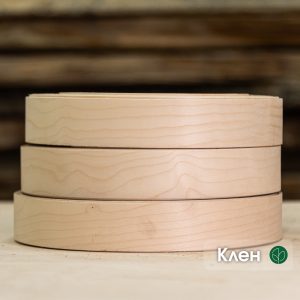
Natural veneer edging seals board edges to match the face — the part reads as solid wood.
Wood is a natural material: shade and figure vary from batch to batch. Ask our manager for current pricing and stock — we will calculate volume and delivery across Ukraine; dispatched from our warehouse.
Maple edging is a material that makes for durable, practical and good-looking furniture. This thin strip of sliced veneer is used to:
The Woodway Expert catalogue carries fleece-backed veneer as well as maple edging both pre-glued and unglued. Veneer is in stock in rolls of the following sizes:
Edge banding in non-standard sizes is also available. Widths of 60-270 mm can be supplied to order. Collection from the warehouse in Kyiv and delivery across Ukraine are both possible. We work with retail and trade customers alike.
What is edge banding? It is a thin strip of sliced veneer, produced by slicing a maple log. The material keeps virtually every quality of the solid timber. Maple has pale wood with a low-contrast figure. The palette runs through light beige, cream and sand tones. The tree, which is common in south-western Asia and central Europe, performs well in use. Makers single out the following properties of the solid timber:
As noted above, edging is a strip used in making furniture and other fittings. The material does three jobs:
| Protection | Environmental safety | Appearance |
|---|---|---|
| Corner-protecting edging prevents chips, scratches and other mechanical damage. The facing keeps moisture out and extends the service life of tables, dressing tables, chests of drawers and other furniture. | Maple edging glued to the edges of particle board or fibreboard seals in the emissions of MDF and particle board. Edge banding material makes furniture environmentally safer. | Natural veneer edging is a simple and effective way to give a worktop or fronts a finished look. |
Woodway Expert supplies edging sanded on the face side. The following types of edging for particle board, MDF or plywood are available:
Maple edging is used in furniture production and in fitting out interiors. A line of natural veneer goes into furniture of every style.
Cabinet and upholstered furniture. Neatly finished edges on wardrobes, chests of drawers, coffee and side tables, shelves, shelving units and the arms of chairs, armchairs and sofas make the piece look complete.
Architectural details. Natural edging is used to face doors and doorways, window sills and window frames, stair rails and balusters, partitions, screens and arches. Properly finished surfaces help create a considered interior.
Wall panels. Veneer edging is used in making wall panels, as well as panelling and mouldings. Wall coverings worked out down to the last detail are used in studies, bedrooms, living rooms, hallways, dining rooms, libraries and meeting rooms.
Decorative items. Pale maple furniture edging takes toning well, so it is widely used in making decorative pieces: candlesticks, baskets, frames for mirrors, paintings and photographs, and collectors’ figurines.
The Woodway Expert warehouse shop supplies maple furniture edging wholesale and retail. Delivery across Ukraine and collection from the warehouse in Kyiv are both possible. Our managers will confirm pricing, stock and payment options when the order is placed.