Order
Place order
Clear the whole list?
The “Elm Veneer Edge Banding” category is being stocked — ask our manager for availability.
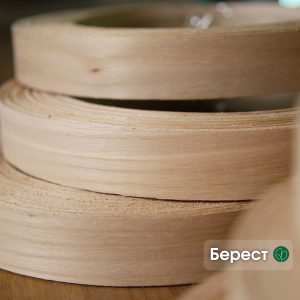
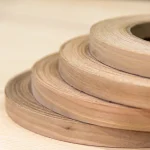
Natural veneer edging seals board edges to match the face — the part reads as solid wood.
Wood is a natural material: shade and figure vary from batch to batch. Ask our manager for current pricing and stock — we will calculate volume and delivery across Ukraine; dispatched from our warehouse.
Elm edge banding is a material used in the manufacture of cabinet and upholstered furniture. This strip of sliced veneer is used for:
The Woodway Expert catalogue lists elm edging both pre-glued and unglued, as well as fleece-backed tape. Material in the following sizes is available for collection from the warehouse in Kyiv:
Besides standard edging we supply strips of natural veneer in non-standard sizes specified by the customer. Delivery across Ukraine is available. We work with retail and trade customers alike.
Natural veneer edging keeps virtually all the properties of elm wood. Makers single out the following qualities of the solid timber:
Solid elm and sawn timber made from it are used in furniture, musical instruments, parquet, sports equipment, knife handles and finishing materials.
What is edge banding? It is a thin tape of sliced veneer glued onto the edges of MDF, particle board and plywood. Veneer in rolls for edge banding performs the following jobs:
The Woodway Expert trade counter stocks edging sanded on the face side. The catalogue offers the following types of edge banding for particle board, MDF and plywood:
| Unglued edging | Veneer edging supplied without pre-applied adhesive. The maker can choose a suitable adhesive independently or ask our managers for advice. |
| Pre-glued edging | This furniture edging carries a layer of adhesive on the reverse side. A heat gun or an iron is used to apply it. The heat softens the adhesive, bonding the veneer tape to the edge of the particle board, MDF or plywood. |
| Fleece-backed veneer | A synthetic non-woven material – fleece – is applied to veneer spliced to length. Fleece backing produces a strong, flexible and stable veneer. Fleece-backed edging does not crack where it bends. What is more, no chips form on the surface of the tape when profiled parts are faced. Fleece-backed elm edging is used for wrapping linear mouldings (furniture cornices, skirtings and architraves). |
Edge banding is a material that solves a variety of design problems. This thin strip of veneer is used in the furniture industry and in interior fit-out.
Furniture. Furniture edging improves the appearance of furnishings and makes them more environmentally sound, and it extends the service life of chairs, tables, shelving units, storage systems and the arms of sofas and armchairs.
Window sills, frames and screens. A neat interior calls for attention to every detail. Properly faced doors, partitions, staircase balusters and arches create a coherent, practical space.
Wall panels and panelling. Wall decoration is another field in which veneer edging is used. The tape covers the edges of panels, wall panelling and mouldings.
Decorative objects. Thanks to its decorative qualities and easy working, elm edge banding is used to make candle holders, mirror and picture frames, baskets, figurines and other decorative items.
Woodway Expert sells quality edge banding for MDF and particle board, wholesale and retail. The edging is available from the warehouse in Kyiv, and delivery across Ukraine is possible. Our managers will confirm stock, pricing, payment methods and estimated delivery times.