Order
Place order
Clear the whole list?
The “Cherry Veneer Edge Banding” category is being stocked — ask our manager for availability.
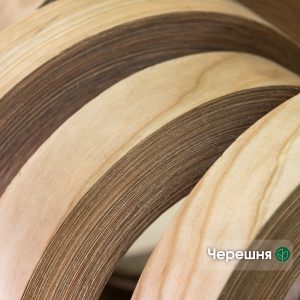
Natural veneer edging seals board edges to match the face — the part reads as solid wood.
Wood is a natural material: shade and figure vary from batch to batch. Ask our manager for current pricing and stock — we will calculate volume and delivery across Ukraine; dispatched from our warehouse.
Cherry veneer edge banding is a finishing material that serves both a protective and a decorative purpose. The thin strip of sliced veneer can be fleece-backed, and natural pre-glued edging is also available.
Edge banding is used for:
Woodway Expert stocks thin veneer in rolls. Sanded edging is offered in the following sizes:
Besides material in standard widths, we supply edging made to the dimensions specified by the customer. Delivery across Ukraine and collection from the warehouse in Kyiv are both available. We work with trade and retail customers alike.
Edge banding is a thin strip of sliced veneer used in making furniture and other objects. The material’s main jobs are to seal in the harmful substances of particle board, plywood or MDF and to improve the appearance of the part. Edging is also used to protect corners and edges against chipping and moisture ingress.
Woodway Expert offers the following types of furniture edging:
The face side of every type of edge banding listed above is carefully sanded. The smooth surface polishes easily and takes lacquers and paints well.
Cherry veneer edging keeps virtually all the qualities of the wood. The tree, which grows in Europe, southern Asia and northern Africa, is not on any conservation body’s lists. European cherry is a readily available material valued in joinery for its good working properties and its broad palette of warm, rich shades.
The tree reaches 18-24 m in height, with a trunk diameter of 75 cm. Fine pores and rays are visible in a section of the heartwood. The surface is smooth and satiny. The structure is notable for its straight grain, with occasional wavy figure. The outer layer is pale (light yellow, white or cream). The heartwood is richer in colour: the palette runs through browns, reds, russets and ambers. A warm undertone is another characteristic of cherry wood.
The main properties of cherry include:
| Impact resistance | Thanks to its dense structure, the solid timber and sawn material made from it withstand the everyday loads of a typical home. A section of the wood is not troubled by chips or knocks. |
|---|---|
| Elasticity | The material does not warp as it dries and keeps a stable shape. |
| Workability | The wood is easy to work. Sanding, polishing, staining and lacquering present no difficulty. |
The main use for veneer edging is cabinet furniture manufacture. Neatly finished edges on wardrobes, bedside cabinets, desks and coffee tables, whatnots and shelving units give furniture a tidy appearance and extend its service life. Natural cherry edging is also used to finish doors, window sills and other architectural elements of a space. It goes into skirtings, cornices, arches and decorative wall panels.
A thin strip of natural wood solves a variety of design problems. Cherry veneer has an attractive range of colours. Stains, oils and lacquers bring out the beauty of the wood’s texture and colour still further.
Woodway Expert sells cherry furniture edging wholesale and retail. The rolls can be collected from the warehouse, and delivery across Ukraine is available. Our managers will confirm current pricing, stock, payment methods and estimated delivery times.