Order
Place order
Clear the whole list?
The “Alder Veneer Edge Banding” category is being stocked — ask our manager for availability.
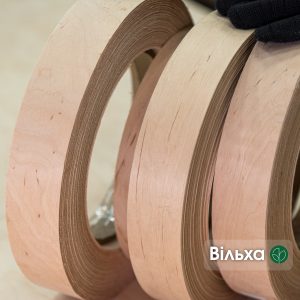
Natural veneer edging seals board edges to match the face — the part reads as solid wood.
Wood is a natural material: shade and figure vary from batch to batch. Ask our manager for current pricing and stock — we will calculate volume and delivery across Ukraine; dispatched from our warehouse.
Alder edging is a strip of sliced veneer used to finish furniture and other items. The material is valued above all for:
Woodway Expert supplies quality veneer in rolls. The catalogue carries pre-glued and unglued edging as well as fleece-backed veneer. Edge banding is available:
Edging in standard sizes is held in stock; edging in unusual widths is made to order. Both collection from the warehouse and delivery across Ukraine are possible. Ask our managers about pricing, stock and delivery times.
Natural edging is made from sliced alder veneer. A slice taken from the trunk of this hardwood keeps the working properties of the solid timber. Alder is notable for the following:
The Woodway Expert catalogue carries edging sanded on the face side. The following types of furniture edging are available:
| Unglued edging | Edge banding with no adhesive applied in advance. Our managers will advise on choosing a suitable material. |
| Pre-glued edging | Self-adhesive furniture edging has a layer of glue on the back. A heat gun or a household iron is needed to work with it. Applying the edging calls for correct technique. Under high heat the adhesive strip softens and fixes the veneer to the edge of the particle board, MDF or plywood. |
| Fleece-backed veneer | The back of veneer spliced along its length carries a layer of fleece, a non-woven synthetic material. Backing it this way gives a stable, flexible edge banding material. Because it is stronger, this furniture edging does not crack on bends. When fleece-backed veneer is applied to profiled parts, no chips form on the faced surface. Fleece-reinforced furniture edging is used to wrap furniture cornices, skirting boards, architraves and other mouldings. |
The answer to the question “What is edge banding?” becomes clear once you look at what the material does. Edging is a strip of sliced veneer of a given width that is glued to the edge of a worktop or other surface. It gives the piece a finished look. Edging for particle board or MDF covers the edge of the board and protects it from moisture and mechanical damage. A strip of natural wood also seals in the harmful emissions of fibreboard or particle board, making the furniture greener.
Edge banding is used above all in making furniture. Edging goes into:
furniture. Veneer edging is used to face the edges of wardrobes, tables, shelves, shelving units, chairs, the arms of armchairs and sofas, chests of drawers and whatnots;
Woodway Expert sells alder edging, pre-glued and unglued, on favourable terms. We work with trade and retail customers alike. Our sales managers will confirm current pricing, stock, payment terms and delivery times.