Clear the whole list?
Veneered Particle Board
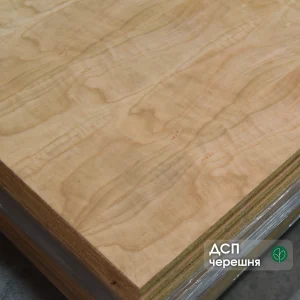
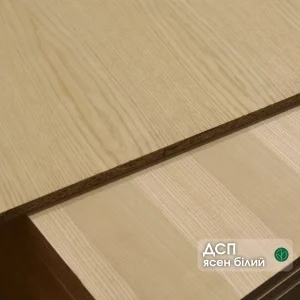
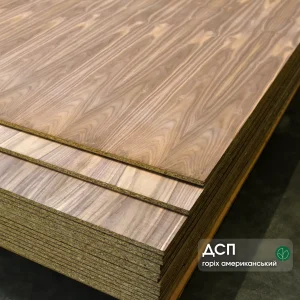
Veneered particle board is faced with natural ash, European cherry, or American walnut veneer — the look of a premium species on an economical core. Thickness 19 mm, format 2800×2070 mm, grade I/II. Sold from a single board.
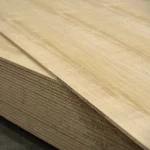
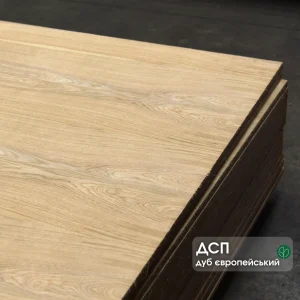
Oak veneered chipboard 19 mm 2800×2070 mm I/II
- Thickness: 19 mm
- Format: 2800x2070
- Grade: I-II
- Wood species
- Oak
- Sheet area
- 5.796 m²
- Weight
- ≈ 74.9 kg / sheet
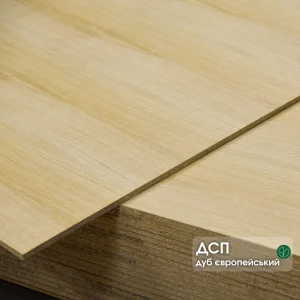
Oak veneered particle board 17 mm 2800×2070 mm I/II
- Thickness: 17 mm
- Format: 2800x2070
- Grade: I-II
- Wood species
- Oak
- Sheet area
- 5.796 m²
- Weight
- ≈ 67.0 kg / sheet
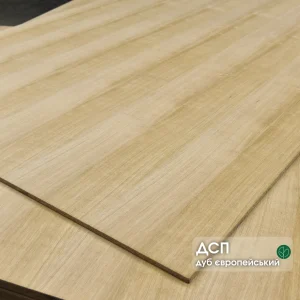
Veneered Chipboard Oak 17 mm 2750×1830 I/II
- Thickness: 17 mm
- Format: 2750x1830
- Grade: I-II
- Wood species
- Oak
- Sheet area
- 5.033 m²
- Weight
- ≈ 58.2 kg / sheet
Veneered chipboard European Cherry 19 mm, 2800×2070, Grade I/II
- Thickness: 19 mm
- Format: 2800x2070
- Grade: I-II
- Wood species
- Cherry
- Type
- Veneered
- Sheet area
- 5.796 m²
- Weight
- ≈ 74.9 kg / sheet
Veneered chipboard White Ash 19 mm, 2800×2070, grade I/II
- Thickness: 19 mm
- Format: 2800x2070
- Grade: I-II
- Wood species
- Ash
- Type
- Veneered
- Sheet area
- 5.796 m²
- Weight
- ≈ 74.9 kg / sheet
Veneered Chipboard American Walnut 19 mm, 2800×2070, Grade I/II
- Thickness: 19 mm
- Format: 2800x2070
- Grade: I-II
- Wood species
- American (Black) Walnut
- Type
- Veneered
- Sheet area
- 5.796 m²
- Weight
- ≈ 74.9 kg / sheet
Particle board (chipboard) is a panel made by hot-pressing wood chips of hardwood or softwood species together with binding resins. Particle board became popular in manufacturing and construction in the 1980s, although it had been available as early as the 1940s.
The composite material is most often used for:
- Facing walls and ceilings. Particle board is made into veneered panels that clad walls and ceilings. This kind of finish is particularly suited to offices, living rooms, lobbies, meeting rooms, libraries and dining rooms. Another popular use of the boards is decorative wall panels, which look striking.
- Making screens, room dividers and other architectural elements. Particle board can be used to zone a space. Well-defined zones make a room considerably more practical and functional. Veneering allows a divider to suit either a classical or a contemporary interior.
- Furniture manufacture. Particle board goes into carcass furniture. Easy to work with, the material is used for wardrobes, cabinets, shelves, shelving units, beds, sideboards and dressing tables.
Particle board: sheet sizes
Woodway Expert supplies particle board in the following sizes:
- width: 1.83 m; 2.07 m;
- length: 2.8 m, 2.75 m;
- thickness: 9 mm, 11 mm, 17 mm, 19 mm.
We offer particle board veneered in natural American walnut, white ash, alder, oak and beech. The price of the composite depends on the size of the sheet and on the type of veneer. We work with trade and retail customers alike. Particle board is available for collection from our shop and warehouse in Kyiv, and orders can be delivered across Ukraine. Our sales managers will confirm stock, payment methods and approximate delivery times.
Particle board characteristics
Particle board is a panel produced by hot-pressing wood chips of hardwood or softwood species together with binding resins. The composite material is used in the manufacture of wall panels and decorative panelling, screens, furniture and room dividers. Particle board became especially popular in manufacturing and construction in the 1980s, although the material had been available as early as the 1940s.
Particle boards differ in:
- the number of layers. There are single-layer, three-layer and multi-layer boards;
- the type of surface finish. A board may be sanded or unsanded;
- the class. The P1 designation covers general-purpose boards, which can be used in dry rooms and for construction work without loading. The P2 marking indicates a flatter surface, so these sheets are more often used for finishing. P2 boards are practically as strong as P1 but are more resistant to moisture. They are also recommended for residential and public spaces;
- the grade. Grade I means sheets with no defects. Grade II boards have minimal imperfections. Grade III boards, or boards with no grade stated, may have significant damage;
- fire resistance. Resistance to fire comes from the flame retardants added to the mix;
- environmental safety. The E0.5 marking is carried by particle board for dry rooms. Such sheets contain 4 mg of formaldehyde per 100 g of chips. The E1 designation is given to moisture-resistant boards and general-purpose boards, which contain 4-8 mg of formaldehyde per 100 g of wood material. Class E2 products contain 8-20 mg of this hazardous substance, so such boards must not be used indoors.
Among the reasons to buy particle board for making interior products is its dimensional stability. The boards are not harmed by water, do not crack when the temperature changes and barely distort over time. There is also a choice of sheets that withstand different service loads. The main types are described in the table.
| Type of particle board | Properties |
|---|---|
| Pressed | A strong material used in the manufacture of carcass furniture. |
| Laminated | This is in fact a pressed sheet covered with a special film. Lamination makes the surface stronger and more wear-resistant. A film-laminated board is also an attractive option: the coating can imitate a variety of wood figures. |
| Moisture-resistant | Paraffin and melamine are usually added to moisture-resistant sheets. The P3 board available in Ukraine can be used in rooms where the humidity rises from time to time. It is not the strongest option, so it is normally used as a finish. Sheets in the P5 category have high moisture resistance and are used for floors and ceilings. P7 boards are intended for damp conditions. This material withstands a higher load and is used in wall and ceiling structures; |
| Extruded | Compared with the products in the previous category, these boards are not as strong, but they have excellent sound absorption. |
| Veneered | Veneered particle board, which can be bought in Kyiv or in any other town in Ukraine, is covered with natural wood. The material meets environmental standards, withstands a significant load and keeps a presentable appearance. |
How particle board is manufactured
Making the sheets involves several stages. First, chips are selected up to 0.2 mm thick, up to 10 mm wide and 5-35 mm long. Fine chips are used for the surface and coarser ones for the core. The wood material is mixed with synthetic resin in dedicated equipment. The resulting mass goes into moulds. Hot pressing follows. High temperatures cure the blank. The particle board is then cooled and left so that the material sets and dries. After that, the sheet is covered with veneer or film.
When furniture, for example, is being made, the composite sheets are cut into pieces of the required shape and size, holes are drilled for the fittings and the necessary parts are added. With veneered particle board there is no need for sanding, painting or any other decorative finishing. To give the product a finished look, it is enough to apply edge banding to the edges. This can be done either by hand or on a machine.
Veneered particle board: wood species
The company’s catalogue offers particle board veneered in the wood species listed below.
- American walnut. Particle board faced with American walnut veneer has an attractive appearance. This strong timber is notable for its expressive figure and its pleasing palette of light and deep brown shades. The material suits high-end furniture.
- White ash. Even colour and straight grain are what make white ash veneer distinctive. This hard species withstands the loads of ordinary homes and of public buildings alike. Ash-veneered particle board is an excellent material for furniture suites, floor and wall facing and household items.
- Alder. This soft timber with an indistinct figure is easy to work. Particle board faced with alder veneer can be bought in any town in Ukraine. Products made from this material have golden, golden-pink and reddish tones.
- Beech. Beech-veneered sheets have an even, grainy surface. This hard, wear-resistant timber in light brown shades is notable for its expressive pattern with clearly visible growth rings.
- Oak. This affordable and popular timber is notably dense and has a distinct figure. Oak-veneered particle board is a reliable material for making interior products. The palette includes grey, brown and golden tones.
Woodway Expert offers veneered particle board measuring 2.80 × 2.07 m or 2.75 × 1.83 m. Ask our managers about payment methods, prices for trade and retail customers and approximate delivery times.