
Order
Place order
Clear the whole list?
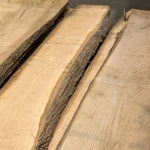
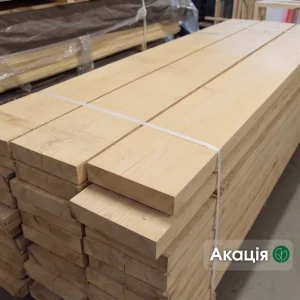
Edged and unedged Red Oak boards (Canadian, Northern, American) are an affordable and popular timber choice. In terms of characteristics, Red Oak is virtually identical to European Oak. The varieties differ mainly in colour palette and texture.
Edged and unedged red oak (Canadian, northern, American) boards are a timber product that is virtually identical in performance to European oak.
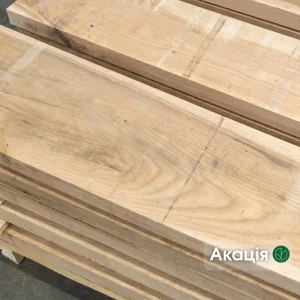
We offer kiln-dried red oak boards with a moisture content of 8–10%. The following extra and 1st-grade timber is available in stock:
You can select the timber personally—we await your visit at our warehouse in Kyiv. If you cannot visit, please contact our manager and send your technical requirements. Our specialist will select the oak boards remotely, providing photos and specifications of the suitable material.
These varieties differ in their colour palette and grain pattern. Red oak wood has a pinkish-red cast, large pores, and less pronounced medullary rays. The solid wood is used in the furniture industry, for manufacturing internal beams and partitions, and for the production of flooring, wall panelling, and household items.
We stock Grade 1 and Extra Grade timber. You have the opportunity to personally choose between edged or unedged Red Oak (Canadian, Northern) boards.
Edged board is material ready for joinery processing, with the bark removed from the side edges. Technical documentation allows for a small amount of wane. Joinery boards without bark are simple to transport and store.
This material is suitable for manufacturing:
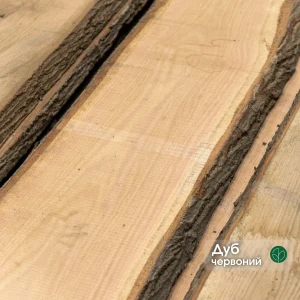
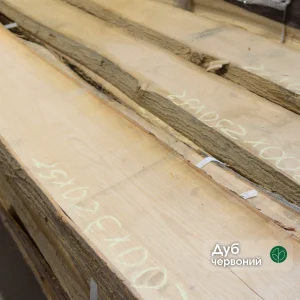
Unedged board is timber where the bark remains on the sides. Boards with bark are more affordable but require additional preparation. Interior items and household goods are produced from quality timber of this type.
For some projects, such as those in a rustic style, timber with bark is specifically used.
Unedged timber is suitable for the following tasks:
Oak boards are sold individually and wholesale. Contact a manager and provide your technical requirements. Our specialist will send photos and specifications of the appropriate timber, explain payment methods, and process the order.
Red Oak is a timber with character. Its porous structure and expressive growth ring pattern make the sorting process particularly important. The choice of timber grade depends on how “clean” the surface of the product needs to be.
Elite raw material for projects where compromises are unacceptable. A maximally clean board with a uniform shade (from light pink to reddish-brown) without sharp colour variations. Knots, sapwood, cracks, and pith are not permitted on the face sides.
It is used for the production of premium facades, elite wall panels, doors, visible staircase elements, and furniture where a perfect surface is required.
The “Gold Standard” for the joinery workshop—the best balance between price and yield of useful billet. The board has a uniform texture. Single light (live) knots of small diameter (up to 10-15 mm), minor sapwood inclusions, or slight colour changes are permitted.
Suitable for manufacturing worktops, flooring (parquet, engineered board), cabinet furniture, and skirting boards. It is easily stained, allowing minor colour variations to be levelled out.
Timber for those who appreciate natural material features and a pronounced texture. Here, Red Oak reveals its full character: contrasting fibres and colour iridescence.
Knots (including dark and fused ones), sapwood, mineral streaks, and micro-cracks are permitted. These features do not affect the hardness or durability of the timber.
It is applied in furniture with rustic aesthetics. Used for intentionally rough tables, barn doors, decorative beams, or internal frames for upholstered furniture.
Red Oak has large open pores. In Extra Grade, the surface becomes smooth after sanding. In Grade 2, due to the presence of knots, the texture will be more relief-like, which is often used by designers for brushing (artificial ageing) of the wood.
We have been selling timber materials since 1996 and cooperate with furniture factories, joinery workshops, interior designers, and craft workshops. We are reliable partners and offer clients:
Timber is measured in cubic metres, so the price in the catalogue and price list is indicated per 1 cubic metre. How many cubic metres is one board? To calculate, refer to the formula: V = a × b × c, where a is length, b is width, and c is thickness.
To make it clearer, let’s look at a concrete example. Let’s take an unedged Extra Grade Red Oak board with the following parameters: width 26 cm (0.26 m), thickness 47 mm (0.047 m), length 2.6 m.
Substitute the characteristics into the formula: 2.6 × 0.26 × 0.047 = 0.032 m³.
The volume of edged and unedged boards of other sizes is determined by the same principle.
If you need to calculate how many boards of a certain size fit into a cubic metre, use the formula: N = 1 ÷ V of the board, where N is the quantity (pieces), and V is the board’s volume.
Let’s find out how many edged Red Oak boards with a thickness of 35 mm, width of 23 cm, and length of 2 m are in 1 m³. Convert the figures to metres, calculate the board volume and the number of pieces per cubic metre.
In our chosen board, the volume is: 0.035 × 0.23 × 2 = 0.016 m³. 1 ÷ 0.016 = 62.5. Therefore, 62 boards of the specified size will fit in a cubic metre.
How much does a board cost? To find out the cost of timber, multiply the price of a cubic metre by the volume of the board. Let’s calculate the price of edged and unedged Red Oak boards.
Example No. 1. Edged board of Extra Grade, length 2.4 m, width 22 cm (0.22 m), and thickness 40 mm (0.04 m). The price per cubic metre is, let’s say, €849. Calculate the volume: 2.4 × 0.22 × 0.04 = 0.021 m³. Calculate the cost of the board: 849 × 0.021 = €17.83.
Example No. 2. Unedged board of Grade 1, width 30 cm (0.3 m), thickness 35 mm (0.035 m), and length 2.3 m. The price per m³ is, suppose, €649. Let’s find the volume of the timber: 0.3 × 0.035 × 2.3 = 0.024 m³. Calculate the price of the board: 649 × 0.024 = €15.58.
Edged and unedged Red Oak boards are an affordable and popular timber on the joinery market. Among the main areas of application, the following should be highlighted:
| Application | Description |
|---|---|
| Furniture | Timber with an interesting colour palette has an expressive pattern valued by joiners and cabinetmakers. Chests of drawers, wardrobes, cabinets, shelves, worktops, coffee tables, and bed headboards are created from Red Oak. Chair backs and legs, sofa armrests, and armchairs are also made from decorative solid wood. |
| Flooring | Tongue-and-groove Red Oak boards are easily laid and provide a flat surface without gaps. Such flooring is used in flats, townhouses, and country houses. Oak timber is also used for manufacturing decks, platforms, and podiums. Additionally, the material is utilised in the production of parquet boards. |
| Wall Decoration | Red Oak timber is sometimes used to clad walls in chalets, country houses, and hotel rooms. However, interior wall panels are more frequently produced from boards. Accenting a wall in a living room, study, bedroom, or library using a decorative wooden panel is a proven design technique. Textured timber logically fits into the aesthetics of Classicism, Ethno, Eclectic, Neoclassical, Scandi, Country, and Loft styles. |
| Decor | Various household items and home decor are made from Canadian Oak solid wood. Craftsmen create frames for paintings, photos, and mirrors, jewellery boxes, organisers for cosmetics, stationery, and jewellery, holders for phones and tablets, vases for dried flowers, statuettes, etc. |
| Construction Works | Edged and unedged boards are suitable for beams, ceilings, non-load-bearing walls, and partitions. Timber is also used in the production of doors, arches, screens, and dividers. |
| Stairs | Hard and dense solid wood is suitable for various elements of internal staircases: steps, risers, handrails, balusters, stringers, newel posts, railings, balustrades, and landings. |
Red Oak (Quercus rubra) is a deciduous tree native to North America. Due to its distribution area, the breed is also often called Northern, Canadian, or American Oak. The plant belongs to the botanical genus Quercus and differs little from White Oak in terms of performance qualities.
The main features of this variety are its colour palette, more porous structure, and less pronounced medullary rays.
Red Oak solid wood is notable for its pinkish-red shade, which becomes more intense after processing. The heartwood is darker than the sapwood. It features a uniform texture with straight fibres and large pores.
The timber has average density indicators—about 700 kg/m³. This wear-resistant breed is simple to process: it glues, saws, mills, sands, stains, and varnishes well.
We have organised our work so that ordering timber is as simple and flexible as possible, regardless of whether you plan a visit to the warehouse or buy remotely.
We ship orders throughout Ukraine using transport companies. Please note that handover of goods to the carrier is carried out exclusively after 100% prepayment.
We have organised our work so that ordering timber is as simple and flexible as possible, regardless of whether you plan a visit to the warehouse or buy remotely.
We ship orders throughout Ukraine using transport companies. Please note that handover of goods to the carrier is carried out exclusively after 100% prepayment.