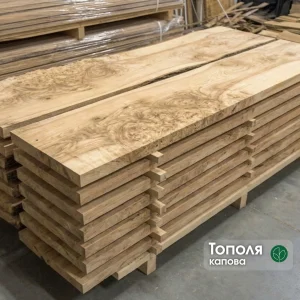
Poplar Burr Timber

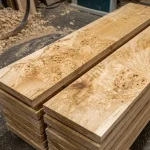
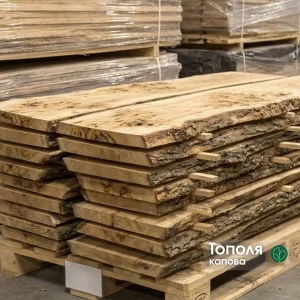
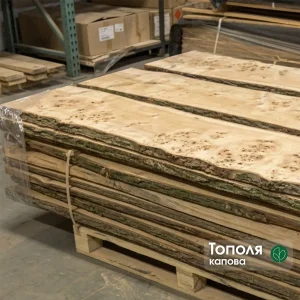
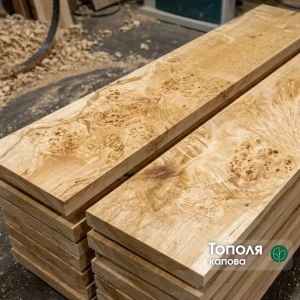
Edged and unedged Poplar Burl (Black Poplar, ‘Eye’ Burl) boards are timber materials actively used in finishing works and the manufacture of exclusive furniture. Due to its knotty structure, this wood possesses unique decorative qualities. Small burl growths form swirling patterns that resemble ‘eyes’ or dots.

Poplar burr unedged board 32/52 mm, extra, 8-10%

  • Wood species: Poplar Burr
  • Thickness: 32 mm, 52 mm
  • Grade: Extra
On request
Type
Unedged
Moisture content
8-10%
Width
20+ cm
Length
1–4.5 m

Poplar burr unedged board 32/52 mm, grade 1, 8-10%

  • Wood species: Poplar Burr
  • Thickness: 32 mm, 52 mm
  • Grade: 1
On request
Type
Unedged
Moisture content
8-10%
Width
20+ cm
Length
1–4.5 m

Poplar burr edged board 32/52 mm, extra, 8-10%

  • Wood species: Poplar Burr
  • Thickness: 32 mm, 52 mm
  • Grade: Extra
On request
Type
Edged
Moisture content
8-10%
Width
20+ cm
Length
1–4.5 m

Poplar burr edged board 32/52 mm, grade 1, 8-10%

  • Wood species: Poplar Burr
  • Thickness: 32 mm, 52 mm
  • Grade: 1
On request
Type
Edged
Moisture content
8-10%
Width
20+ cm
Length
1–4.5 m

Poplar Burl Joinery Boards: Dimensions, Stock Availability, Grades, and Characteristics

Edged and unedged burl poplar (black eye poplar) lumber is a premium timber used for interior decoration and exclusive furniture manufacturing. We stock both edged and unedged black poplar lumber in our warehouse:

  • moisture content: 8-10%;
  • thickness: 32 mm, 52 mm;
  • length: 1-4.5 m;
  • width: From 20 cm;
  • grade: 1, Extra.

We invite you to select materials for your projects personally by visiting our warehouse. If this is not possible, please contact our manager, and we will select the boards for you remotely.

Black Poplar Boards: Warehouse Availability

Our warehouse programme includes edged and unedged boards from approximately 20 distinct species. Black Poplar (Burl) is available in stock, and bespoke timber supply is also possible.

We offer high-quality edged and unedged boards. What are the differences between these varieties? Both are stable timber materials that undergo kiln drying. However, there are key distinctions:

  • Edged Poplar Burl boards: These have little to no bark on the side edges. The additional processing stage—trimming the wane—increases the cost of the timber. Boards without bark are ready for further processing and are more convenient for transport and storage. This material is used to create various interior items.
  • Unedged Black Poplar boards: This is timber with bark remaining on the side edges. Such material is more affordable, but the craftsman will need to remove the wane manually. For certain projects, unedged boards are preferable. For instance, for rustic wall panels or ‘live edge’ worktops, timber with bark is chosen to emphasise the naturalness of the material and the rugged aesthetic of the product.

Grading Classification of Poplar Burl Boards

The criteria for sorting Poplar Burl timber differ radically from ordinary construction timber. Whilst knots are considered a defect in standard boards, they are the primary value in Poplar Burl. The more ‘eyes’ and swirls present, the higher the class.

Characteristic Extra Grade 1st Grade 2nd Grade
Pattern Saturation Maximum concentration of ‘eyes’ (burl growths). The pattern is dense, evenly covering 80-100% of the board’s surface area. The pattern is distinct but may be uneven (alternating burl zones with zones of calm wood). Pattern coverage is 50-70%. Weak burl saturation or a ‘wild’ appearance. Large zones of clean wood without pattern or, conversely, large bark ingrowths.
Physical Defects No through holes, rot, or deep cracks. The surface is integral and dense. Micro-cracks inherent to burl are permitted. Small surface cracks and minor bark ingrowths are permitted, which are easily filled or sealed with varnish. Presence of through holes, large cracks, cavities (caverns), soft areas, or deep pockets with bark.
Intended Use Exclusive furniture facades, veneer, expensive boxes, knife handles, car interior decor. Worktops, coffee tables, wall panels. Worktops covered with epoxy resin.

Does Grade Affect the Strength of Poplar Burl?

Poplar burl itself is not a structural material; frameworks are not built from it. The growth impacts structural integrity, as burl is a chaotic intertwining of fibres. Extra grade timber is the most dense and uniform.

The 2nd grade is physically weaker in its ‘raw’ state. If such a board is simply varnished, it may crack or break under load in defect areas.

The paradox of Poplar Burl is that the 2nd grade often becomes stronger than Extra, but only with correct processing. Low-grade boards are almost always used in conjunction with epoxy resin. The resin fills cavities and cracks, transforming the board into a monolithic polymer-wood composite.

If you plan to use the wood only under oil/wax, choose Extra or 1st Grade. If a fully encapsulated table is planned, choose 2nd Grade. You will save on material costs and obtain an interesting pattern, whilst the resin ensures strength.

Why Buying Dry Poplar Boards at WoodWay Expert is Beneficial

WoodWay Expert is a company that has been operating on the Ukrainian market since 1996. For more than two decades, our team has helped select timber materials for thousands of projects of various formats.

We value professionalism and engagement. To build mutually beneficial cooperation, we offer clients:

  1. Warehouse Programme. Poplar boards are available at our warehouse in Kyiv. To select timber by size, texture, and volume, please visit our warehouse shop.
  2. Retail and Wholesale Timber Sales. Our clients include joiners and designers, as well as construction companies and furniture factories. Customers require varying amounts of material, so we offer Poplar boards for sale individually and wholesale.
  3. Selection Assistance. Experienced managers help select timber at the warehouse and remotely. If visiting the warehouse is not possible, provide our specialist with a technical brief. After processing the request, you will be sent photos, videos, and specifications of boards that suit your enquiry.
  4. Loyalty Programme. We have a loyalty programme that provides special offers for wholesale clients. The size of the discount is influenced by the type of product and the volume of the batch.
  5. Collection and Delivery across Ukraine. You can collect Poplar Burl boards from the warehouse yourself. Shipping to other cities in Ukraine by carrier companies is possible. Important: Timber is dispatched after 100% payment.
  6. Convenient Payment Methods. Choose a suitable payment method: cash (till receipt) or bank transfer (Sole Trader or Ltd with VAT).
  7. Additional Services. By agreement, rough cutting of boards purchased in our shop is possible. Furthermore, we compile cutting maps, veneer boards to order, and apply edging to parts.

How to Calculate the Cubic Volume of Poplar Burl Timber?

Since wood is measured in cubic metres, the price of timber is quoted per cubic metre. How do you find out how many cubic metres one board is? To determine the volume of a board, use the formula: V = a × b × c, where ‘a’ is length, ‘b’ is width, and ‘c’ is thickness.

For example, let us take an edged Black Poplar board of 1st Grade, with a length of 2.9 m, a width of 25 cm, and a thickness of 35 mm. Convert the indicators into metres, substitute them into the formula, and perform the calculations: 2.9 × 0.25 × 0.035 = 0.025 (m³). The cubic volume of boards with other parameters is determined by the same principle.

Price of Black Poplar Board: How to Determine?

In the price list and catalogue, the price is indicated for 1 m³. How do you find out how much 1 board costs? The cost of timber depends on the type, grade, and dimensions.

For calculations, use the formula: price per cube × (a × b × c). Simply multiply the price of the cube by the volume (cubic capacity) of a specific board. Let us calculate the price of edged and unedged Poplar Burl boards.

Example 1. Edged board, 1st Grade, length 3.2 m, width 30 cm (0.3 m), thickness 32 mm (0.032 m), price per cubic metre — €999. We perform calculations using the formula: 999 × (3.2 × 0.3 × 0.032) = €30.97.

Example 2. Unedged board, 1st Grade, length 3.1 m, width 29 cm (0.29 m), thickness 35 mm (0.035 m), price per m³ — €699. We calculate the cost similarly to the first example: 699 × (3.1 × 0.29 × 0.035) = €21.67.

How Many Poplar Burl Boards are in 1 Cubic Metre?

How do you determine how many boards of a certain size will fit into a cubic metre? The formula N = 1 ÷ (a × b × c) helps here. You need to divide 1 by the cubic volume of the timber.

Let us count the number of Poplar boards in a cube. The characteristics are as follows: length – 2.7 m, width – 35 cm (0.35 m), thickness – 48 mm (0.048 m). Calculation: 1 ÷ (2.7 × 0.35 × 0.048) = 22.22. Therefore, 22 boards will fit in 1 cubic metre.

Applications of Poplar Burl Board

Soft wood with a winding pattern is used for interior products. Massive Poplar Burl boards are used to produce:

  1. Furniture. Facades of wardrobes, cabinets, sideboards, and dressers made of Black Poplar do not require additional decor—varnishing is sufficient. The textured surface with an intricate pattern becomes more expressive under varnish. Worktops, stools, benches, ottomans, headboards, and armrests of chairs and sofas made of Poplar burl look spectacular. Black Poplar furniture fits into various interior styles: from retro and vintage to art and eclectic.
  2. Wall Panels. The swirling pattern and pleasant colour palette make Poplar Burl an excellent option for manufacturing interior wall panels. Such decoration is suitable for living rooms, bedrooms, children’s rooms, studies, libraries, hotel rooms, reception zones of restaurants, cafes, and spa centres.
  3. Car Interior Trim. This valuable timber is used to manufacture trim elements for car interiors, including dashboard inlays and gear shift knobs.
  4. Partitions. Craftsmen make interior partition walls, louvre dividers, screens, and decorative panels from dry Poplar boards. Light, aesthetic, and easy-to-install constructions help to zone the space.
  5. Interior Items. Various souvenirs are created from Poplar Burl. Home decor is also in demand: vases for dried flowers, frames for mirrors and paintings, clocks, boxes, organisers for jewellery, stationery, cosmetics, phone stands, key holders, and napkin holders.

Elements of musical instrument bodies, knife handles, and door handles are also made from solid Poplar Burl boards. The WoodWay Expert team has helped realise hundreds of design projects of varying complexity and is ready for new tasks. We are in touch—please contact us!

Characteristics of Poplar Burl Timber

Burl, ‘Eye’, or Black Poplar (Populus nigra) is a deciduous tree with plantations covering Eurasia. A characteristic feature of the tree is its knotty structure. What explains the appearance of burls?

During the early vegetative period, small growths with dormant buds form on the plant’s trunks. Shoots can grow from burls. It is believed that such formations are a kind of insurance for the tree. Branches growing from burls are necessary to restore the tree in case of damage to the crown.

Poplar burl has a chaotic pattern of intertwined fibres. The colour of Poplar wood is light brown, with yellowish, golden, or even pinkish hues. Burl veins are darker and more contrasting: dark brown, black, or dun.

The density is approximately 500-600 kg/m³, but varies depending on the area. Places where the grain intertwines are quite hard, so well-sharpened tools should be used when working with burl wood. The decorative solid wood is simple to process: it lends itself to cutting, gluing, sanding, toning, and varnishing.

Boards, sawn veneer, and sliced veneer are produced from the solid wood. Timber is utilised in the furniture industry and the manufacture of finishing materials.

How and Where to Buy Poplar Burl Board in Kyiv and Ukraine

Relying on 30 years of experience working with exclusive timber, we have created a flexible sales system that allows you to obtain unique material as conveniently as possible. You can become the owner of Poplar Burl board in one of three ways:

  1. Personal Selection of Material. The best way to evaluate the unique patterns of the burl is to visit our warehouse in Kyiv. At 7d Zdolbunivska Street (entry landmark — 17e Dniprovska Embankment), you can personally sort through the boards, compare the saturation of the ‘eye’ texture, and choose the exact specimen that is ideal for your project.
  2. Manager Assistance via Telephone. If you are located in another city, our specialists will ensure professional selection remotely. Contact us via Viber, Telegram or call +380 (67) 180-38-13: a manager will calculate the cost of a specific board, advise on the optimal grade (edged or unedged variant), and send proposals tailored to your tasks.
  3. Quick Order on the Website. You can make a purchase directly through the online shop basket. Since the pattern of Poplar Burl is always unique, we will definitely send you photographs of the selected boards for order confirmation before dispatch.

We cooperate with leading transport companies to deliver cargo to any corner of Ukraine. Please note: timber is dispatched to the carrier only subject to full (100%) prepayment of the goods.

How and Where to Buy Poplar Burl Board in Kyiv and Ukraine

Relying on 30 years of experience working with exclusive timber, we have created a flexible sales system that allows you to obtain unique material as conveniently as possible. You can become the owner of Poplar Burl board in one of three ways:

  1. Personal Selection of Material. The best way to evaluate the unique patterns of the burl is to visit our warehouse in Kyiv. At 7d Zdolbunivska Street (entry landmark — 17e Dniprovska Embankment), you can personally sort through the boards, compare the saturation of the ‘eye’ texture, and choose the exact specimen that is ideal for your project.
  2. Manager Assistance via Telephone. If you are located in another city, our specialists will ensure professional selection remotely. Contact us via Viber, Telegram or call +380 (67) 180-38-13: a manager will calculate the cost of a specific board, advise on the optimal grade (edged or unedged variant), and send proposals tailored to your tasks.
  3. Quick Order on the Website. You can make a purchase directly through the online shop basket. Since the pattern of Poplar Burl is always unique, we will definitely send you photographs of the selected boards for order confirmation before dispatch.


We cooperate with leading transport companies to deliver cargo to any corner of Ukraine.

Please note: timber is dispatched to the carrier only subject to full (100%) prepayment of the goods.

FAQ: Frequently Asked Questions

What is Poplar Burl and why is it so valued?

Poplar Burl, or 'Mappa Burl', is wood with growths on the trunk (burls). In the growth areas, fibres are arranged chaotically and form patterns in the form of 'eyes', curls, and lace. The main value is decorative. No other species provides such a dense and complex texture, which resembles marble after processing.

What is the difference between using edged and unedged Poplar board?

Edged board is used to create furniture facades, wall panels, shelves, tables, and coffee tables. Unedged board is the basis for exclusive products. It is purchased for the sake of the 'live edge'—the natural contour which becomes the main accent in worktops.

What is the moisture content of Poplar Burl board?

We offer material exclusively kiln-dried with a moisture content of 8-10% (±2%). This is a critical indicator for burl. Due to the entangled fibres, under-dried burl will be torn apart by cracks in a matter of days when drying in room conditions. Only factory drying guarantees integrity.

What are the advantages of kiln drying specifically for burl timber?

For burl, kiln drying relieves the internal stress of multidirectional fibres. Burls are often a habitat for insects. Thermal treatment guarantees the elimination of all pests. Kiln drying allows the creamy colour of the Poplar to be preserved, which often turns grey or blue during atmospheric drying.

Is it difficult to process Poplar Burl?

Yes, it is a material of medium complexity to work with. Although the wood is soft, due to the chaotic direction of the fibres, the tool may tear out chunks rather than slicing them. Sharp knives, high tool speeds, and careful sanding are required so as not to 'bury' the small eyes.

How does Poplar Burl 'get along' with epoxy resin?

Perfectly. It is perhaps the best companion for epoxy. Poplar has a porous structure that absorbs resin well. The light colour of the wood allows for the use of transparent or any coloured pours.

Is Poplar Burl wood strong?

Poplar is a soft species; it scratches easily. However, the burl structure adds hardness to the solid wood: intertwined fibres densify one another. Nevertheless, the main strength of the product is provided by the finish coating (hard varnish, epoxy resin). A burl table under a layer of resin will last forever.
View list
Compare