
Order
Place order
Clear the whole list?
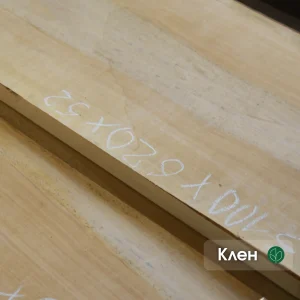
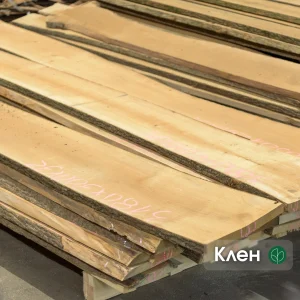
The “Maple Timber” category holds 4 items in the WoodWay Expert warehouse. In stock: thicknesses 32–52 mm; grades Extra, 1.
Kiln-dried boards go into furniture, stairs, worktops, window sills and joinery; waney-edge boards make slabs and design pieces.
Wood is a natural material: shade and figure vary from batch to batch. Ask our manager for current pricing and stock — we will calculate volume and delivery across Ukraine; dispatched from our warehouse.
Edged and unedged maple boards are widely specified for the interior decoration of residential and public premises. Our warehouse stocks solid maple timber with the following technical characteristics:
Self-pickup is available from our facility, alongside reliable delivery across Ukraine via leading freight transport companies. Sales start from a single board. Please contact our sales managers to check the current price per piece or per cubic metre for wholesale volume buyers and retail customers.
This wear-resistant, durable, and highly aesthetic lumber is essential for the commercial production of solid flooring, wall panelling, cabinet furniture, doors, partitions, windowsills, and various structural wood components.
Maple is a premium hardwood species highly valued for its uniform light colour, significant Janka hardness, and signature silky wood texture. The choice between edged and unedged raw material significantly impacts final product cost and the overall manufacturing process.
This timber has undergone full primary woodworking processing: the bark is completely removed, and the cross-section geometry is squared. Edged boards allow production managers to immediately calculate the net yield and usable surface area of the material without hidden defects under the waney edge or bark.
Sawn timber products with preserved natural waney edges and bark serve as the ideal basis for cost-effective, rational cutting plans. Unedged maple boards are typically significantly wider than edged alternatives. This provides production masters with maximum flexibility and freedom of movement when laying out complex templates.
Edged maple lumber is the optimal choice for manufacturing straight-lined contemporary furniture, engineered architectural panels, or musical instruments, where assembly throughput speed and calibrated geometry are essential.
Unedged maple timber is highly suitable if your production line involves numerous shaped components, turned elements, or if your design goal is to create unique, high-margin eco-style furniture.
Maple is often referred to as the woodworker’s “white gold.” This hardwood species is highly valued for its uniform light colour, significant Janka hardness, and ability to be polished to a mirror shine. When grading maple lumber, the primary criteria are colour and clarity: the lighter and more uniform the sawn timber, the higher its commercial grade.
Visual characteristics. The board features a homogenous, uniform surface that is practically bright white or light straw-coloured. The wood texture is silky and completely homogenous. It is entirely free from knots, cracks, and, most importantly, dark mineral streaks or heartwood discolouration typical of lower-grade maple.
Applications. Extra-grade timber is specified for the manufacture of premium-grade furniture, musical instruments (acoustic violin bellies/soundboards, guitar necks), and high-end solid flooring for dance halls and gymnasiums.
Advantages. Provides a seamless, “monolithic” light surface effect. Ensures maximum net usable yield during cutting optimization. Clear lacquering perfectly preserves the natural pale shade of the solid wood.
Visual characteristics. Minor natural colour variations and subtle color shading are permitted. Occasional small, “live” knots (light, sound, and tight/intergrown knots) that do not compromise surface smoothness or structural integrity are acceptable.
Applications. Serial industrial production of furniture fronts, solid wood tabletops, interior doors, stair treads, and handrails.
Advantages. The optimal commercial balance of premium aesthetics and material cost.
Visual characteristics. The board features a highly distinct, prominent grain pattern. The presence of dark (“false”) heartwood, contrasting mineral streaks, sound knots of various diameters and colours, and minor surface checks or small cracks are permitted.
Applications. Manufacture of upholstered furniture frames, structural parts intended for opaque painting, industrial work surfaces, heavy-duty pallets, and loft-style rustic furniture.
Advantages. Provides an ultra-strong structural frame at a minimal budgetary cost. Grade II maple retains the exact same hardness as Extra Grade, making it highly suitable for hidden load-bearing structural elements.
Due to its exceptional resistance to friction, high density, and Janka hardness, edged maple timber is widely specified for the production of heavy-duty floor coverings. Premium solid wood is utilized to manufacture the following types of flooring:
| Engineered Flooring | The product consists of a stable multi-layer structure (typically three layers). The backing base is a solid wood sheet about 1.5 mm thick. The core layer consists of softwood blocks or lamellas glued together perpendicular to the top layer. The top wear layer is solid maple wood, which is pre-finished with hard-wax, oil, or protective lacquer. Engineered boards differ by their wear resistance class and board joining profile (click-lock or tongue-and-groove systems). |
| Solid Wood Flooring | For connoisseurs of traditional, long-lasting floor finishes, solid wood flooring boards are highly recommended. Typically, these floorboards feature a standard tongue-and-groove (T&G) profile on the edges. Tongued boards are straightforward to install: the projection (tongue) on one board is tightly inserted into the matching groove of the adjacent one. Such flooring profiles ensure a seamless covering without gaps or spacing. |
| Decking | For outdoor flooring applications on verandas, gazebos, patios, balconies, garden relaxation areas, or poolside zones, specialized outdoor decking boards (terrace boards) are used. The material features relief grooves on the reverse side and a ribbed, non-slip profile on the face. Several flooring material options are available on the market:
|
|
Ship Decking (Smooth Decking) |
For the construction of piers, boat jetties, garden paths, poolside platforms, loggia floors, open verandas, and exterior terraces, smooth ship decking boards are chosen. This building material does not feature a ribbed surface or relief grooves on the reverse side. Thanks to the distinct bevelled edges (rounded chamfers) of the floorboards, deformation of the decking due to seasonal moisture variations is completely avoided. |
Maple is heavily utilized to produce durable structural elements for upholstered furniture. Thus, solid wood is specified to create frame components, heavy-duty armrests for armchairs and sofas, as well as turned chair legs and backrests. Maple furniture boards are essential in manufacturing solid tops for writing desks, coffee tables, commercial bar counters, and kitchen islands.
Premium furniture frontages made from joinery boards for sideboards, wardrobes, cupboards, wall-mounted units, and floor cabinets are selected for well-thought-out interiors in retro, minimalist, modernist, neoclassical, Scandi, and eco styles. The doors can easily be styled using advanced CNC milling, sanding, intricate carving, staining, and lacquering.
This dense hardwood timber is ideally suited for commercial office furniture. Solid maple excellently withstands intense mechanical loads and heavy daily use. Products manufactured from high-quality maple boards have proven their long-term reliability in corporate offices, conference halls, libraries, hotel rooms, shopping centres, and wellness spa salons.
Square-edged timber is widely used in the production of interior architectural joinery. This premium solid wood is ideal for manufacturing:
To manufacture these high-end products, appearance-grade timber—specifically selected for its aesthetic value—is typically utilized. Stains, waxes, and varnishes can be seamlessly applied to tone the wood, highlighting the natural beauty of the grain pattern and making the material’s color deeper and more saturated.
Maple (Acer) stands are natively found across Southwestern Asia and Central Europe. Approximately 20 varieties of this valuable hardwood species occur in Ukraine, with their natural range covering the Forest-Steppe, the Carpathians, and the Subcarpathian region. Mature maple trees reach a height of 20–35 m, with a trunk diameter ranging from 1 to 1.5 m.
This hard and dense wood is characterized by excellent bending strength. Tough and elastic, solid maple seasons and dries stably without warping or splitting, provided that the correct kiln-drying technology is followed. The clean, smooth machine cut reveals a natural silky luster. Growth rings are clearly visible on the surface, forming a clean, low-contrast subtle pattern. The commercial maple color palette consists of elegant light shades: light beige, cream, and sand.
Solid maple is highly workable and easily machined with standard joinery tools and industrial equipment. The timber can be precisely cut, glued, milled, sanded, polished, stained, painted, and varnished.
WoodWay Expert guarantees streamlined B2B service for both large-scale furniture manufacturers and individual craftsmen. We offer several flexible options for placing an order. Choose the most convenient one for your business:
Our logistics and delivery geography covers the whole of Ukraine, ensuring prompt supply to Lviv, Kharkiv, Odesa, Dnipro, Rivne, Chernihiv, Khmelnytskyi, Zaporizhzhia, Uzhhorod, and other regions.
WoodWay Expert guarantees streamlined B2B service for both large-scale furniture manufacturers and individual craftsmen. We offer several flexible options for placing an order. Choose the most convenient one for your business:
Our logistics and delivery geography covers the whole of Ukraine, ensuring prompt supply to Lviv, Kharkiv, Odesa, Dnipro, Rivne, Chernihiv, Khmelnytskyi, Zaporizhzhia, Uzhhorod, and other regions.