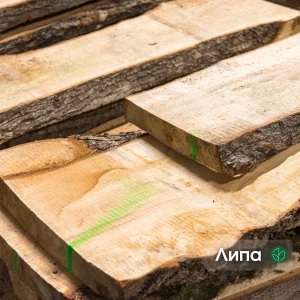
Lime Timber

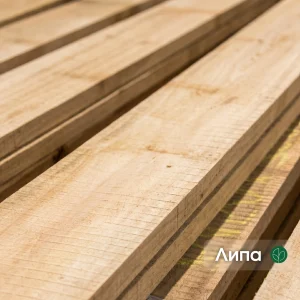
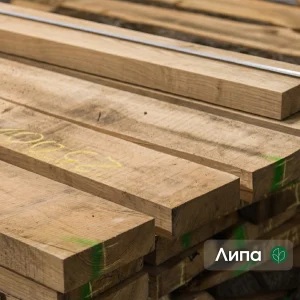
Edged and unedged Lime boards are remarkably easy materials to work with. This light, soft timber is characterised by a uniform texture. The solid wood cuts, saws, glues, sands, and stains without issue. It also takes lacquer finishes perfectly.

Lime edged board 32/52 mm, extra, 8-10%

  • Wood species: Lime
  • Thickness: 32 mm, 52 mm
  • Grade: Extra
549,00  / m³
Type
Edged
Moisture content
8-10%
Width
20+ cm
Length
1–4.5 m

Lime edged board 32/52 mm, grade 1, 8-10%

  • Wood species: Lime
  • Thickness: 32 mm, 52 mm
  • Grade: 1
499,00  / m³
Type
Edged
Moisture content
8-10%
Width
20+ cm
Length
1–4.5 m

Lime unedged board 32/52 mm, extra, 8-10%

  • Wood species: Lime
  • Thickness: 32 mm, 52 mm
  • Grade: Extra
449,00  / m³
Type
Unedged
Moisture content
8-10%
Width
20+ cm
Length
1–4.5 m
Made to order

Lime unedged board 32/52 mm, grade 1, 8-10%

  • Wood species: Lime
  • Thickness: 32 mm, 52 mm
  • Grade: 1
399,00  / m³
Type
Unedged
Moisture content
8-10%
Width
20+ cm
Length
1–4.5 m

Dry Lime Board: How to Buy Edged and Unedged Timber

Edged and unedged linden boards are an easy-to-work-with material.

We offer craftsmen timber products with the following specifications:

  • grade: 1, Extra;
  • length: 1–4.5 m;
  • width: From 20 cm;
  • moisture content: 8–10%;
  • thickness: 32 mm, 52 mm.

Our manager will provide the exact dimensions of the Lime boards. The price of timber products depends on the type, grade, and dimensions.

Please send your technical requirements to our manager. Our specialist will select the material based on volume, size, and texture, and will send photos and specifications of suitable options.

Light soft wood is characterised by a uniform texture. The solid wood is easily cut, sawn, glued, sanded, stained, and varnished. Dry linden boards are used in the manufacture of furniture, finishing materials for walls, ceilings, and floors, as well as lighting fixtures, musical instruments, household items, and home decor.

Joinery Lime Board: Edged or Unedged?

Lime is a soft hardwood species with a homogeneous structure and a pleasant creamy-white hue.

The solid wood is not noted for high mechanical strength like Oak or Ash. However, it is valued by craftsmen for entirely different qualities.

Key Characteristics of Lime Timber

  • Low Thermal Conductivity. Lime does not heat up to high temperatures, even in hot rooms. This makes it the number one material for saunas and bathhouses (it is impossible to burn oneself on Lime).
  • Ease of Processing. The wood cuts in any direction, does not chip, and is optimal for carving.
  • Colour Stability. Over time, Lime does not darken as significantly as coniferous species and does not exude resin when heated.

Edged Lime Board

This timber features processed side edges and is cleared of bark and wane. It is used for the following tasks:

  • Fitting out Saunas and Bathhouses. Boards are used to make shelves, loungers, backrests, floor duckboards, and cladding.
  • Carving and Decor. Lime solid wood serves as blanks for icons, bas-reliefs, souvenirs, and kitchen utensils, as the wood does not impart foreign odours to food.
  • Beekeeping. Frames for hives are created from this timber because Lime is lightweight and retains heat well in winter.
  • Drafting Boards and Models. Pins and tacks enter the soft wood easily.

Unedged Lime Board

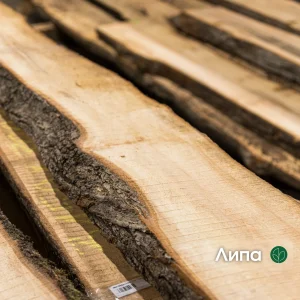
Boards with a preserved natural edge are often used by designers to create an authentic atmosphere. This timber is chosen for:

  • Rustic, Country, Eco, and Loft Style Items. Unedged Lime creates wall and ceiling finishes in sauna relaxation rooms. It emphasises the naturalness of the material and maintains a deliberately rough style.
  • “Live Edge” Furniture. There is demand for benches, massive shelves, or tabletops where the edge of the board retains the natural curvature of the trunk.
  • Economy for Craftsmen. If you carve small figures yourself, it is more cost-effective to buy cheaper unedged boards and cut them into blocks of the required size yourself.

Grades of Lime Board: Selection Criteria

Since Lime is primarily a material for saunas and artistic carving, surface purity plays a decisive role.

Extra Grade (Highest)

A clean surface with a delicate creamy-white or light yellow colour. The face side is completely free of knots, cracks, sapwood, or discolouration.

It is applied in the manufacture of shelves (loungers) and headrests in saunas (where the body directly touches the wood). It is also used for complex artistic carving, icons, and facades.

Grade 1

Timber comparable in strength to Extra grade boards. Single live light knots of small diameter (up to 10–15 mm) are permitted.

Minor natural variations in wood shade that do not spoil the general appearance are also allowed.

This timber is used for cladding to line walls, manufacturing hive frames, furniture facades for staining, and kitchen utensils.

Grade 2

Material for technical needs or specific designs. Dark and fused knots, as well as contrasting spots, are present.

Grade 2 boards are used to create hidden frame elements, rough sub-boarding, and short components. They are also used for interior decor items in a “hunting lodge” or rustic style.

For carving, it is recommended to choose Extra or Grade 1. Knots in Lime are significantly harder than the main wood and can interfere with the chisel.

For sauna fitting, higher grade wood is typically used to avoid the risk of knots falling out and burns (knots heat up more intensely).

7 Reasons to Buy Lime Board at WoodWay Expert

We are a reliable partner. We value mutually beneficial cooperation and have been selling timber materials since 1996. We offer clients:

  1. Constant Material Availability. Lime boards and about 20 other species are represented in our warehouse programme. Visit our warehouse store and select quality timber for projects of varying complexity yourself.
  2. Retail and Wholesale Board Sales. We cooperate with both wholesale and retail buyers. You have the opportunity to buy a single board or order several tens/hundreds of cubic metres. Contact the manager and provide your technical task. You will be sent photos, videos, and specifications of suitable options. Note: Timber is dispatched after full payment.
  3. Assistance in Selection. Specialists help select boards at the warehouse and also select timber remotely. Managers will propose a board that fits by volume, dimensions, type, shade, and texture.
  4. Special Offers for Wholesale. The loyalty programme provides discounts for wholesale buyers. The size of the discount depends on the type and volume of products.
  5. Delivery Across Ukraine, Collection. You can collect Lime boards from the warehouse in Kyiv yourself. We send via transport companies across Ukraine.
  6. Various Payment Methods. You can choose a convenient payment method: cash (receipt) or bank transfer (Sole Trader or LLC with VAT).
  7. Additional Production Services. By agreement with the buyer, we perform rough (transport) cutting of the board bought in our shop. We also provide services such as cutting lists, edge banding, and veneering.

Thanks to the constant availability of materials in stock, we help implement projects of any complexity. Customers receive not only high-quality timber but also professional assistance with selection, additional production services, and convenient cooperation terms. We work with retail and wholesale buyers across Ukraine.

How to Determine How Many Cubic Metres are in a Lime Board?

Timber is measured in cubic metres, so prices are indicated per 1 m³. Let us calculate the volume of a single board.

For example, take an edged Lime board 2.3 m long, 31 cm (0.31 m) wide, and 38 mm (0.038 m) thick.

The standard volume formula is used for calculation: V = a × b × c, where ‘a’ is length, ‘b’ is width, and ‘c’ is thickness.

Substituting the values, we get: 2.3 × 0.31 × 0.038 = 0.027 m³.

Calculations are performed similarly for unedged boards.

What is the Price of Lime Board?

The cost of dry timber depends on the grade, type, and dimensions.

The formula used for calculations is: Price per cube × V of the board. The volume of timber is determined by multiplying length, width, and thickness.

Let us find out how much 1 board costs using specific examples.

Timber Dimensions Calculation
Edged Lime Board Grade 1:

Length: 2.7 m

Thickness: 50 mm (0.05 m)

Width: 18 cm (0.18 m)

Price per cube is, for example, **€549**.

Determine the board volume: 2.7 × 0.05 × 0.18 = 0.024 m³

The price of the board equals:

549 × 0.024 = **€13.18**

Unedged Lime Board, Grade 1:

Length: 3.1 m

Thickness: 45 mm (0.045 m)

Width: 22 cm (0.22 m)

Price per m³ is, suppose, **€399**.

Calculate the volume: 3.1 × 0.045 × 0.22 = 0.031 m³

Determine the cost of timber:

399 × 0.031 = **€12.37**

How Many Lime Boards in a Cubic Metre?

How many boards of a certain size make up 1 cube? To get the answer, apply the formula: N = 1 ÷ V, where N is pieces, and V is the board volume.

Let us ascertain how many 40×300×2900 boards fit in a cubic metre. The first step is to determine the volume, the second is the quantity.

The timber volume is: 0.04 × 0.3 × 2.9 = 0.035 m³.

The number of boards in a cubic metre equals: 1 ÷ 0.035 = 28.57 pieces. Thus, 28 boards of the specified size fit in a cube.

Where are Lime Boards Used?

Edged and unedged Lime boards are suitable for interior finishing works. Timber is used to produce:

  1. Cabinet Furniture. Facades for wardrobes, bedside tables, chests of drawers, sideboards, and tall units made of solid Lime are easily stained. Therefore, furniture can be stylised for various design projects. Elements for chairs, sofas, armchairs, and beds are also created from the wood.
  2. Furniture and Wall Cladding for Saunas. Lime does not overheat, so it is suitable for manufacturing tables, benches, and shelves for the bathhouse or sauna. Lime cladding for bathhouses has also proven itself well. Wood products are covered with special impregnations, oils, and waxes.
  3. Partitions. Light and easy-to-work joinery Lime boards are actively used for erecting non-load-bearing walls. Room partitions, louvre dividers, and screens help highlight functional zones in a space. Constructions are easily decorated (painted, lacquered, stained) and installed.
  4. Kitchen Utensils. There is demand for various kitchen smalls. Organisers for spices and cutlery, knife holders, containers for storing dry products, trivets, fruit serving platters, and sectional dishes are produced from Lime.
  5. Musical Instruments. Lime wood is used in the production of musical instruments. Harp elements, piano keys, and organ reed pipes are manufactured from the solid wood.
  6. Light Fixtures. Designer wooden lamps are a current trend in interior fashion. Light, concise floor lamps, sconces, table lamps, and ceiling lights fit into Minimalism, Loft, Eco, Scandi, Art, and Ethnic settings. Wooden lamps with carved details are chosen for interiors in Neoclassical, Art Deco, Classicism, Rococo, Retro, and Vintage styles.

Various home decor is also created from Lime: frames for paintings and photographs, organisers for jewellery and stationery, boxes, figurines, sculptures, vases for dried flowers, and toys.

Main Characteristics of Lime Wood

Lime (Tilia) is a deciduous tree common throughout Europe. The soft and light wood has a density of about 450–490 kg/m³.

Lime solid wood is stable. Dry wood retains its shape well and is not prone to deformation.

The colour palette includes white, light yellow, and cream shades. The wood has a uniform fine-grained texture. The grain pattern is practically unnoticeable.

The solid wood is easily sawn, planed, drilled, glued, stained, and lacquered. It lends itself well to carving and holds fixings securely.

Lime possesses thermal insulation properties and absorbs sound, contributing to a comfortable microclimate and soundproofing of the room. Timber, plywood, decorative items, and interior objects are created from the wood.

How to Buy Lime Board in Kyiv and Ukraine

We have over 30 years of experience selling timber materials and are ready for various tasks. You can order Lime board from us in a convenient way:

  1. Selection Directly at the Warehouse. A personal visit to our warehouse in Kyiv allows you to examine the Lime boards in detail. You can compare shades, assess the texture character, and decide on the appropriate grade. Warehouse address: 7d Zdolbunivska St, convenient entry from 17e Dniprovska Embankment.
  2. Remote Consultation and Ordering. When it is not possible to visit, selecting timber is easily done online or by phone. Our manager is available at +380 (67) 180-38-13 (Calls, Viber, Telegram). They will select edged or unedged Lime board, calculate the price per piece, and advise on the optimal grade for your specific task.
  3. Placing an Order via the Website. Buying is available directly in the online shop—simply add the required items to the basket. Before dispatch, you will receive current photos of the exact boards being prepared for shipment so you have a complete idea of the material.

We organise the delivery of orders across Ukraine using transport companies.

Important. Handing over timber to the carrier is possible exclusively after full (100%) prepayment of the order.

FAQ: Frequently Asked Questions about Linden Boards

What is the moisture content of Lime board?

We offer kiln-dried joinery board. Standard moisture content is 8–10% (±2%). This is the optimal indicator for using wood indoors (furniture, cladding, decor) and in saunas.

What are the advantages of kiln-dried Lime board over air-dried board?

Kiln drying is a technological process that relieves internal wood stress, minimising the risk of warping and cracking. High temperature in the chamber destroys woodworm and its larvae, as well as fungal spores. The board can be immediately planed, sanded, and glued without additional seasoning.

Why is Lime considered the best material for bathhouses and saunas?

Lime has low density and thermal conductivity. In practice, this means that shelves and cladding made of Lime do not heat up to temperatures that could burn the skin. Furthermore, unlike Pine, Lime does not exude resin when heated.

Is Lime board suitable for carving?

Yes, Lime is the number one material for carvers. Thanks to its softness and homogeneous structure, the solid wood cuts easily in any direction. It does not chip and allows for the detailing of the finest elements. It is optimally suitable for manufacturing decor, souvenirs, and icons.

Does Lime board change colour over time?

Fresh Lime wood has a white or light cream colour. Over time, under the influence of ultraviolet light and oxygen, the solid wood may acquire a yellowish or amber hue. In saunas, due to high temperature and humidity, the darkening process occurs faster. To preserve the original colour, it is recommended to use special oils or waxes for bathhouses.

Is Lime suitable for making beehives?

Yes, Lime is a traditional material for hives. The wood is light (hives are easier to carry), warm (retains heat well in winter), and does not have a sharp resin smell that could irritate bees. For hives, Grade 2 board or unedged board is often taken for economy.

Is it necessary to sand the board additionally before painting?

Before applying oil or varnish, it is recommended to sand the surface (grain 120–150). Lime is a soft wood, so dents or tool marks easily remain on it. Sanding raises the grain and opens the pores for even absorption of the coating.

How to Buy Lime Board in Kyiv and Ukraine

We have over 30 years of experience selling timber materials and are ready for various tasks. You can order Lime board from us in a convenient way:

  1. Selection Directly at the Warehouse. A personal visit to our warehouse in Kyiv allows you to examine the Lime boards in detail. You can compare shades, assess the texture character, and decide on the appropriate grade. Warehouse address: 7d Zdolbunivska St, convenient entry from 17e Dniprovska Embankment.
  2. Remote Consultation and Ordering. When it is not possible to visit, selecting timber is easily done online or by phone. Our manager is available at +380 (67) 180-38-13 (Calls, Viber, Telegram). They will select edged or unedged Lime board, calculate the price per piece, and advise on the optimal grade for your specific task.
  3. Placing an Order via the Website. Buying is available directly in the online shop—simply add the required items to the basket. Before dispatch, you will receive current photos of the exact boards being prepared for shipment so you have a complete idea of the material.


We organise the delivery of orders across Ukraine using transport companies.

Important. Handing over timber to the carrier is possible exclusively after full (100%) prepayment of the order.

FAQ: Frequently Asked Questions

What is the main difference between edged and unedged Lime board?

Edged board has correct geometry: all four sides are sawn, and bark is completely absent or minimal (according to grade tolerances). Edged boards are ready for joinery processing. Unedged board has only two faces sawn, while the side edges remain with bark (waney edge). Unedged material is cheaper and often bought by craftsmen who cut blanks of the required shape themselves, or for creating "live edge" designs.

What is the moisture content of Lime board?

We offer kiln-dried joinery board. Standard moisture content is 8–10% (±2%). This is the optimal indicator for using wood indoors (furniture, cladding, decor) and in saunas.

What are the advantages of kiln-dried Lime board over air-dried board?

Kiln drying is a technological process that relieves internal wood stress, minimising the risk of warping and cracking. High temperature in the chamber destroys woodworm and its larvae, as well as fungal spores. The board can be immediately planed, sanded, and glued without additional seasoning.

Why is Lime considered the best material for bathhouses and saunas?

Lime has low density and thermal conductivity. In practice, this means that shelves and cladding made of Lime do not heat up to temperatures that could burn the skin. Furthermore, unlike Pine, Lime does not exude resin when heated.

Is Lime board suitable for carving?

Yes, Lime is the number one material for carvers. Thanks to its softness and homogeneous structure, the solid wood cuts easily in any direction. It does not chip and allows for the detailing of the finest elements. It is optimally suitable for manufacturing decor, souvenirs, and icons.

Does Lime board change colour over time?

Fresh Lime wood has a white or light cream colour. Over time, under the influence of ultraviolet light and oxygen, the solid wood may acquire a yellowish or amber hue. In saunas, due to high temperature and humidity, the darkening process occurs faster. To preserve the original colour, it is recommended to use special oils or waxes for bathhouses.

Is Lime suitable for making beehives?

Yes, Lime is a traditional material for hives. The wood is light (hives are easier to carry), warm (retains heat well in winter), and does not have a sharp resin smell that could irritate bees. For hives, Grade 2 board or unedged board is often taken for economy.

Is it necessary to sand the board additionally before painting?

Before applying oil or varnish, it is recommended to sand the surface (grain 120–150). Lime is a soft wood, so dents or tool marks easily remain on it. Sanding raises the grain and opens the pores for even absorption of the coating.
View list
Compare