
Order
Place order
Clear the whole list?
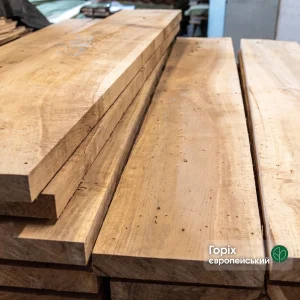
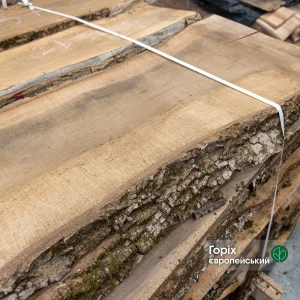
European walnut joinery boards are a valuable timber product used in the furniture industry and interior fit-outs due to their decorative qualities.
European walnut joinery boards are a valuable timber product used in the furniture industry and interior fit-outs due to their decorative qualities. Edged and unedged walnut boards are available with the following specifications:
Delivery across Ukraine is available, as well as collection from our warehouse store in Kyiv. Our consultant managers will provide information on stock availability, the current price per piece and per cubic metre, payment methods, and estimated delivery times.
When choosing European Walnut timber, the determining factor is the grade of the board. This does not affect the basic physical properties of the wood. Instead, the grade shapes the visual perception of the material: texture uniformity, character of the pattern, and the number of natural features.
European Walnut boards of this class have a uniform texture and deep natural colour: from light brown to rich chocolate. The tone is consistent, without sharp contrasts or light inclusions. Knots, cracks, sapwood, and other natural features are completely absent.
This timber is used in premium segment products. It is ideal for exclusive furniture fronts, worktops, staircase elements, decorative panels, and interior details where flawless aesthetics are essential.
Selected board offers maximum useful yield during cutting. It is easily sanded and finished, allowing the natural depth of the Walnut’s colour and texture to be highlighted.
Occasional small, sound, intergrown knots are permitted. Slight natural shade transitions inherent to European Walnut, which do not disrupt the overall integrity, are possible.
This timber is suitable for manufacturing furniture fronts, worktops, door leaves and frames, wall panels, and decorative interior elements.
It is a rational choice for joinery and furniture workshops. The board retains high decorative properties whilst displaying the natural character of the wood. It offers an optimal balance of cost and appearance.
The presence of various natural features is permissible: knots of different types, small cracks, contrasting colour transitions, dark streaks, and spots. The wood pattern becomes more expressive and dynamic.
The board is suitable for painted items, internal furniture elements, tool handles, sub-floors, pallets, as well as furniture in Loft, Eco, or Rustic styles.
This is the most affordable grade. Strong and stable timber allows for the realisation of functional and reliable structures whilst optimising the budget.
Dry edged or unedged European Walnut boards that have undergone a full cycle of kiln drying to a joinery moisture content of 8-10% are materials fully ready for cutting and finishing. We offer raw materials that minimise production risks for joinery shops and furniture factories.
Why choose kiln-dried Walnut?
By choosing kiln-dried boards, you invest in the predictability of the production process. Using stable raw materials with a moisture content of 8-10% allows you to significantly reduce the percentage of technological waste and optimise the cost of the finished product. This is a reliable base for creating long-lasting furniture.
When choosing the type of Walnut board, it is important to consider the specifics of the final product and the technological capabilities of the workshop. Let us consider the features of edged (square edged) and unedged (waney edged) timber.
This is sawn timber from which the bark has been completely removed or is present minimally.
A board with unprocessed edges retains the natural contour of the trunk. In the case of European Walnut, this is particularly valuable due to the contrasting light sapwood along the edges.
The wood has an interesting pattern, which determines the high aesthetic qualities of the material. The palette includes brown shades, often with a cool undertone. The main areas of application for solid European Walnut are described in the table below.
| Area | Application |
|---|---|
| Interior | Furniture boards are used to make tables, chairs, wardrobes, shelving units, cabinets, chests of drawers, shelves, and bed headboards. Statuettes, sculptural compositions, bas-reliefs, picture frames, and other decor items made from solid Walnut look striking. Parquet and wall panels are also made from this wood. |
| Exterior | Solid Walnut belongs to medium-hard species, so it is rarely used for open spaces. If Walnut is used in the design of a veranda, winter garden, or covered terrace, it is usually for decorative elements coated with special protective agents. |
| Industry | Since the wood is easily processed and strong, various household items are produced from it. For example, Walnut is used to create elements of musical instruments, acoustic speakers, tableware, gun stocks, and more. |
Items made from solid wood are a classic choice that adapts to fashion trends without losing relevance. Masters consider solid European Walnut board to be one of the optimal options for crafting interior and exterior items, decor, and cladding materials.
This timber belongs to the valuable species category, featuring an interesting pattern and excellent performance parameters.
Walnut timber is characterised by medium density (640–670 kg/m³) and significant hardness (3.5 Brinell). Thanks to this, it:
Another important feature of European Walnut and its timber is the complex textural pattern. The specific structure of the tree creates differences in the pattern within the growth layers.
This explains the difference in the pattern across various cuts. A tangential cut yields a moiré/arched pattern, whilst a radial cut produces a striped one.
To make the purchasing process as convenient as possible, we offer several ways to place an order. You can use the one that best suits you.
We ship orders to Lviv, Zhytomyr, Kharkiv, Odesa, Ivano-Frankivsk, Dnipro, Rivne, Chernihiv, Khmelnytskyi, Mykolaiv, Zaporizhzhia, Uzhhorod, and other cities. Important: Dispatch of timber is carried out exclusively after 100% prepayment.
To make the purchasing process as convenient as possible, we offer several ways to place an order. You can use the one that best suits you.
We ship orders to Lviv, Zhytomyr, Kharkiv, Odesa, Ivano-Frankivsk, Dnipro, Rivne, Chernihiv, Khmelnytskyi, Mykolaiv, Zaporizhzhia, Uzhhorod, and other cities. Important: Dispatch of timber is carried out exclusively after 100% prepayment.