
Order
Place order
Clear the whole list?
Dry cherry boards are a vital material for the furniture industry. This eco-friendly and easily processed raw material is distinguished by its decorative qualities. Thanks to a pleasant palette of warm shades and expressive patterns, solid cherry is popular among cabinet makers and interior designers.
Dry cherry boards are an important material for the furniture industry. At our warehouse in Kyiv, we stock edged and unedged timber of Extra and I grades. We offer a choice of boards with the following dimensions:
Prices in the catalogue and price list are quoted per cubic metre. We offer collection from the warehouse or delivery via carrier companies throughout Ukraine.
Cherry is a species valued for its warm colour palette and ability to deepen in tone over time. When selecting timber, one focuses on grades—a visual characteristic defined by texture, colour uniformity, and the presence of natural features.
| Grade | Characteristics |
|---|---|
| Extra | Texture is even, fibres are straight. Colouring is uniform. Shade palette ranges from golden-pink to red-brown. Contrasting white sapwood on the face side is not permitted. Knots are absent. Application: Premium furniture facades, musical instruments, veneer, decorative wall panelling. |
| 1 | Texture is expressive; natural growth ring patterns are permitted (tangential and radial cuts). Minor tone variations are possible. Healthy touch of light sapwood is allowed (usually no more than 10-15% of the area or on the reverse side). Light, healthy (intergrown) knots up to 15-20 mm in diameter occur. Application: Worktops, cabinet furniture, doors, stairs, décor elements. |
| 2 | Texture is uneven, with a distinct fibre pattern and swirls. Colour contrast is present. Unlimited amount of light sapwood is permitted. Healthy knots of any size are present, as well as dark knots (sometimes with cracks requiring filling with filler or resin). Application: ‘Live edge’ tables, antique-effect flooring, decorative beams, loft, country, eco, and rustic style items. |
For manufacturing furniture and interior elements from cherry, a joinery moisture content of 8-10% is essential. This is achieved through kiln drying. Using under-dried material (transport moisture 18-20%) or over-dried material (less than 6%) leads to irreversible defects in the finished product.
Here are the main reasons why joiners work with kiln-dried timber:
By purchasing kiln-dried cherry boards, you are not just paying for wood. You receive quality raw materials for products of varying complexity levels.
The choice between square edge and waney edge boards depends not so much on wood quality (it is identical within the same grade), but on the style of the item and the production process.
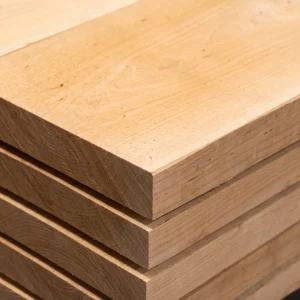
This is material ready for processing. All four planes are sawn, and bark is removed. The main advantage of square edge cherry is the minimisation of sapwood. Since white sapwood in cherry contrasts strongly with the red heart, it is often cut off during production in higher grades.
Select for the following tasks:
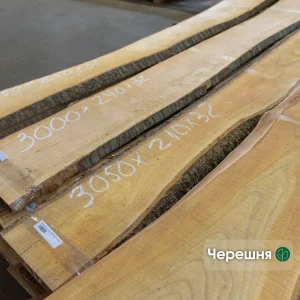
Boards where the side edges retain the natural contour of the trunk, with or without bark. In cherry, the waney edge looks particularly striking due to the sharp colour transition: from dark bark to creamy sapwood and the rich golden-reddish heart. This natural gradient is the main value of unedged material.
Select for the following tasks:
Solid wood cabinet furniture underscores status and can last for generations. Furniture cherry board is used to create worktops, chest of drawer facades, wardrobes, sideboards, chair legs and coffee tables, headboards, and armchair armrests.
Solid cherry lends itself excellently to processing, allowing for the production of furnishings in both classic and contemporary styles. Cherry items are decorated with carving, inlay, painting, and enamel.
Correctly chosen flooring helps set the right mood for a space. Cherry timber is used to manufacture the top layer of engineered parquet. The covering consists of three parts.
The base is a monolithic wood canvas approximately 1.5 mm thick. The middle layer is made of glued softwood blocks. The second layer houses the connection system: tongue and groove or click-lock type. The face layer is decorative. Cherry wood is covered with oil, wax, or varnish.
Traditional floorboards are also made from solid wood. Boards may have a protrusion (tongue) on the edge, which connects to a groove on another board during laying. Tongue and groove floorboards ensure an even covering without gaps or crevices.
Square edge timber is used for the production of wall and ceiling panels, doors, window sills, cornices, and stair elements. A unique product can be made from decorative cherry board obtained through:
Cherry boards can be transformed into an intriguing material for creating exclusive interior elements. Processing techniques make it possible to reveal the natural beauty of the growth rings or adjust the colour palette. Cherry wood is suitable for projects where it is important to combine the reliability of classic timber with artistic design.
A member of the Rosaceae family, the sweet cherry (Prunus avium) is common in warm climates. This deciduous tree grows in Southern Asia, Europe, and North Africa. On average, cherry trees reach 18–24 m in height, with a trunk diameter of around 75 cm.
Cherry is a heartwood species. The sapwood is light, dominated by white, pale yellow, and cream tones. The heartwood is darker, coloured in amber, auburn, brown, and red shades. The solid wood possesses a warm undertone and straight grain. Rays and small pores are visible on a smooth cut.
Cherry timber has medium density (600 kg/m³) and hardness (3.5 Brinell). Solid wood withstands the wear and tear of residential spaces. Cherry is shock-resistant and bends well. Furthermore, the timber is easy to process.
Wood can be sawn, glued, polished, sanded, milled, stained, painted, and varnished without issues. Thanks to the palette of beige-brown tones and distinct pattern, cherry solid wood is valued by furniture makers and designers. Aesthetic interior items are created from both square edge and waney edge boards.
We have organised the ordering process so that every client can choose a convenient purchase format: from personal material selection to online ordering.
Delivery throughout Ukraine is performed by transport companies. Please note: Handover of timber to carriers is carried out only after receipt of full (100%) prepayment.
Calculation formula: Thickness (m) × Width (m) × Length (m) = Volume (m³). For the square edge, multiply all parameters. For waney edge, width is measured at the middle of the board’s length (excluding bark) or as the arithmetic mean of the two end widths. Example: 0.052 m (52 mm) × 0.20 m (200 mm) × 3.0 m = 0.0312 m³.
To get the cost of one board, multiply its volume by the price per cubic metre. Board Volume (m³) × Price per m³ = Cost. Example: if a cubic metre costs 40,000 UAH and the board volume is 0.0312 m³, then: 0.0312 × 40,000 = 1,248 UAH.
We sell boards individually and wholesale. A manager will select the appropriate timber and calculate the cost of a specific board.
Yes, this is a unique feature of cherry. Freshly sawn wood has a light pink or golden hue. Under the influence of UV light, the solid wood darkens over time, acquiring a rich reddish-brown (cognac) shade.
Sapwood is the light strip along the edges of the board. In cherry, it contrasts heavily with the heartwood. In waney edge boards, it is an advantage that highlights naturalness. In Extra grade square edge boards, sapwood is usually not permitted or is cut off, whereas in Grades 1–2, its presence is the norm.
We sell boards exclusively kiln-dried with a moisture content of 8-10%. This is the optimal figure for joinery work. Such wood is stable and ready for gluing and varnishing.
Yes. Thanks to high density and interesting colour transitions (from white sapwood to almost red heartwood), cherry wood looks striking under transparent or coloured resin. The main thing is to thoroughly clean the edge of bark and ensure moisture does not exceed 10%.
We have organised the ordering process so that every client can choose a convenient purchase format: from personal material selection to online ordering.
Delivery throughout Ukraine is performed by transport companies. Please note: Handover of timber to carriers is carried out only after receipt of full (100%) prepayment.