Finger-jointed Pine Solid Wood Panels: Grades, Benefits and Structural
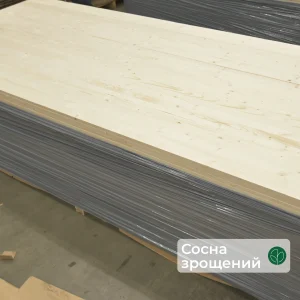
Finger-jointed pine edge-glued panel is an engineered joinery material manufactured from bonded timber staves. Unlike solid stave panels, a finger-jointed board is assembled from shorter pine staves joined together both longitudinally (lengthways) and laterally (widthways).
This manufacturing method allows for the creation of a robust timber panel that is virtually free of internal stresses and possesses a distinctive, mosaic-like grain pattern. Available for purchase by the piece or in bulk (wholesale quantities). Warehouse self-pickup or shipping across Ukraine. Please check available thicknesses and dimensions with our managers.
How is Finger-Jointed Pine Panel Manufactured?
The production process for these panels combines rigorous raw material selection with precise engineering. The creation of the material involves several distinct stages:
- Raw Material Selection. Kiln-dried pine boards are used as the primary stock. Achieving a stable moisture content is the foundation of a high-quality panel.
- Ripping into Staves. Solid pine is ripped into small workpieces (staves). Natural defects such as loose knots, resin pockets, and cracks are removed at this stage to ensure material purity.
- Finger-Joint Milling. A precise serrated profile—the finger-joint—is milled onto the ends of the selected staves.
- Longitudinal Splicing. The segments are joined lengthways using high-strength adhesives and hydraulic presses. This splicing process produces continuous lamellas of the required length.
- Panel Assembly. The spliced lamellas are laid out to create a multi-directional structure. The grain direction in adjacent elements is alternated to counteract natural movement. The staves are then glued along their edges under high pressure. After the adhesive cures, the panel undergoes precision calibration and sanding.
The finished sheet material is stacked onto pallets and protected with industrial-grade wrap for transport.
Advantages of Finger-Jointed Pine Panels over Solid Timber
- Dimensional Stability. Wood is a naturally hygroscopic material. A wide solid pine board contains long fibres that act like bowstrings; fluctuations in humidity cause them to contract or expand, leading to bowing, twisting, or cracking. In a finger-jointed panel, the length of each individual stave is short (typically 200 to 500 mm). Internal tension within each segment is neutralised at the glue joints. This renders the panel practically inert to temperature fluctuations and humidity changes.
- Superior Strength and Durability. Solid pine often harbours hidden structural flaws such as internal shakes, resin pockets, or unstable knots. Under structural load, solid wood may fracture at these weak points. During the production of finger-jointed panels, all structural weaknesses are eliminated. Furthermore, the surface area of the finger-joint bond significantly exceeds that of a standard butt joint, allowing the panel to withstand greater static loads than a solid plank of similar dimensions.
- Aesthetic Versatility. Sourcing long, wide pine boards free of knots or sapstain is extremely difficult and costly. Finger-jointing technology allows for the creation of large-format panels (e.g., 3 or 4 metres in length) with a “clear” surface. The parquet-style construction creates an expressive pattern that highlights the natural richness of the timber’s texture.
- Economic Efficiency and Zero Waste. Working with solid timber requires significant machining allowances, as boards often require heavy planing to rectify warping after drying. This leads to substantial material loss. By purchasing an edge-glued panel, you receive a calibrated and sanded product with precise geometry. The material utilisation coefficient approaches 95–98%, significantly reducing the unit cost of the finished item without compromising quality.
- Enhanced Fastener Retention. Due to the alternating grain direction and the reinforcement of the adhesive layers, a finger-jointed panel provides superior screw and fastener withdrawal resistance. In solid wood, fasteners can loosen over time as they sit between long parallel fibres; in an engineered panel, they are anchored within a stable, multi-layered structure.
Areas of Application for Finger-Jointed Pine Edge-Glued Panels
Finger-jointed pine panels are preferred in applications where dimensional stability is more critical than a continuous grain pattern. This material is widely used to manufacture products such as:
- Staircase Elements. The finger-jointed structure provides exceptional resistance to mechanical loads, making it the optimal choice for treads and risers. The high density of glue joints ensures that steps remain resistant to bowing, cupping, and cracking over time.
- Cabinet and Dresser Carcasses. Finger-jointed panels ensure structural rigidity and provide superior retention for furniture hardware and fittings.
- Worktops. A surface composed of multiple bonded staves is less susceptible to point impacts and deformation than wide solid timber boards.
- Window Sills. Finger-jointed pine is one of the few timber materials that maintain stability even when positioned in close proximity to heating radiators.
- Wall and Ceiling Panelling. The lightweight nature of pine allows for the installation of extensive wooden cladding without placing excessive structural load on walls or ceilings.
- Door Leaves. The stability of the finger-joint construction guarantees that doors will not jam or warp due to seasonal expansion and contraction of the timber.
Classification of Finger-Jointed Pine Panel Grades
The grade of the panel is determined by the visual characteristics of both faces. Because finger-jointed panels consist of numerous staves, correct grade selection allows manufacturers to achieve either a perfectly uniform surface or an emphatically rustic texture.
| Grade
|
Characteristics
|
| 1 (A)
|
The highest quality standard. The face side is “clear”: free of knots, pith, resin pockets, or sapwood. Staves are colour-matched to ensure the transitions between elements are as seamless as possible. This is the optimal choice for clear coatings or light tinting.
|
| 2 (B)
|
The ideal choice for Scandinavian-style furniture. Small “sound” (intergrown) knots and natural shade variations are permitted. These features add authenticity and emphasize the natural timber origin.
|
| 3 (C)
|
A budget-friendly solution with a vivid, rustic character. Large knots, pith, contrasting colour variations, and micro-shallows are permitted. These panels are typically used for internal furniture components or projects requiring a distressed, “aged” look or solid paint coverage.
|
Specifics of Combined «Sandwich» Panels
For applications such as stair treads and heavy-duty worktops, “sandwich” constructions are frequently utilised. These are 40 mm thick panels created by bonding two 20 mm panels of different grades. This is an engineered solution to reduce costs without compromising the visual impact of the finished product.
Popular grade combinations include:
- Grade 1/2 (A/B). The face side features a uniform texture (A), while the reverse displays natural timber characteristics (B). This is the industry standard for window sills and furniture fronts where only one side is visible.
- Grade 1/3 (A/C). Offers maximum cost-efficiency. You obtain a premium face surface, while the reverse side (C) may contain knots. This combination is ideal for stair treads mounted on concrete or steel sub-structures.
- Grade 2/3 (B/C). The most practical option for structural components intended for opaque painting or for use within hidden furniture carcasses.
Regardless of the visual grade (A or C), the technical performance remains consistently high. The structural strength of the finger-joint bond and the equilibrium moisture content (8–10%) are identical across all classes. The grade strictly dictates the visual aesthetics of the material.
Areas of Application for Finger-Jointed Pine Edge-Glued Panels
Finger-jointed pine panels are preferred in applications where dimensional stability is more critical than a continuous grain pattern. This material is widely used to manufacture products such as:
- Staircase Elements. The finger-jointed structure provides exceptional resistance to mechanical loads, making it the optimal choice for treads and risers. The high density of glue joints ensures that steps remain resistant to bowing, cupping, and cracking over time.
- Cabinet and Dresser Carcasses. Finger-jointed panels ensure structural rigidity and provide superior retention for furniture hardware and fittings.
- Worktops. A surface composed of multiple bonded staves is less susceptible to point impacts and deformation than wide solid timber boards.
- Window Sills. Finger-jointed pine is one of the few timber materials that maintain stability even when positioned in close proximity to heating radiators.
- Wall and Ceiling Panelling. The lightweight nature of pine allows for the installation of extensive wooden cladding without placing excessive structural load on walls or ceilings.
- Door Leaves. The stability of the finger-joint construction guarantees that doors will not jam or warp due to seasonal expansion and contraction of the timber.
Pine edge-glued panels are chosen for projects in country, rustic, chalet, and eco styles. A prominent texture, cost-effectiveness, and excellent machinability are the main reasons for the material’s popularity.
Pine Timber: Technical Specifications
Finger-jointed pine panels combine ease of machining with reliable performance metrics, making them a versatile construction material. Pine has an average density of approximately 500–520 kg/m³. Furniture manufactured from pine is sufficiently durable while remaining lightweight, ensuring ease of transport and reduced load on flooring structures.
Softwood timber has low thermal conductivity, meaning pine remains warm to the touch. This provides exceptional comfort when the wood is used for window sills, bed frames, or office desks.
The colour palette is defined by warm tones: from light sandy hues to rich golden amber. Over time, and under the influence of UV light, the timber acquires a sought-after honey patina.
Pine requires a professional approach to surface finishing. Due to the varying hardness between earlywood and latewood (spring and summer growth), the surface must be sanded meticulously to prevent a “rippled” or “washboard” effect.
The material exhibits excellent absorption of pigments and stains. It is highly suitable for toning to imitate more expensive species (such as walnut or rosewood) or for opaque painting. Brushing techniques (distressing) accentuate the grain relief, creating a premium tactile effect.
Why Buy Finger-Jointed Pine Edge-Glued Panels from WoodWay Expert?
We have been operating in the Ukrainian timber market since 1996, providing furniture manufacturers and professional craftsmen with high-quality materials. Our competitive advantages include:
- Inventory Programme. We eliminate lead times for standard orders. Panels in the most popular dimensions and grades are always available ex-stock at our warehouse: Kyiv, 7d Zdolbunivska St. (access via 17e Dniprovska Embankment).
- Remote Material Selection. For clients outside of Kyiv, we provide detailed photographic and video inspections of specific panels via Viber or Telegram, ensuring you are confident in the quality prior to dispatch.
- Value-Added Services. Beyond sourcing panels, you can order precision dimensioning (rough cutting), edge banding, or the veneering of other sheet materials such as chipboard, MDF, and plywood.
- Flexible Payment and Logistics. We support all payment methods, including VAT (NDS) and cash settlements. We facilitate prompt delivery across Ukraine via leading transport and logistics providers.
How to Buy Finger-Jointed Pine Edge-Glued Panels: Three Convenient Ways
We respect our clients’ time, which is why we have developed an ordering system tailored for both urgent retail needs and planned high-volume wholesale supplies.
- Self-Pickup and Personal Selection at the Warehouse (Kyiv). The ideal option for those who wish to personally inspect the sanding quality and select panels based on specific shades or grain patterns. Address: 7d Zdolbunivska St. For heavy goods vehicles, please use the entrance from 17e Dniprovska Embankment. You can receive a technical consultation on-site, complete your payment, and load the material in a single visit.
- Remote Inspection and Selection. If you are located in another region or cannot visit in person, our managers will assist you remotely. Contact us at: +380 (67) 180-38-13 (Viber, Telegram). Provide your technical specifications (grade, thickness, quantity), and we will send a video review of the exact panels assigned to your order, ensuring total transparency.
- Efficient Online Ordering. A streamlined way to reserve high-demand items or large batches 24/7. Select the required parameters in our digital catalogue (panel type, grade, size), add to your cart, and submit the contact form. A manager will contact you promptly to confirm availability and finalize payment terms (Individual Entrepreneur/FOP, LLC/VAT, or cash) and logistics.
To ensure the structural integrity of finger-jointed panels during transit, we utilize heavy-duty industrial packaging. Nationwide delivery is performed by leading logistics companies, and our pre-cutting service is available to simplify transportation for smaller vehicles.