Clear the whole list?
Finger-jointed Ash Solid Wood Panels
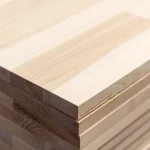
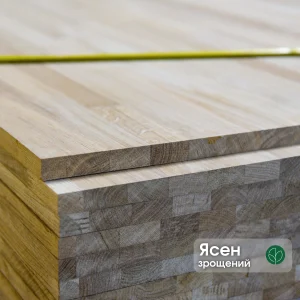
Finger-jointed ash solid wood panels are sheet materials crafted from wooden staves (lamellas) of equal width but varying lengths. Ash solid wood panels are available from stock. A wide range of thicknesses and dimensions is available.
Finger-Jointed Ash Solid Wood Panel, 20 mm, 1-3×0.65 and 1.22 m, Grade 1
- Wood species: Ash
- Thickness: 20 mm
- Grade: 1
- Type
- Finger-jointed
- Moisture content
- 8-10%
- Dimensions
- 1-3x0.65 and 1.22 m
Finger-jointed Ash Solid Wood Panels: Where to Buy, Grades, and Features
Finger-jointed ash solid wood panels are sheet materials crafted from wooden staves (lamellas) of equal width but varying lengths. Ash solid wood panels are available from stock. A wide range of thicknesses and dimensions is available. Self-pickup or shipping across Ukraine.
To achieve the required panel length, these wooden staves are joined using an interlocking profile known as a finger joint.
The segments are glued together and compressed under high pressure. Once dry, the resulting sheet is cut into panels of specific dimensions.
Edge-glued panels are used to create worktops, window sills, staircases, cabinet facades, doors, podiums, bed headboards, and other interior elements.
How to Buy Ash Solid Wood Panels in Ukraine?
Our mission is to provide manufacturers with rapid access to quality timber materials. To purchase finger-jointed edge-glued panels:
- Submit a request via our website;
- Call a manager on +380 (67) 180-38-13 (Viber, Telegram);
- Visit our warehouse at: Kyiv, 7d Zdolbunivska Str. (Entrance via 17 Dniprovska Embankment).
Our specialists work with projects of all scales. Get in touch; we are ready for new challenges.
Varieties of Ash Edge-Glued Panels
Let us clarify how solid wood panels differ from other sheet materials. Chipboard and MDF are made from shavings and adhesive resins, whereas edge-glued panels are manufactured from solid wood staves and glue.
A solid wood panel is a product manufactured from lamellas of uniform width (typically 10-50 mm). Segments selected by size are laid out in a specific order and glued under a press. Finished sheets are calibrated and sawn to the required dimensions.
A glued panel visually resembles solid timber but surpasses traditional solid wood in terms of stability and strength.
Solid wood is prone to cracking and deformation. If drying technology, storage rules, or usage guidelines are not followed, solid wood can dry out and split.
In contrast, a sheet made of glued staves is significantly more rigid and stable. This is due to reduced internal tension, varying grain directions in the staves, and strict quality control during the selection and drying of lamellas.
On the joinery market, you may find glued timber panels marked MR or BWP. Panels marked MR (Moisture Resistant) are used for interior production, while BWP (Boiling Water Proof) is used for exterior works.
The structure of the edge-glued panel depends on the production technology. There are two varieties of the material:
- Finger-jointed solid wood panel. Staves of different lengths are used to manufacture the panel. To obtain a segment of the required length, blocks are spliced across the length using a finger joint (toothed connection). The lamellas are glued by length and width, laid into a single sheet, and compressed. The resulting material is often called “block-style” or “parquet-style bonding”. The surface of a finger-jointed board resembles a patchwork: segments differ in texture and shade.
- Full stave (solid) edge-glued panel. Manufactured from lamellas of identical length, this panel resembles solid timber. The length of the panel equals the length of the stave, with only longitudinal gluing of elements performed. Due to fewer glue lines, the surface of the panel is more uniform. Considering the raw material consumption, full stave panels are more expensive than the finger-jointed variety.
Both types of glued panels are presented in the WoodWay Expert catalogue. Craftsmen choose these materials for their optimal combination of price, operational performance, and decorative qualities.
Finger-jointed Ash Edge-Glued Panels: Features
The finger-jointing technology ensures efficient timber utilization, resulting in a high-strength material with a distinct natural grain pattern. High manufacturing standards and the inherent properties of ash timber ensure the panels deliver excellent characteristics for furniture production and interior millwork.
- Dimensional stability. Thanks to its rigid construction, the material remains stable and withstands temperature and humidity fluctuations in residential environments.
- Wear resistance. Finger-jointed ash panels are robust materials capable of withstanding significant mechanical loads.
- Thermal and acoustic insulation. Installing solid wood panels for wall cladding does more than just solve decoration issues. Wood helps reduce noise levels and regulates the indoor microclimate.
- Decorative appeal. Due to its characteristic “parquet” pattern, finger-jointed ash panels are rarely used in strictly classical interior designs (Baroque, Empire, Classicism). However, for projects without strict aesthetic canons, finger-jointed ash is often the preferred choice. The edge-glued panel, consisting of segments varying in texture and shade, fits perfectly into styles such as Country, Industrial, Loft, Art, Eco, Eclectic, Boho, Scandi, and Retro. Oils and varnishes help reveal the beauty and multifaceted nature of the grain pattern.
- Environmental sustainability. An important characteristic of solid wood panels is their eco-friendliness. Natural wood and certified safe adhesives are used to manufacture the material. Products made from these panels are fully recyclable.
Finger-jointed ash panels combine practicality, durability, and cost-effectiveness, making these edge-glued boards a popular choice for furniture, decorative paneling, and other interior solutions. According to feedback from our clients, the material is highly preferred for projects where structural integrity and a prominent, natural wood texture are essential.
Grades of Finger-jointed Ash Edge-Glued Panels
The grade determines the aesthetic qualities of the material. The density, hardness of the wood, and quality of the gluing are equally high for all categories.
- Grade 1 (A, Select). Each lamella is selected to create a maximally uniform, light surface. The colouring is even: there are no sharp colour contrasts between adjacent staves. Knots, sapwood, dark cores, and cracks are not permitted.
- Grade 2 (B, Nature). Here, ash demonstrates the multifaceted nature of its texture. Contrasting transitions from light sapwood to darker fibres create an expressive pattern. Healthy “live” knots (up to 15–20 mm) and natural shade variations are present, highlighting the natural origin of the material. Lamellas are not matched by tone.
- Grade 3 (C, Rustic). In the case of ash, this grade is often chosen for design purposes rather than economy. The colour gamut ranges from white to dark brown. Dark knots, sapwood, and natural defects that do not affect structural strength are permitted.
Combined grade variants are found in “sandwich” (multi-layer) panels, allowing for rational budget use. A/B — Clean face side and a more variegated reverse surface. A/C or B/C — An optimal solution for stair treads where the bottom is glued to concrete, or for built-in furniture.
Finger-jointed Ash Edge-Glued Panels: Stock Availability
To select quality materials for your projects, please visit our warehouse. Our stock programme includes solid wood panels made of finger-jointed lamellas, with characteristics listed in the table below:
| Thickness, mm | Width, m | Length, m | Grade |
|---|---|---|---|
| 20 / 40 («sandwich») | 0.65 | 1 – 3 | 1 / 1/1 |
A “sandwich” construction, meaning a 40 mm solid wood panel, consists of two glued 20 mm panels. We manufacture thick panels to order. Production requires up to 10 business days. Thanks to the layered structure, the material acquires additional stability.
Finger-jointed Ash Edge-Glued Panels: Areas of Application
Solid wood panels are highly workable: they can be sawn, sanded, tinted, lacquered, and painted. The panels are used for the production of interior joinery, finishing materials, and furniture components. Edge-glued ash is used to create:
- Worktops. Craftsmen often choose edge-glued panels for tables. The distinctive grain of light-coloured ash requires minimal decorative finishing — applying oil or varnish to the surface is sufficient. Ash solid wood panel worktops complement projects in Loft, Industrial, Neoclassical, Scandinavian Modern, Boho, Country, Eco, Art, Fusion, and Shabby-chic styles. Finger-jointed panels are suitable for kitchen islands, bar counters, desks, dining tables, retail counters, and coffee tables.
- Chairs. This wear-resistant material is ideal for various chairs, stools, benches, and ottomans.
- Cabinet Furniture. If sturdy wardrobes, cabinets, or chests of drawers are required, the solid wood panel is the perfect solution. Durable and aesthetic furniture made from edge-glued solid wood lasts for generations.
- Window Sills. Stable, strong, and resistant to fluctuations in humidity and temperature, this material is excellent for wide window sills. To extend service life, the surface is treated with specialized impregnations and lacquered.
- Stairs. Stair treads made from edge-glued panels withstand significant operational loads. To preserve a premium appearance and protect against wear, treads are impregnated with protective agents and finished with high-traffic varnishes.
- Wall Panels. Finger-jointed panels are used for decorative wall cladding. Ash segments assembled into a single sheet offer a variety of shades, textures, and patterns. The multifaceted nature of textures and tones makes the panel an excellent option for accentuating walls in living rooms, studies, halls, or hotel foyers.
- Partitions. Non-structural partitions are an ideal solution when room layouts need to be adjusted. Interior partitions, screens, and sliding or folding structures made of finger-jointed ash are commonly used in open-plan apartments and open-space offices.
This is not an exhaustive list of products made from finger-jointed edge-glued panels. Shelves, doors, drawers, and decorative elements are also manufactured from this material.
7 Reasons to Order Finger-jointed Ash Edge-Glued Panels from WoodWay Expert
We have been operating in the Ukrainian market since 1996 and understand the importance of the right materials. With us, you can do more than just buy solid wood panels on favourable terms. We focus on long-term cooperation and offer our clients:
- Stock Availability. Our stock programme includes 20 mm finger-jointed ash edge-glued panels. Panels with a thickness of 40 mm are produced to order.
- Retail and Wholesale. Glued ash is sold by the sheet, from 1 piece. We fulfil wholesale orders and cooperate with both retail and trade customers. Various formats of solid wood panels are available: the price is quoted per square metre and depends on dimensions and grade.
- Assistance in Material Selection. A manager will help you choose a wooden panel that fits your size, shade, thickness, and texture requirements. Upon request, we send specifications, photos, and videos of the products.
- Special Offers for Trade Customers. We provide discounts to wholesale clients, the size of which depends on the batch volume and product type.
- Collection and Delivery. Ash panels can be collected from our warehouse in Kyiv. We offer prompt dispatch across Ukraine via transport companies.
- Custom Orders. We provide an additional service for rough (transport) cutting of edge-glued panels. Wholesale supplies of non-standard sized materials are possible. Clients can also order cutting maps, veneering, and edging for Chipboard, Plywood, and MDF purchased in our store.
- Convenient Payment. Orders can be paid via cashless settlement (FOP, LLC with VAT) or cash at the warehouse.
For over 20 years, we have helped furniture factories, craft workshops, and joiners complete hundreds of projects of various scales. Our team is here to help—please get in touch.
Solid Ash: Main Characteristics
The distribution area of Ash (Fraxinus) covers Asia, Europe, and North America. Botanists identify approximately 65 varieties of this deciduous tree. Ash is a premium hardwood species. The density of dry wood is 690 kg/m³, with a Brinell hardness of 4.0–4.2.
Dense and resilient solid wood is resistant to splitting and responds well to steam bending. Both manual and industrial tools are used to process ash. The wood is easily sawn, milled, sanded, and glued. When proper technology is followed, it takes tints and lacquers exceptionally well.
The colour palette of the ash heartwood includes shades from near-white to golden, light brown, and olive-brown. The sapwood is lighter. Fibers are generally straight, though logs with interlocked grain are occasionally found. The texture is uniform, featuring a clearly defined grain pattern.
For over 20 years, we have helped furniture factories, craft workshops, and joiners realize hundreds of projects of various scales. Our team is online; please get in touch.
How to Buy Ash Solid Wood Panels in Ukraine?
Our mission is to provide manufacturers with rapid access to quality timber materials. To purchase finger-jointed edge-glued panels:
- Submit a request via our website;
- Call a manager on +380 (67) 180-38-13 (Viber, Telegram);
- Visit our warehouse at: Kyiv, 7d Zdolbunivska Str. (Entrance via 17 Dniprovska Embankment).
Our specialists work with projects of all scales. Get in touch; we are ready for new challenges.