Finger-Jointed Alder Solid Wood Panel: Moisture, Structural Features, Grades, and Applications
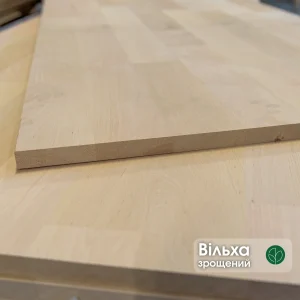
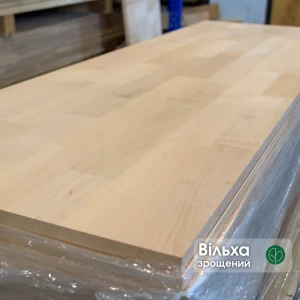
Finger-jointed alder edge-glued panels are robust materials crafted from timber blocks bonded together. These elements are joined across both width and length, creating a stable and rigid construction. Available edge-glued panels are 20 mm thick; 40 mm “sandwich” panels are made to order. In-person collection from the warehouse in Kyiv. Shipping via transport companies across Ukraine is available.
Due to this multi-directional bonded structure, the product demonstrates high wear resistance and withstands significant mechanical loads. The solid wood panel maintains its geometry, resists cracking, and holds fasteners securely.
Furthermore, finger-jointed alder panels retain excellent thermal and sound insulation properties, making them a popular choice for interior fittings.
Since 1996, we have supplied quality timber materials for manufacturing and design solutions. Our clients include furniture factories, private workshops, construction firms, interior designers, and architects.
If you are looking for finger-jointed alder edge-glued panels, we are ready to assist. Please get in touch—we have extensive experience with both wholesale and retail orders, offering a bespoke approach for tasks of any complexity.
Alder Solid Wood Panel: Structural Features
An alder solid wood panel is a material consisting of wooden staves (lamellas) approximately 10 to 50 mm wide, bonded with industrial-grade adhesive. Edge-glued panels compete with solid timber, demonstrating superior stability and resistance to deformation—particularly across large surface areas.
Both materials—solid wood and edge-glued panels—are eco-friendly and valued for their natural texture. However, wide-format solid timber is prone to drying out and warping, especially with fluctuations in humidity and temperature.
In contrast, alder edge-glued panels are resistant to deformation and retain their shape even under intense use, thanks to their multi-directional structure.
There are two types of solid wood panels:
- Finger-Jointed Edge-Glued Panel. This is manufactured from staves of equal width but varying lengths. The elements are joined at the ends using a micro-tenon (finger-joint) method, then glued lengthwise and widthwise to form a stable panel with minimal internal stress. Experts note its high strength due to longitudinal and transverse joints. It features a distinct texture resembling a mosaic pattern or parquet and comes at an affordable cost. Finger-jointed panels are easy to process (sand, stain, varnish) and suit various styles: from Loft, Scandi, and Country to Boho, Retro, and Eclectic. It is particularly popular in projects where the interplay of texture and rich wood patterns is essential.
- Full Stave (Solid Lamella) Wood Panel. This consists of staves of equal length glued exclusively along the sides (edge-glued). Such a panel looks remarkably similar to wide-plank solid timber, distinguished by a uniform texture and even colouring. Advantages include aesthetic uniformity, a premium appearance, and stylistic versatility. The cost of full stave panels is higher due to the rigorous selection of timber required for colour and grain matching.
Whether finger-jointed or full stave, alder solid wood panels are not merely structural elements but a foundation for stylish and durable furniture, cladding, and architectural solutions. The choice depends on aesthetic requirements, budget, and functionality.
Finger-Jointed Alder Panel: Key Advantages
- Resistance to Loads and Sagging. The material is suitable for manufacturing long shelves, racking, and furniture facades, outperforming MDF and Chipboard in rigidity.
- Wear Resistance. Edge-glued panels withstand intense use, making them suitable not only for residential use but also for high-traffic areas: cafes, shops, and offices.
- Sound and Heat Insulation. When used for wall cladding, flooring, and ceilings, the solid wood panel helps improve acoustics and the general microclimate within a room.
- Competitive Pricing. The optimal balance of quality and cost makes finger-jointed alder particularly popular among craftsmen and large-scale manufacturers.
- Decorative Appeal. The variegated surface of the panel harmonises with various design concepts. Alder wood absorbs stains effortlessly, allowing the material to be easily finished to mimic more expensive timber species.
Finger-Jointed Alder Solid Wood Panels: Grades
The classification of a solid wood panel into a specific grade does not affect the material’s structural performance. All grades demonstrate equally high indicators of strength, density, and glue joint quality. The division is used solely to assess visual appearance.
- Grade 1 (A). These panels belong to the premium segment and feature a perfectly clean surface. To achieve visual similarity with solid timber, staves are matched by colour and grain direction. Visual defects are entirely absent.
- Grade 2 (B). A universal solution for most furniture projects. The natural look is formed by soft colour transitions, occasional light sapwood zones, and small live knots up to 10–20 mm in size.
- Grade 3 (C). This material appeals through authentic aesthetics and affordable cost. Contrasting colouring, knots of various types, and barely perceptible micro-cracks emphasise the material’s natural origin.
Features of Combined Markings (A/B, B/B, B/C)
For edge-glued panels, fractional designations are applied to indicate the quality of each face. This scheme allows for a higher grade on the face side while optimising the budget with a more affordable reverse side.
- Combination A/B. This option is most frequently used for staircases and worktops. The visible surface meets Class A requirements, while the Class B reverse side may contain certain natural aesthetic features.
- Combination B/B. When the item remains visible from all sides, it is advisable to choose a panel with surfaces of the same grade. Both sides feature a natural pattern without critical defects.
- Combinations A/C or B/C. These technical solutions are used in situations where one side is not visible or will be completely covered by opaque paint.
Joinery Moisture Content as a Key Factor in Stability
Even the highest grade material will not ensure product longevity if the moisture content (MC) exceeds permissible limits. For interior joinery, a timber moisture level of 8–10% is the industry standard.
This requirement is due to the hygroscopic nature of wood—its ability to constantly interact with the environment. With stable indoor relative humidity at 40–60%, alder panels with a moisture content of 8–10% maintain excellent dimensional stability.
If excessively dried (below 6%), solid wood panels begin to absorb moisture from the air, which can lead to swelling and warping.
Conversely, when the moisture content exceeds 12%, the material will release excess water in a dry living space. This results in fibre shrinkage, cracks, and potential failure of the glue seams.
Dimensions of Alder Edge-Glued Panels
The WoodWay Expert warehouse programme features alder solid wood panels with various parameters. The main specifications are listed below:
| Thickness (mm)
|
Width (m)
|
Length (m)
|
Grade
|
| 20, 40
|
0.65
|
1, 2
|
A, A/B
|
Edge-glued panels with a thickness of 20 mm are available in stock and can be selected personally. Visit our facility or contact a manager for remote selection.
40 mm solid wood panels are manufactured to order. This specific product is a double-layer (sandwich) construction consisting of two 20-millimetre panels. According to customer feedback, such a construction is distinguished by significantly increased rigidity and resistance to heavy mechanical loads.
Applications of Finger-Jointed Alder Solid Wood Panels
The material is suitable for a wide spectrum of design and technical tasks. It can be processed with standard joinery tools and is easily sanded, cut, stained, varnished, or painted.
Edge-glued panels are used to manufacture:
- Furniture. Kitchen island worktops, bar and reception counters, dining and writing desks made from alder panels serve for decades. Wooden wardrobes, chests of drawers, cabinets, shelving units, and bed headboards are chosen for both classic and contemporary projects.
- Architectural Elements. Screens, internal partitions, and sliding structures are used for space zoning. Doors, window sills, and staircases made from alder edge-glued panels are typically finished with wax or varnish to protect the surface from wear.
- Cladding. Solid wood panels are used for wall and ceiling panelling in residential and commercial interiors. The material is ideal for high-traffic premises: hotels, offices, libraries, and conference halls.
WoodWay Expert is your reliable supplier of timber materials with 20 years of experience. We assist with projects of any scale. Call us or leave a request—we are here to help!
How to Purchase Alder Edge-Glued Panels at WoodWay Expert: 3 Options
We offer convenient cooperation formats for both furniture manufacturers and private clients—choose the optimal ordering method:
- Visit the Warehouse in Kyiv. You can view the range and personally assess the quality of the solid wood panels at: 7d Zdolbunivska St . For quick access, follow the turn from Dniprovska Embankment, 17e.
- Remote Selection and Ordering. For clients in other regions, our specialists provide high-resolution photos or videos of the specific material. For consultation, please call +380 (67) 180-38-13 or contact us via Viber or Telegram.
- Online Order via Website. The fastest way to reserve material, especially for high-demand items, is to purchase via the online checkout. Select parameters in the catalogue, leave your contact details, and we will contact you to arrange delivery across Ukraine.
Advantages of Cooperating with WoodWay Expert
- Wide Selection of Timber Materials in Stock. We operate a continuous warehouse programme, ensuring manufacturers have immediate access to high-quality edge-glued panels.
- Remote Selection. For out-of-town clients, our managers select material according to your technical brief, providing detailed visual confirmation and technical specifications.
- Bespoke Orders. We manufacture 40 mm solid wood panels (double-layer construction) to order. Wholesale supplies of panels in custom sizes and configurations are also available.
- Special Offers for Wholesale Buyers. Flexible discount schemes apply to large volume orders, depending on the quantity and specific product type.
- Delivery Across Ukraine and Collection. Materials can be collected from our Kyiv warehouse or dispatched via reliable transport companies to any settlement.
- Additional Services. We offer professional services including rough cutting, cutting list preparation, edging, and veneering of sheet materials (MDF, Chipboard, Plywood).
- Convenient Payment Methods. Orders can be settled in cash at the warehouse (with a receipt) or via bank transfer (for Sole Traders and LLCs, including VAT).
Alder Timber: Main Characteristics
Alder is a soft hardwood species widely used in furniture production and interior finishing. Its Brinell hardness is approximately 3, and its density ranges from 510–550 kg/m³. This deciduous timber features a fine-grained, uniform texture and is practically knot-free.
The colour palette consists of warm pink-red-brown shades. The solid wood is resistant to cracking and is easily cut, sanded, and routed. Alder timber is distinguished by its stability; it does not warp or deform when seasoned and dried correctly.