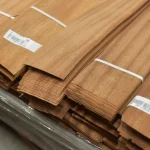
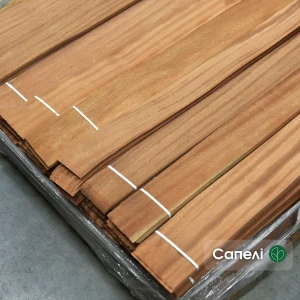
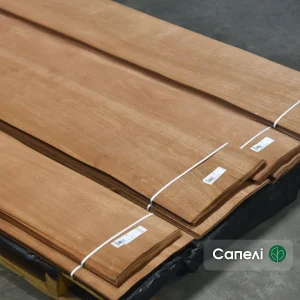
Sliced Sapele Veneer

Sapele is an exotic wood species originating from Central and West Africa. Due to its physical and mechanical properties, alongside its visual resemblance to mahogany, Sapele veneer is classified as a premium material for the furniture industry and interior design.

Sapele veneer 0.6 mm, 1–2 m, grade 1

  • Wood species: Sapele
  • Thickness: 0.6 mm
  • Grade: 1
77  / m²
Type
Sliced

Sapele veneer 0.6 mm, 2–3.8 m, grade 1

  • Wood species: Sapele
  • Thickness: 0.6 mm
  • Grade: 1
On request
Type
Sliced

Sliced Sapele Veneer: Texture, Applications, and Grades

Sapele is an exotic wood species originating from Central and West Africa. Due to its physical and mechanical properties, alongside its visual resemblance to mahogany, Sapele veneer is classified as a premium material for the furniture industry and interior design.

Our warehouse offers sliced Sapele veneer with the following parameters:

  • Moisture content: 8-10%.
  • Grade: 1.
  • Thickness: 0.6 mm.
  • Width: from 9 cm.
  • Length: 1-2 m.

Sapelli veneer can be ordered starting from 1 bundle. The price per bundle is calculated individually, depending on the square metreage and grade. Self-pickup is available, and we ship across Ukraine.

Key Characteristics of Sapele Wood Veneer

Craftsmen highlight the following features of this exotic wood facing material:

  1. Sufficient density. The average density of Sapele timber is approximately 620–650 kg/m³, which is comparable to oak.
  2. Texture and colour. The material features a pronounced natural lustre. The colour palette ranges from light pink to a rich red-brown.
  3. Banding. Due to interlocked grains, a radial cut produces a distinct pattern of uniform light and dark stripes.

Utilising sliced Sapele veneer can reduce manufacturing costs by 5–8 times compared to solid wood, whilst maintaining an identical appearance.

Natural Sapele Veneer vs Fine-Line: What is the Difference?

Choosing between these materials dictates not only the visual outcome but also the longevity and eco-friendliness of the product. Let us compare natural veneer and fine-line (reconstituted veneer) across the following attributes:

  1. Origin. Natural Sapele veneer is a thin slice of solid timber. Every sheet possesses a unique natural grain. Fine-line is manufactured from peeled veneer of cheaper wood species. Sheets are dyed, glued into blocks, and re-sliced to imitate a specific texture.
  2. Pattern stability. Sapele veneer is characterised by a natural sheen. The pattern is formed by stripes that alter in hue depending on the lighting angle. Sheets are bundled in slicing sequence but show minor variations in grain and colour, confirming their authenticity. Fine-line offers a 100% repetitive texture and colour across batches. This is highly convenient for large-scale commercial projects but strips the product of exclusivity.
  3. Technical specifications and wear resistance. Fine-line is less dense, at 350–450 kg/m³ versus 620–650 kg/m³. Natural veneer is 100% Sapele wood, whereas fine-line comprises 80% soft timber, 15% adhesive, and 5% dye. Natural material can withstand multiple sandings, whilst reconstituted veneer has sanding limitations due to its porous base.

For the HoReCa sector and premium furniture, natural veneer is highly recommended. Once varnished, the material endures heavier operational loads. Fine-line is a rational choice for budget-friendly solutions where obtaining hundreds of identical facades is critical.

Natural Sapele Veneer: Quality Grades

Veneer grading is a standardised system for evaluating the quality of finishing materials. It is based on visual characteristics, sheet integrity, and the presence of natural or technical defects. In the woodworking sectors of Ukraine and the EU, the grade dictates both the aesthetic value and the rational application of the veneer.

The grade is determined by the quantity and size of knots (sound, dark, ‘pin knots’), alongside the presence of cracks, fibre distortions, colour variations, or sapwood.

Comparative Analysis of Sapele Veneer Grades

Parameter Grade 1 (A) Grade 2 (B) Grade 3 (C)
Visual Clarity 98–100%. Uniform texture. 85–90%. Slight grain inconsistency and minor fibre distortions are permitted. Under 70%. Indistinct texture with a chaotic fibre arrangement.
Presence of Knots Not permitted. Knots, splits, and medullary rays are absent. Occasional ‘pin knots’ up to 0.5–1 mm in diameter are possible (maximum 1–2 per linear metre). Small, sound, intergrown knots up to 3–5 mm in diameter are acceptable. Unrestricted (sound knots).
Colour Stability High. No abrupt colour transitions. For quarter cuts, parallel banding is standard. Medium. Sapwood may be present as a narrow light band along the sheet edge (no more than 5–10% of the width). Low. Traces of heartwood and pronounced sapwood are visible.
Price Category Premium Standard Budget

Applications for Sapele Wood Veneer

This decorative finishing material is utilised in both mass furniture production and the creation of bespoke art objects. Employing a thin slice of timber instead of solid wood allows for the construction of large-scale items that are resistant to cracking and significantly lighter.

  1. Cabinet furniture. Sapele is considered the benchmark for premium executive furniture and suites. The timber is used for facing cabinet doors, worktops, and visible wardrobe panels.
  2. Wall panelling. When outfitting interiors, veneered MDF panels are deployed to decorate residential zones, conference rooms, and hotel lobbies. Beyond their decorative role, veneered panels enhance a room’s acoustic properties. Sapele pairs beautifully with brass inlays and LED lighting.
  3. Interior doors. Sapele veneer is amongst the finest materials for cladding door leaves. Unlike solid wood, veneered doors maintain a stable shape during humidity fluctuations.
  4. Partitions and decorative screens. Interior partitions decorated with sliced timber offer a simple, aesthetic method to alter a room’s layout. Exotic veneer is also used to adorn screens and mobile partitions, helping to delineate functional zones.
  5. Souvenirs and small decor. Sliced veneer is applied in crafting photo frames, statuettes, jewellery boxes, presentation knife handles, and lamp shades. The thin timber slice is a highly favoured material for marquetry. Mosaic inlays are frequently used to embellish exclusive products.

Due to its striking texture and pinkish-brown palette, sapelli veneer is sometimes used as an alternative to mahogany. After varnishing, veneered surfaces acquire a richer colour.

Manufacturing Technology of Sliced Sapele Veneer

This facing material is produced by slicing flitches (prepared logs) on specialised veneer-slicing machines.

  1. Preparatory stage. Only selected logs are used in production. Initially, they are cut into blocks, cleared of bark, and sawn lengthwise into flitches.
  2. Hydrothermal preparation. The formed blocks undergo thermal treatment, either by boiling in special vats or steaming in autoclaves. This process increases fibre plasticity and reduces internal stress within the timber. After the cycle, any remaining bark is removed from the flitches.
  3. Veneer slicing. The prepared timber block is secured on a machine, where a blade sequentially cuts veneer sheets of a specified thickness.
  4. Drying. Freshly sliced sheets are transferred to drying kilns, bringing the material to a working moisture content of 8–10%. This ensures the stability of the timber veneer.
  5. Grading and packaging. Following the drying process, the veneer is classified by grade, length, and cut type. Selected sheets are bundled into flitches for subsequent storage and transport.

The standard sheet thickness is 0.5–0.6 mm, which is optimal for veneering surfaces without the risk of glue bleed-through.

Sapele Veneer Cut Types: Visual and Technical Differences

  1. Quarter cut (Radial). For Sapele veneer, the quarter cut is the gold standard. The blade passes perpendicularly to the growth rings, through the centre of the log. This results in parallel banding. Due to interlocked fibres, the stripes exhibit varying light reflection coefficients, creating a shimmering effect. Quarter-cut veneer is more stable, but the material yield is lower than that of crown cut.
  2. Crown cut (Tangential). The blade cuts tangentially to the growth rings, at a specific distance from the log’s centre. A characteristic pattern of cones or arches forms on the surface. The texture is broader and less graphic than a radial slice.
  3. Half-quarter cut (Half-radial). An intermediate option where the blade’s tilt angle to the face ranges from 30° to 60°. It combines elements of both types: straight lines on one side of the sheet may smoothly transition into arches on the other. This is often viewed as a compromise, allowing for the rational use of the entire flitch. It boasts good decorative properties but requires careful pattern matching during splicing.

Comparison Table of Sapele Veneer Cut Types

Parameter Quarter Cut (Radial) Crown Cut (Tangential) Half-Quarter Cut
Pattern Stripes Arches Mixed
Stability Coefficient Highest Medium Above average
Lustre Maximum Moderate Partially pronounced
Waste Percentage 20–30% 10–15% 15–20%

Sapele Timber: Fundamental Characteristics

Sapele (Entandrophragma cylindricum) is a highly sought-after exotic hardwood. The tree flourishes in the tropical rainforests of West and Central Africa (from Côte d’Ivoire to Angola, including the Congo River basin). These are giant trees, reaching heights of 30-45 m and trunk diameters of 1–1.5 m, enabling the production of wide, defect-free veneer.

Average density metrics stand at 640–670 kg/m³ (at 12% moisture content). The Brinell hardness rating is 4.1–4.5, which exceeds that of oak. Solid Sapele is resistant to indentations and impact loads. Thanks to its high density and natural oil content, the timber is exceptionally wear-resistant.

Sapele is characterised by impressive bending and compressive strength. The modulus of elasticity is approximately 12,000 MPa. The wood responds well to steam bending, although interlocked grains can cause tension, meaning the bending radius should be moderate.

The species’ decorative qualities are a major market advantage. Freshly sawn solid wood is pink, but upon exposure to light and oxygen, it rapidly adopts a deep red-brown or golden-cedar hue.

The primary distinguishing feature is the interlocked grain, which creates a ‘striped’ pattern on quarter-sawn surfaces. The texture is fine and uniform. Pores are diffuse, ranging from fine to medium.

Due to the interlocked fibres, surface fuzzing may occur during machining. A recommended cutting angle is 15–20°. It readily accepts all types of industrial adhesives (PVA, PU); however, due to resin content, it is advisable to degrease the surface beforehand.

The timber polishes exceptionally well. When clear varnishes are applied, an iridescence effect emerges—a deep, inner glow of the fibres that shifts depending on the viewing angle.

Why Order Sapele Veneer from WoodWay Expert: 7 Reasons

Here is why furniture brands, interior designers, architects, and artisan workshop owners prefer collaborating with us:

  1. Stock availability. Sapele veneer, alongside over 50 varieties of natural veneer, is consistently available at our Kyiv warehouse. Orders are dispatched following payment.
  2. Remote selection. Our account managers can assist you in selecting materials online. Upon your request, we will send photographs and specifications of specific bundles. This allows you to evaluate the actual veneer grain prior to dispatch.
  3. Proper storage conditions. We supply premium material with an 8-10% moisture content. The veneer is stored in a warehouse where the correct microclimate is rigorously maintained.
  4. Wholesale and retail. We are open to partnering with businesses of all sizes. You can order veneer starting from just one bundle. We also efficiently fulfil wholesale supply orders.
  5. Payment options. Clients can settle their accounts at the warehouse in cash (a till receipt is issued) or utilise cashless payment methods (LLC with VAT and Sole Traders).
  6. Collection and nationwide delivery. In addition to the option of personally collecting goods from our warehouse, we arrange delivery via popular couriers to any destination across Ukraine.
  7. Production services. We perform bespoke veneer splicing and custom veneering of board materials (MDF, chipboard, plywood).

We ensure fast access to high-quality timber materials. Over 25 varieties of veneer are available in one place. Our team is ready to select facing materials for projects of any complexity.

Three Convenient Ways to Buy Sapele Veneer in Ukraine

Procuring finishing materials is equally straightforward for independent carpenters and mass production facilities.

  • Visit our Kyiv warehouse. At 7d Zdolbunivska Street, you have the opportunity to independently inspect available flitches, compare hues, and select bundles featuring a specific cut type. The landmark for entry is 17e Dniprovska Embankment.
  • Contact an account manager. The manager’s contact number is +380 (67) 180-38-13 (Viber, Telegram). Ring us or submit an enquiry via messenger applications. Our specialists will prepare photos and videos of items that meet your technical brief.
  • Order via the website. You can order available products directly on the website using the basket feature. Once the application is processed, a manager will ring you back to agree upon the square footage, grade, grain, and cut type.

Get in touch—we are here to help!

FAQ (Frequently Asked Questions)

Why is the price of Sapele veneer higher than oak or ash?

This is driven by the logistical costs of shipping from Africa and the timber’s status. Furthermore, Sapele is considered a premium ‘exotic’ wood, which automatically elevates its market value in comparison to domestic species.

Where in Kyiv can I personally select bundles of Sapele veneer by grain pattern?

You can visit the WoodWay Expert warehouse (Kyiv, 7d Zdolbunivska St.), where various batches of veneer are consistently in stock. This will allow you to precisely match the texture and hue to your specific project.

How does Sapele veneer differ from classic Mahogany?

Sapele belongs to the same Meliaceae family as genuine mahogany but possesses a higher density (circa 640 kg/m³) and greater hardness. Visually, Sapele is distinguished by a more defined ‘striped’ texture, whereas mahogany features a more chaotic grain pattern.

What is the standard Sapele veneer thickness for furniture manufacturing in Ukraine?

The most popular option is veneer with a thickness of 0.5–0.6 mm. This is the industry standard for veneering MDF or chipboard, allowing for high-quality adhesion and sanding.

Which adhesive is best for gluing Sapele veneer?

For professional veneering, it is recommended to use PVA-based adhesives (D3 class) or polyurethane mixtures. It is crucial to avoid excessive application to prevent the glue from bleeding through the veneer pores.

How can I distinguish quarter-sawn Sapele from crown-cut?

With a quarter cut (radial), you will observe distinct parallel lines (stripes) along the entire sheet. A crown cut (tangential) exhibits a pattern composed of arches or broad swirls.

Can Sapele veneer be painted?

This is impractical. Sapele is a valuable, decorative timber species. For painting, it is advisable to choose cheaper, less textured species such as alder or birch. Sapele’s beauty is best revealed under a clear or translucent finish.

View list
Compare