
Order
Place order
Clear the whole list?
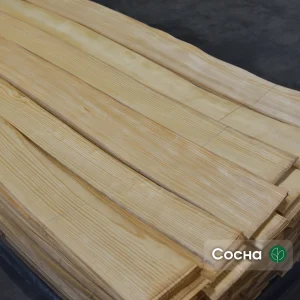
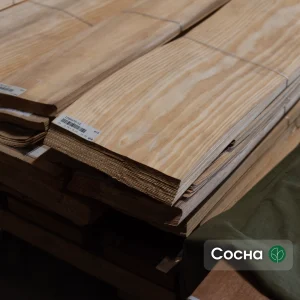
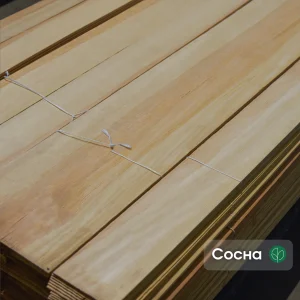
Sliced pine veneer is a natural facing material that is in high demand due to its affordable cost and easy workability. Pine veneer is chosen for finishing furniture, wall panels, skirting boards, cornices, doors, partitions, screens, and other interior items.
Sliced pine veneer is a natural facing material that is in high demand due to its affordable cost and easy workability. Pine veneer is chosen for finishing furniture, wall panels, skirting boards, cornices, doors, partitions, screens, and other interior items.
We stock pine veneer supplied from Ukraine, alongside imported European and American pine. The characteristics of the veneer from our warehouse programme are as follows:
| Veneer Origin | Thickness | Width | Length | Features |
|---|---|---|---|---|
| Ukraine | 1.5 mm, 2.5 mm | from 9 cm | 0.8-3.8 m | A characteristic feature of this veneer is the presence of natural resin pockets, typical for pine from this region. |
| European pine | 0.7 mm | from 9 cm | 2-3.8 m | Due to slow growth in specific climatic zones, European pine features denser annual rings. Low resin content ensures excellent adhesion with varnishes and paints. |
| American pine | 0.6 mm | from 9 cm | 2-3.8 m | American pine is distinguished by wide annual rings. Thanks to its low resin content, the veneer boasts a more uniform, light colour. |
Pine veneer is sold in bundles. The price is indicated per square metre. The cost of a bundle depends on its square metreage and grade. Shipping across Ukraine and self-pickup from our Kyiv warehouse are available.
Pine is a softwood species, which dictates the specific characteristics of its veneer:
When working with pine veneer, the presence of resin (sap) must be considered. For a high-quality finish, preliminary de-resining of the surface is recommended to ensure even bonding with paint and varnish materials.
The choice between natural pine veneer and reconstituted fine-line veneer dictates not only the aesthetics of the product but also its operational durability. Although both materials consist of timber, their production technology and physical-chemical properties differ significantly.
Natural pine veneer is prized because every sheet is unique. The texture features pronounced annual rings and natural colour transitions. Fine-line is produced by gluing and pressing peeled softwood veneer, then slicing the resulting blocks. This yields a consistent colour across thousands of square metres, crucial for mass furniture production, but it diminishes the natural beauty of the wood.
Natural pine contains natural resins, making the veneer more moisture-resistant compared to porous fine-line. When stained, natural veneer absorbs pigment unevenly (depending on the density of early and latewood), creating a three-dimensional effect. Due to its structure, fine-line often requires more primer and varnish, as it acts like a sponge.
Natural veneer may have internal stresses and is sensitive to sudden changes in humidity. Fine-line, thanks to its multi-layered structure and ample glue, is less prone to cracking on curved surfaces. For premium-segment products where the tactile feel of wood is essential, natural veneer is the only choice. Fine-line is better suited for budget projects or where strict colour uniformity is required.
The veneer grade is an indicator of the wood sheet’s quality, determined by the presence, quantity, and size of natural features (knots, cracks, resin pockets) and processing defects. Sorting is carried out manually by specialists immediately after the drying stage.
Used for manufacturing the front surfaces of premium furniture, wall panels, and door leaves.
The optimal choice for mass-produced furniture and interior items where a natural wood appearance with minor nuances is acceptable.
Applied for interior furniture components, rough veneering, or creating interiors in country, loft, rustic, or eco styles, where technological defects become a design element.
| Parameter | 1st Grade (A) | 2nd Grade (B) | 3rd Grade (C) |
|---|---|---|---|
| Healthy knots | Not permitted (or <2 mm) | Up to 15 mm (isolated) | Without restrictions |
| Resin pockets | Absent | Up to 2 mm (closed) | Permitted |
| Colour variation (blue stain) | Not permitted | Up to 5% of sheet area | Up to 30% of sheet area |
A precise understanding of grades helps optimise project budgets. For instance, it is illogical to purchase 1st grade veneer for the back panels of wardrobes, whereas saving on the grade for kitchen fronts could lead to a high scrap rate during cutting.
The manufacturing process is governed by strict standards, ensuring the stability of the material and surface quality. Veneer is produced by slicing flitches, which are specially prepared blocks of timber cut from logs.
The standard thickness of the veneer is 0.5–0.6 mm, which allows for veneering without the risk of glue bleeding through to the front surface.
Using sliced pine veneer instead of solid pine reduces the cost of the final product by 30–50%, whilst maintaining the authentic look of coniferous timber. It is an eco-friendly alternative, as a single log yields tens of times more usable surface area than manufacturing solid boards.
The geometry of natural pine veneer’s pattern directly depends on the slicing direction relative to the log’s axis. The choice of cut determines not only the furniture’s design but also the yield coefficient of the finishing material.
With a radial cut, the slicing plane passes through the pith of the trunk, perpendicular to the annual rings. The texture appears as parallel straight lines. The pattern is highly uniform and minimalist. This material offers the highest stability. The shrinkage/swelling coefficient for radial veneer is 1.5–2 times lower than that of tangential veneer. It is the most labour-intensive method with a high percentage of waste, making such veneer 20–30% more expensive.
The slicing plane runs tangentially to the annual rings, at a certain distance from the pith. It produces the most expressive and “alive” texture. V-shaped patterns (“cones” or “arches”) formed by the annual layers are clearly visible on the surface. It is used where the natural essence of the wood needs to be emphasised. This is a classic choice for rustic or country-style cabinet fronts. Tangential veneer has a higher moisture deformation coefficient, but for 0.6 mm thick veneer glued to a stable substrate (MDF, plywood), this factor is not critical.
An intermediate option where the angle of the annual rings to the veneer plane is between 45° and 60°. The pattern consists of parallel lines that may transition into arcs in one part of the sheet. It combines the aesthetics of the tangential method with the stability of the radial method. It allows for efficient use of raw materials whilst minimising stresses within the wood.
| Cut Type | Ring Angle | Visual Effect | Stability |
|---|---|---|---|
| Radial | 60° – 90° | Straight lines (streaks) | High (best) |
| Half-radial | 45° – 60° | Mixed (lines + half-arcs) | Medium |
| Tangential | < 45° | Pronounced arches, curves, and cones | Satisfactory |
When selecting pine veneer for large wall panels, it is recommended to use a radial cut to create a visually seamless canvas, or a tangential cut using the “book-matching” method to form a symmetrical ornament.
Scots pine (Pinus L.) is a fundamental species in the European woodworking sector. The breed’s popularity stems from an optimal balance between weight, strength, and ease of mechanical processing. Pine covers vast territories across Northern and Central Eurasia. In Ukraine, pine forests are primarily concentrated in Polissya (up to 60% of the region’s forest stock) and the Carpathians. Timber from northern regions and highlands is considered superior due to the higher density of annual rings.
Pine is categorised as a softwood species. The medium-density timber (500 – 520 kg/m³) has a Brinell hardness of 2.1 – 2.5. It possesses good elasticity but is prone to snapping under critical loads. Due to its high resin content and fibre structure, it does not respond well to steam bending. It absorbs impact loads well and is resistant to abrasion only on the radial cut.
The sapwood is wide, pale yellow, or white. The heartwood has a distinct reddish-brown or pinkish hue (especially in mature trees). The texture is clearly defined due to the sharp transition between light earlywood and dark latewood. Annual rings are visible on all cuts. The fibres are straight and long. The wood contains numerous vertical and horizontal resin canals.
As a material for veneer and solid timber, pine has specific characteristics that must be considered during processing. Due to the high content of sap (resin), the surface must be treated with special solvents prior to painting or varnishing. This ensures the adhesion of the topcoat. The material sands easily, however, due to the varying hardness of the layers, a “wavy” effect can occur if excessively soft abrasives are used. It takes wood stains well, though it is prone to uneven absorption. The prior use of a wood conditioner is strongly recommended.
Our partners (furniture brands, architectural bureaus, private craft artisans) highlight the following reasons for collaborating with our team:
The purchasing process for surfacing raw materials is organised to meet the needs of both bespoke furniture makers and large industrial enterprises.
The standard thickness is 0.6 mm. This is the optimal choice for veneering the majority of furniture fronts and doors. For bespoke orders, veneer can be manufactured at thicknesses of 1.5 mm or 2.5 mm.
Pine features a more pronounced annual ring pattern and a broader colour palette (from straw to pinkish-brown), whereas spruce is typically lighter and has smaller knots. Furthermore, pine contains significantly more resin.
When working with pine veneer, it is recommended to use class D3 PVA adhesives (moisture-resistant) or urea-formaldehyde resins (for hot pressing).
This is a natural process of photo-ageing. Under the influence of ultraviolet light, pine timber acquires a rich amber or golden-brown hue. To slow down this process, the use of varnishes with UV filters is advised.
The moisture content of sliced veneer should be between 8–10%. If the moisture is higher, there is a risk of cracking once the product dries; if it is lower, the veneer becomes excessively brittle and may snap during cutting.
Grade A is a clean sheet devoid of knots, resin pockets, and colour changes. It is used for premium front-facing panels. Grade B permits the presence of healthy, intergrown knots and slight shade variations. It is frequently used for internal furniture components or rustic-style items.
Ukrainian pine has a high resin content. Veneer from European suppliers is noted for its high density and uniform structure with a moderate amount of resin. American pine boasts wide annual rings, an expressive pattern, and minimal resin levels.