
Order
Place order
Clear the whole list?
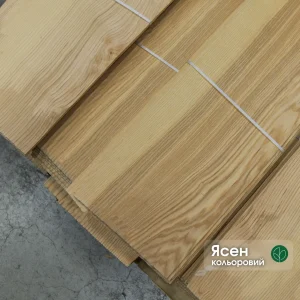
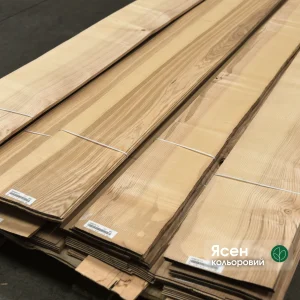
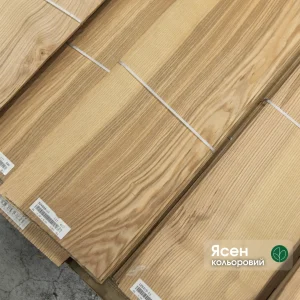
Natural veneer from olive or coloured ash is a surfacing material. It is produced by slicing layers of wood from ash logs that feature a pronounced dark core. Unlike classic white ash, coloured ash is highly valued for its unique contrasting pattern. This striking appearance closely resembles the wood of an olive tree.
Natural veneer from olive or coloured ash is a surfacing material. It is produced by slicing layers of wood from ash logs that feature a pronounced dark core. Unlike classic white ash, coloured ash is highly valued for its unique contrasting pattern. This striking appearance closely resembles the wood of an olive tree.
Our stock programme includes the following finishing materials:
Using sliced veneer allows for the rational use of forest resources. On average, one cubic metre of timber yields 850 square metres of veneer with a thickness of 0.55 mm. Sold starting from 1 bundle. The price per bundle is calculated individually and depends on the square metreage and grade.
Choosing between natural and reconstituted veneer affects not only the aesthetic features of the product but also its operational durability. Let us compare the materials based on key parameters.
| Characteristic | Natural olive/coloured ash veneer | Fine-Line veneer |
|---|---|---|
| Composition | 100% solid wood | Peeled softwood veneer + glue + dye |
| Texture | Unique natural pattern, presence of annual rings | Repetitive, templated ‘ash-like’ pattern |
| Density | 680–750 kg/m³ (high wear resistance) | 450–550 kg/m³ (medium density) |
| Thickness (standard) | 0.6 mm | 0.5–0.6 mm |
| Eco-friendliness | Maximum (natural raw material) | Depends on glue content (up to 15-20% of composition) |
| UV resistance | High (with proper varnishing) | Prone to fading due to dyes in the structure |
Natural olive ash veneer is the priority for products in the premium and luxury segments, where naturalness and uniqueness are valued. Fine-line is advisable for the mass production of serial furniture. In such cases, complete colour uniformity and minimisation of production costs are critical.
The veneer grade indicates the material’s quality. It is determined based on visual characteristics and the presence of natural wood features. In the woodworking industry, sorting allows for the rational use of raw materials.
It clearly differentiates the material by its intended purpose, ranging from facades to hidden structural elements. When evaluating olive ash veneer, the key factors are surface cleanliness, core colour uniformity, and the absence of mechanical damage.
This is the highest quality material, used for the front surfaces of furniture and elite interior solutions. It shows full compliance with the declared cut: a clear radial or harmonious tangential pattern. The colour transitions of the olive core are smooth and balanced.
Occasional ‘eyes’ (up to 2 mm in diameter) are permitted, numbering no more than 1-2 per linear metre. The surface is smooth and without fuzziness. Cracks, rot, and sapwood are completely absent.
This is the optimal choice for elements where moderate natural variability of the wood is acceptable. A slight deviation from the parallelism of lines in a radial cut or a less pronounced arch pattern in a tangential cut is possible.
The presence of sound, intergrown knots up to 5–8 mm in diameter is allowed. There are minor colour changes that do not spoil the overall aesthetic. Micro-cracks on the ends are possible, with a length of no more than 3–5% of the total sheet length.
This is technical veneer applied for internal details and rough facing. It is also used for subsequent painting and for products in rustic, eco, loft, or country styles. It features a chaotic pattern, pronounced contrast, and the possible presence of a ‘wild’ texture.
Black (non-intergrown) knots and medullary rays are permitted. Significant cracks, loose knots, and greater tolerances for surface roughness are also possible.
Olive ash veneer is considered one of the most versatile materials in the premium finishing segment. The contrasting pattern of the core allows for the creation of visual accents that do not require additional toning.
Veneer with contrasting coloration and a distinct grain pattern is chosen for projects in various styles.
In the production of sliced coloured ash veneer, three main types of texture are distinguished. These depend on the angle of inclination of the annual rings to the cutting plane.
With a radial cut, the cutting plane passes through the core of the log perpendicular to the annual rings. The angle of inclination of the rings is from 60° to 90°. The texture is represented by parallel straight lines. In coloured ash, this creates a strict, rhythmic pattern with a clear alternation of light sapwood stripes and dark core stripes.
Radial veneer has the highest stability coefficient. It also demonstrates minimal expansion and contraction rates when humidity changes. This material is often chosen for assembling matched panels over large areas.
The cut passes tangentially to the annual rings at a certain distance from the core. The angle of inclination of the rings is less than 30°. The pattern looks like cones, arches, or wavy swirls.
In olive ash, the tangential cut maximally reveals the decorative ‘marbled’ core. This creates a dynamic and expressive design. Tangential veneer is highly decorative, making it a popular choice for manufacturing furniture facades and wall panels.
This is an intermediate type of cut where the angle of inclination of the annual rings is shifted relative to the central axis. The angle of inclination of the rings is from 30° to 60°. It combines straight lines on one side of the sheet with arc-shaped lines (half-arches) on the other.
This creates a softer transition than in a strict radial cut. It is the optimal choice for projects where it is necessary to preserve the naturalness of the wood without the excessive graphic quality of the radial cut or the randomness of the tangential cut.
When ordering olive ash veneer for a single project, it is important to combine packs with the same type of cut. This guarantees the identity of the core shade and the pitch of the annual rings across the entire facing area.
Olive ash is not a separate botanical species. It is the name for the mature wood of the common ash (Fraxinus excelsior), which during its growth has acquired a characteristic dark core colour. This natural feature makes the wood a popular material for manufacturing premium natural veneer.
The main distribution area of the plant covers Europe, from Scandinavia to the Mediterranean. This includes the regions of Ukraine and the Caucasus. The olive core most often forms in trees over 60–80 years old growing on calcium-rich soils.
Ash is among the three strongest species in the temperate zone. It often surpasses oak in terms of impact toughness and splitting resistance. The density varies from 680 to 750 kg/m³, making it a heavy and strong wood.
The Brinell hardness is 4.0–4.1, which ensures high resistance to dents and mechanical damage. The wood is wear-resistant and exceeds oak by 20% in impact toughness. The material is indispensable for products subjected to dynamic loads.
The aesthetic of olive ash is based on contrast and a pronounced texture. There is a clear distinction between the light yellow (straw) sapwood and the heartwood, which features dark stripes of brown, olive, and grey shades. The fibres are predominantly straight, but they may have a slight waviness where the colour transitions.
The pores are open and deep. Thanks to its high density, the solid wood sands easily, allowing for a smooth surface. The recommended grit is P150-P180. It holds all types of joinery glues (PVA, PUR) well.
Olive ash looks best under oils or wax, which highlight the contrast of the core. When varnishing, it is recommended to use varnishes with a UV filter. This helps prevent the natural yellowing of the wood over time.
WoodWay Expert represents systematic cooperation with a supplier that focuses on the technological requirements of furniture production and actual market demands. Below are seven arguments that determine the choice of our clients, including furniture factories, design studios, and craft workshops.
Cooperation with WoodWay Expert involves not just the supply of material, but a comprehensive approach. We provide consultation on choosing the species, cut type, and optimal sheet thickness, along with recommendations for further processing.
We have organised the process of selecting and purchasing veneer to be equally convenient for serial furniture manufacturers, design studios, and carpentry workshops. Choose the format of interaction that suits your schedule.
Get in touch—our specialists are ready for tasks of any scale and level of complexity.
It is the exact same species (Fraxinus excelsior). ‘Olive’ refers to veneer sliced from the central part of old trees, where a dark (‘false’) core has formed. The material features contrasting brown, greenish, or grey stripes, whereas white ash is distinguished by a uniform light shade.
The most popular veneer has a thickness of 0.6 mm. This thickness provides a sufficient layer for high-quality sanding after gluing. At the same time, it allows for the economical use of expensive raw materials.
Like any natural wood, ash is prone to ‘ageing’. Under the influence of ultraviolet light, light areas can become slightly yellower, and dark areas less contrasting. To preserve the original appearance, we recommend using varnishes with UV filters.
Yes, the material is used for renovating furniture. Ash veneer is easily applied to prepared surfaces, giving old items a premium look.
Radial veneer has a pattern of straight lines and is better suited for modern minimalist interiors. Tangential veneer features an arch-shaped pattern, which is traditional for classic furniture.
It is possible, but usually impractical. The main value of olive ash lies in its natural pattern. If you want to change the colour, it is better to choose standard white ash. Olive ash is typically covered with oil or clear varnish to highlight the ‘marbled’ texture.