
Order
Place order
Clear the whole list?
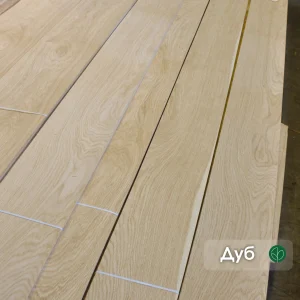
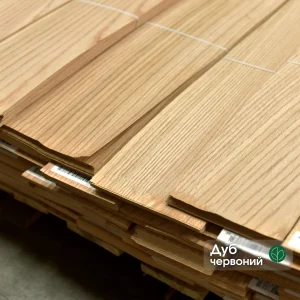
Sliced oak veneer — thin sheets of natural wood for facing furniture, doors, and panels. Grades from extra to 3 and knotty, thicknesses 0.6–2.5 mm, lengths up to 3.8 m. Sold by the bundle; Kyiv pick-up, delivery across Ukraine.
Unlike sawn veneer (lamella), natural sliced oak veneer allows for the most efficient use of raw materials while preserving unique grain texture. Thin wood slices are used to face furniture, doors, partitions, and light fixtures. The veneered surface is virtually indistinguishable from solid wood.
We have oak veneer in stock with the following characteristics:
Oak veneer can be purchased in bundles. The price per bundle is determined based on the grade and square metreage. Self-pickup is available, and we ship across Ukraine via transport companies.
Natural oak veneer is produced by slicing solid oak without altering the natural structure of the fibers. The physical and mechanical properties of oak (at 12% moisture content) are as follows:
The cut has a pronounced texture that retains the visual and tactile qualities of solid wood. The finishing material is characterized by good adhesion to varnishes, oils, and stains. Sliced veneer is a material with a unique pattern used in the premium segment of furniture, doors, and interior panels.
Fine-line is an engineered (reconstituted) veneer made from peeled veneer of fast-growing species (poplar, abachi). The sheets are dyed, glued together into blocks under a press, and then sliced again. Technical characteristics:
The texture of the sheet imitates oak: the pattern is templated, and the coloring is uniform. The material is cheaper, but the glued layers reduce natural vapor permeability. In addition, fine-line is not as resistant to mechanical stress. Fine-line veneering is practical for mass-produced furniture, hotel, and office projects where texture repeatability and budget control are important.
| Parameter | Natural Oak Veneer | Fine-Line |
|---|---|---|
| Origin | Solid oak | Engineered material |
| Density | 680–750 kg/m³ | 450–600 kg/m³ |
| Hardness | 3.4–3.8 (Brinell) | Lower |
| Texture repeatability | Low | 95–100% |
| Visual features | Possible | Absent |
| Color stability | Variable | Controlled |
| Segment | Premium | Mid-range / Economy |
The manufacturing process of sliced veneer is based on strict adherence to a multi-stage technology.
The facing material is stored in a room where a stable microclimate is maintained.
The veneer cut determines not only the aesthetics of the texture but also the stability of the material, its behavior when moisture changes, and its scope of application. The type of cut depends directly on the direction of the cut relative to the log’s annual rings.
A tangential cut is performed tangentially to the annual rings. This is the most common method of veneer production, with a high material yield—up to 80–90% of the log’s usable area. A pattern of arches, cathedral grain (flames), and cones forms on the surface of the sheet. Tangential veneer stands out for its decorative appeal and active texture. This finishing material is chosen for veneering case goods, shelves, doors, and wall panels.
A radial cut is made perpendicular to the annual rings—through the center of the trunk. This is a more technologically complex and less economical method: the material yield is usually 60–70%. At the same time, the material is more stable. The pattern consists of parallel lines. The uniform texture is the optimal choice for mass production or projects with a minimalist design.
A semi-radial (or semi-tangential) cut is an intermediate option. The cutting angle is approximately 30–60° to the annual rings. Such a sheet has a less contrasting pattern than a tangential one. A linear texture is combined with arches. Semi-radial veneer is often used in mass production, where it is necessary to combine cost-effectiveness, stability, and a predictable pattern.
The choice of veneer texture should be based on the technical specifications, stability requirements, and the project’s visual concept. Tangential cutting is chosen for an accent texture, and radial for a uniform surface. If it is important to show the wood grain but an active tangential pattern is not suitable, semi-radial veneer is used.
A thickness of 0.6 mm is considered the standard in furniture production. This is a technically justified balance between durability and cost-effectiveness. This sheet thickness is sufficient to:
Thicker veneer (0.9/1.5/2.5 mm) is used for special tasks where resistance to mechanical stress is important.
Veneer grade classification is based on visual and structural characteristics. The presence of knots, cracks, sapwood, color variations, and texture uniformity is taken into account.
Material with a minimal amount of natural defects. Only small, sound knots up to 3–5 mm in diameter are allowed. The texture is uniform, the fibers are straight, and the color is even without sharp contrasts. Grade 1 means minimal waste during cutting and a clean surface.
Sound knots up to 8–10 mm in diameter are allowed on the surface of the sheet. Slight color variations, sapwood, and areas with uneven grain are possible. The defect area is up to 5–7% per 1 m². Grade 2 veneer is the optimal compromise between price and appearance.
Knots of various types with a diameter of more than 10 mm are present, including loose knots (for restoration). There are pronounced color contrasts and texture variability. The defect area can exceed 10% per square meter. Grade 3 veneer is used for veneering the back of a product or where the natural “liveliness” of oak is part of the design concept.
The grade of sliced oak veneer does not determine the strength of the material, but rather its visual qualities and scope of application. Choosing the right grade allows for optimizing costs and ensuring a predictable result in the production of furniture and millwork.
Oak (Quercus) is one of the most technologically stable and wear-resistant wood species. This hardwood tree is widespread in the temperate climate zone of the Northern Hemisphere.
The density of solid European oak is 680–750 kg/m³. Its Brinell hardness is 3.4–3.8. The modulus of elasticity is 10,000–13,000 MPa, and the bending strength limit is 90–110 MPa. This tough wood handles dynamic loads well. Solid oak is wear-resistant, which is why oak is used in the production of flooring and stairs.
The wood species has a pronounced texture. The fibers are mostly straight, with large pores. The color palette ranges from light yellow to honey-brown shades. Due to its high density, sharp tools should be used when processing solid oak. The surface is easily sanded with P120–P180 grit. Oak is glued with PVA, polyurethane, and urea-formaldehyde glues. It takes oils, waxes, and stains perfectly. Due to its porous structure, the use of primers is recommended for even varnishing.
Buying veneer from WoodWay Expert means partnering with a supplier who understands the specifics of furniture and millwork production and operates with real production needs in mind.
WoodWay Expert provides not only veneer supply but also a comprehensive approach to the needs of furniture and millwork manufacturers.
We have organized the veneer purchasing process to be convenient for both large furniture enterprises and private workshops. You can choose a collaboration format that suits your schedule and workflow.
The most common thickness is 0.6 mm. This is the optimal balance between stability, easy sanding (up to 0.1 mm), and economical material consumption. For special tasks, veneer with a thickness of 0.9 mm, 1.5 mm, 2.5 mm, etc., is used.
The recommended moisture content is 8–10%. Deviations from this range can lead to warping or cracking of the finishing material.
Radial (quarter sliced) has a calm pattern of straight lines and higher stability. Tangential (plain sliced) is characterized by a pronounced “flame” pattern (cathedral grain) and greater texture variability.
Yes. Subject to adherence to veneering technology and stable moisture content of the substrate, oak-veneered interior doors will last for decades.
Grades 1, 2, and 3 are the most commonly used. The difference lies in the number of knots, color variations, and other visual features.
Oak takes stains and oils well thanks to its open pores. However, due to its tannin content, reactions with metal elements or certain chemical compounds are possible, which should be taken into account when selecting a finish.
Subject to adherence to veneering technology and stable operating conditions (air humidity 40–60%), the decorative coating can maintain its performance properties for 15–25 years or more.