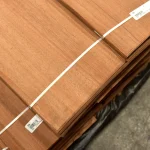
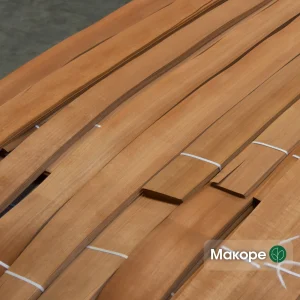
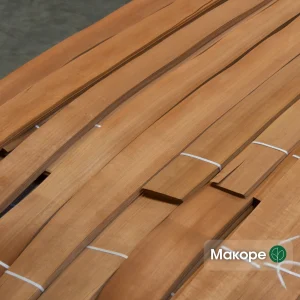
Sliced Makore Veneer

Natural Makore veneer is a finishing material obtained from exotic wood originating from the tropical forests of West and Central Africa. The species is often referred to as African cherry and cherry mahogany due to its remarkably rich colour.

Makore veneer 0.6 mm, 2–3.8 m, grade 1

  • Wood species: Makore
  • Thickness: 0.6 mm
  • Grade: 1
128  / m²
Type
Sliced

Makore veneer 0.6 mm, 1–2 m, grade 1

  • Wood species: Makore
  • Thickness: 0.6 mm
  • Grade: 1
On request
Type
Sliced

Sliced Makore Veneer: Grades, Dimensions, and Applications

Natural Makore veneer is a finishing material obtained from exotic wood originating from the tropical forests of West and Central Africa. The species is often referred to as African cherry and cherry mahogany due to its remarkably rich colour. This exclusive premium-segment veneer is widely utilised in the production of elite furniture, interior panels, and musical instruments.

We currently have Makore veneer in stock featuring the following specifications:

  • With a moisture content of 8-10%.
  • Available in 1st grade.
  • With a thickness of 0.6 mm.
  • With lengths ranging from 2 to 3.8 m.
  • With widths starting from 9 cm.

Available from 1 bundle. The price per bundle is determined based on the square metreage and grade. Self-pickup is available, and we ship across Ukraine via transport companies.

Key Advantages of Makore Veneer for Production

Makore is highly valued for its exceptional density and stability. This dense wood with a uniform texture features an intriguing colour palette, ranging from pale pink to deep red-brown.

Among the main characteristics of the material, the following should be highlighted:

  • Decorative variety. Makore often exhibits specific pattern types, such as “moiré”, “bird’s eye”, or “figured pattern”.
  • Biostability. The wood contains natural silicas that promote resistance to fungi and insects.
  • Simple processing. The veneer is excellently suited for polishing and varnishing.

Utilising sliced Makore veneer allows you to achieve the effect of solid wood while significantly saving valuable raw materials.

Fine-line or Natural Makore Veneer?

The choice between natural sliced Makore veneer and its reconstructed analogue (fine-line) is influenced by budget, durability, and aesthetic value. Below is a comparison of the materials based on key technical and operational parameters.

  • Composition and origin. Natural veneer is a 100% wood slice that preserves structure, colour, and texture. Fine-line veneer is a reconstructed product made from peeled softwood veneer. The sheets are dyed, glued into blocks, pressed, and then sliced at an angle to imitate the Makore pattern.
  • Technical and physical indicators. Natural Makore veneer boasts a high density of 620–700 kg/m³, driven by the species’ natural hardness. In comparison, fine-line shows lower density figures of around 400–500 kg/m³ due to its reconstructed and glued nature. The standard thickness of natural Makore veneer is 0.5–0.6 mm, whereas fine-line varies from 0.35 to 0.6 mm. Natural veneer excels in wear resistance thanks to its natural structure, while fine-line is less resistant to mechanical damage and deforms easily. Furthermore, natural Makore veneer contains no glue, unlike fine-line, which includes up to 10–15% synthetic binders.
  • Decorative differences. Natural veneer possesses a unique texture where the fibre pattern never repeats and varies in every pack. Fine-line features a repeating rapport that provides a predictable result but lacks natural authenticity. The main advantage of natural Makore is its inherent “glassy” shine, which cannot be fully replicated by dyeing. Natural veneer has a pronounced three-dimensionality of fibres, whereas fine-line looks flatter and more graphic.
  • Processing and operation features. Fine-line has higher porosity, absorbing 20-30% more primer and varnish compared to dense natural Makore. Products featuring natural veneer can undergo multiple sanding and restoration cycles. Due to its low base density, fine-line is easier to “sand through” to the glue layer.

Natural Makore veneer is the preferred choice for exclusive products with high added value, bespoke design, and a lifespan exceeding 20–30 years.

Fine-line is suitable for veneering large batches of furniture (for instance, for hotels or offices), where optimising the budget and reducing cutting waste is essential.

Sliced Makore Veneer Grades: Technical Criteria and Differences

Classifying facing materials by grade is a standardised system for evaluating material quality, based on visual characteristics, natural wood features, and geometric accuracy. The grade determines both aesthetics and the material’s intended purpose, directly impacting the final product’s cost calculation. For Makore veneer, being an exotic species, colour uniformity and the absence of mechanical damage are critically important.

Characteristic 1st Grade (A) 2nd Grade (AB) 3rd Grade (B)
Colour and texture Complete shade identity within one pack. The texture is clean and uniform, without abrupt colour transitions. Slight shade variations and sapwood are permitted. Significant colour differences and uneven patterns are present.
Features Natural defects are practically absent. Occasional “eyes” (up to 0.5–1 mm in diameter) are allowed, not exceeding 1-2 per running metre. Small “sound” knots (up to 3-5 mm in diameter) and fibre curls may be present. The number of defects is limited and must not spoil the overall appearance. Intergrown knots, medullary rays, and minor mechanical defects (end cracks up to 5-10 cm) that can be removed during cutting are permitted.
Parameters Sheets possess clear geometry, without waves or fuzziness. The length typically exceeds 2.5–3.0 m, allowing the veneer to be used for wall panels and tall facades. May feature a narrower sheet width, requiring more careful selection when forming a “shirt” or layon. Length and width may be non-standard. The primary advantage of this grade is the minimal price whilst retaining the physical properties of natural Makore wood.

A “Special Grade” also exists for Makore veneer, which encompasses veneer with a pronounced decorative effect, such as pommele. Material with an interlocked texture is valued significantly higher than 1st grade owing to its unique artistic merit.

Where is Natural Makore Veneer Used?

Sliced Makore veneer is a premium finishing material. Veneering allows for the creation of products that are visually almost indistinguishable from solid wood but are significantly more stable and ecologically sustainable.

The primary areas of Makore veneer application in industry and design include:

  1. Cabinet furniture. Makore veneer is a benchmark material for facing facades and visible furniture parts. This exotic species is normally used for decorating executive office furniture and classic bespoke suites.
  2. Interior wall panels. The use of veneered MDF panels is a leading trend in contemporary interior design. Such panels decorate the walls of conference rooms, offices, home cinemas, and hotel lobbies.
  3. Interior doors. A door leaf finished with Makore veneer has the appearance of an expensive solid mahogany product but is devoid of warping risks. Veneered doors are installed in both residential and public premises.
  4. Decorative partitions and screens. Veneered structures assist in altering layouts and highlighting functional zones. Partitions and mobile screens are utilised for zoning in open-plan offices, restaurants, and apartments.
  5. Decor items and musical instruments. Thin wood slices are applied in veneering the bodies of acoustic guitars, pianos, and violins. Makore veneer is frequently used for inlay work (marquetry) in the decoration of luxury yachts and business-class vehicle interiors. The material is crafted into cigar humidors, jewellery boxes, cases, and stationery sets.

We offer furniture and door veneer with consistent moisture content. This high-quality facing material is easy to work with and is stored under proper conditions.

Stages of Manufacturing Sliced Makore Veneer

  1. Preparation of raw materials. Selected wood without signs of rot, cracks, or other external defects is used for production. Logs are cut into required lengths, debarked, and longitudinally cut to produce flitches.
  2. Hydrothermal treatment. Flitches are steamed or boiled to increase fibre elasticity and stabilise the wood’s shade. This treatment reduces internal stresses and minimises the likelihood of cracking during slicing. Afterwards, the blocks are cleaned of remaining bark and dirt.
  3. Veneer slicing. The prepared flitch is secured in a veneer-slicing machine, thickness parameters (usually 0.5–2.5 mm) are set, and feed speed is adjusted. A knife sequentially cuts thin layers across the entire plane, forming the facing material’s texture.
  4. Drying. Sheets have high moisture content after slicing, so they are sent to drying chambers. The material’s moisture is reduced to a working level of 8–10%.
  5. Sorting and packaging. The dried veneer is selected by grade, dimensions, thickness, and type of cut. Colour uniformity, texture clarity, and the absence of production defects are additionally evaluated. After selection, sheets are stacked into bundles, edges are trimmed with a guillotine, and the finished packs are labelled and palletised for storage and transport.

Types of Makore Veneer Cuts: Tangential, Radial, Half-Radial

The textural pattern of sliced Makore veneer depends on the angle of the knife relative to the wood’s annual rings during cutting. Three primary types of cuts are distinguished within the woodworking industry.

Radial Cut

In the radial method, the knife passes through the centre of the trunk perpendicularly to the annual rings. The texture appears as parallel straight lines situated along the entire length of the sheet. Makore in a radial cut frequently displays a striped pattern with alternating light and dark tones. This veneer has the highest stability coefficient and is least susceptible to deformation upon humidity changes. The material is ideal for manufacturing doors, wall panels, and minimalist or classic furniture.

Tangential Cut

The knife moves tangentially to the annual rings at a specific distance from the log’s centre. A pronounced pattern of cones, crowns, and arches forms on the sheet’s surface. It is in the tangential cut that the decorative nature of Makore is best revealed: rich colour and wide annual layers. It is applied for veneering cabinet furniture facades, panels, and doors.

Half-Radial Cut

This is an intermediate option where the angle of the knife to the annual rings is approximately 45°. On one edge of the sheet, lines may be straight (radial), whilst closer to the other, they acquire an arched shape, creating a natural texture transition. The veneer combines the moderate stability of a radial cut with the aesthetics of a tangential one. Application areas include finishing large furniture pieces where avoiding excessive graphic straight lines is necessary to convey the wood’s pattern.

The phenomenon of interlocked grain, or twisting fibres, is characteristic of Makore. The figured wood effect is best manifested specifically on radial and half-radial cuts.

Makore Wood: An Overview of Main Characteristics

Makore (Tieghemella heckelii), known as “African cherry”, belongs to the category of exotic species. The species is predominantly distributed in the humid tropical forests of West and Central Africa. The main exporters are Ivory Coast, Ghana, Nigeria, Cameroon, and Gabon.

Trees reach considerable dimensions, with heights up to 45–55 metres and trunk diameters up to 1.5–2.5 metres. Substantial volumes of veneer with a uniform texture are obtained from these trees. Makore is distinguished by heightened strength and natural biological resistance, making this species suitable for products with elevated operational requirements.

The density metric stands at 620–700 kg/m³. This dense structure provides the material with high mechanical endurance. Brinell hardness ranges between 4.0 and 4.5, surpassing the metrics of oak.

The modulus of elasticity (toughness) is 10,000–12,500 MPa, indicating sufficient rigidity and the material’s ability to maintain its shape under load. Wear resistance is evaluated as high, as the wood is resistant to abrasion and mechanical damage.

The bending capacity is characterised as medium. Concurrently, Makore demonstrates high stability following the drying process. The colour gamut varies from pale pink to a deeply saturated red-brown hue. The sapwood is clearly demarcated and possesses a creamy shade.

The texture is fine and uniform, with fibres typically straight, though interlocked structures are frequently encountered. Pores are minute and evenly distributed. The wood features a pronounced natural silky lustre.

Makore wood contains a significant amount of silica, leading to the rapid blunting of cutting edges. It is strictly recommended to use only tungsten carbide tooling. Despite its high density, Makore glues well with standard PVA and polyurethane adhesives. The exotic solid wood accepts varnishes and waxes brilliantly.

7 Reasons to Order Makore Veneer from WoodWay Expert

We boast over 30 years of experience in the sale of timber materials. We collaborate with furniture factories, design bureaus, architects, construction firms, and craft workshops. We are chosen for the following reasons:

  1. Warehouse programme. Our warehouse inventory includes over 50 varieties of natural veneer, from oak and ash to exotic Makore, Sapele, or American walnut. Orders are dispatched upon payment.
  2. Remote material selection. You can order veneer remotely from us. Send your technical specifications, and our manager will select the appropriate packs, providing photos and videos of the products so you can view the texture and material grade prior to dispatch.
  3. Proper product quality. The veneer packs conform to the stated characteristics: 8-10% moisture content, grade, and dimensions. The finishing material is stored in a warehouse where the correct microclimate is maintained.
  4. Retail and wholesale sales. Our client base ranges from large furniture factories with serial production to private workshops crafting bespoke designer pieces. The minimum order is 1 pack, and we readily fulfil wholesale orders.
  5. Payment options. Clients may pay for their orders in cash at the warehouse, receiving a fiscal receipt, or utilise cashless transfers. We operate with sole traders and limited companies with VAT.
  6. Collection from the warehouse and dispatch across Ukraine. Self-collection from the warehouse is available. For clients from other regions of Ukraine, we have organised a system of daily dispatches via transport companies.
  7. Production services. We offer additional services for materials purchased in our shop. You can order a set of veneer “shirts” (layons), board veneering, detailing, the development of a cutting map, and edge banding.

We provide a comprehensive approach to client inquiries and supply high-quality facing material. With over 20 varieties of natural sliced veneer available in our warehouse, we can select the right option for diverse design projects.

Three Ways to Buy Makore Veneer in Kyiv and Ukraine

To order high-quality finishing materials:

  1. Visit the warehouse. At our wholesale and retail timber materials base, you can independently select materials for your project. Managers will assist in choosing options by texture, dimensions, and colour. The warehouse address is: Kyiv, 7d Zdolbunivska St. To enter the office complex territory, navigate to the address: 17e Dniprovska Embankment.
  2. Contact a manager. Telephone +380 (67) 180-38-13 (Viber, Telegram) and leave a request. You can send your technical specifications directly via messengers. Managers will prepare packs according to the square metreage and provide photos and videos so you can evaluate the texture. Following approval and payment, the material is securely packaged and handed over to transport companies.
  3. Order on the website. The catalogue displays the current veneer prices per square metre. Leave an enquiry, and a manager will contact you to clarify the required square metreage, taking into account the selection coefficient, grade, and texture. We select packs that most closely match in terms of dimensions and colour. After agreement, the manager will issue an invoice.

We have extensive experience in supplying veneer for projects of any scale. Get in touch—we are here to help!

Three Ways to Buy Makore Veneer in Kyiv and Ukraine

To order high-quality finishing materials:

  1. Visit the warehouse. At our wholesale and retail timber materials base, you can independently select materials for your project. Managers will assist in choosing options by texture, dimensions, and colour. The warehouse address is: Kyiv, 7d Zdolbunivska St. To enter the office complex territory, navigate to the address: 17e Dniprovska Embankment.
  2. Contact a manager. Telephone +380 (67) 180-38-13 (Viber, Telegram) and leave a request. You can send your technical specifications directly via messengers. Managers will prepare packs according to the square metreage and provide photos and videos so you can evaluate the texture. Following approval and payment, the material is securely packaged and handed over to transport companies.
  3. Order on the website. The catalogue displays the current veneer prices per square metre. Leave an enquiry, and a manager will contact you to clarify the required square metreage, taking into account the selection coefficient, grade, and texture. We select packs that most closely match in terms of dimensions and colour. After agreement, the manager will issue an invoice.

FAQ (Frequently Asked Questions)

How does Makore veneer differ from standard "mahogany" (Sapele, Mahogany)?

Makore surpasses most types of mahogany in density and hardness. Unlike Sapele, Makore features finer pores and a pronounced natural lustre, allowing for a "mirror" effect during final finishing.

What thickness of Makore veneer is stocked in Kyiv?

Makore veneer is standardly available in a thickness of 0.6 mm. This is the optimal metric for professional veneering; the thickness is sufficient for high-quality sanding, yet the sheet remains elastic enough for covering radiused surfaces.

What is "figured" Makore veneer and why is it more expensive?

This is a veneer exhibiting rare fibre growth anomalies: fiddleback, pommele, or moiré. Such material is highly prized by designers for its unique 3D texture effect.

Which adhesive is best to use for gluing Makore veneer?

We recommend utilising high-quality PVA dispersions (class D3) from Kleiberit. Due to Makore's high density, it is crucial to control pressing pressure (usually 2-5 kg/cm²) and avoid excessive adhesive application.

Is it possible to buy Makore veneer by the sheet?

We sell veneer by the pack, with the minimum order being 1 pack. Because veneer is a natural product, the sheets within a single pack are identical in colour and pattern, guaranteeing the visual integrity of the finished product.
View list
Compare