
Order
Place order
Clear the whole list?
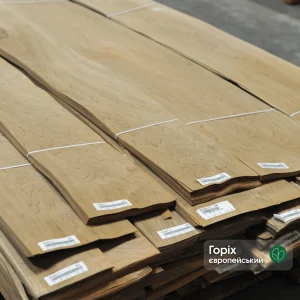
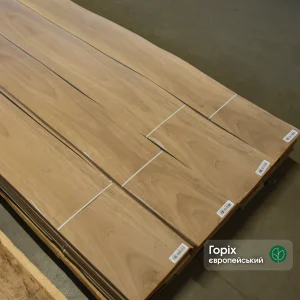
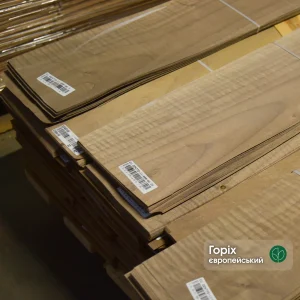
Natural European (walnut) veneer is a material that combines the premium aesthetics of solid walnut with the efficient use of natural resources. European walnut differs from the American variety in colour: tones range from light grey to brown with almost black veins.
Natural European (walnut) veneer is a material that combines the premium aesthetics of solid walnut with the efficient use of natural resources. European walnut differs from the American variety in colour: tones range from light grey to brown with almost black veins. Our warehouse stocks sliced walnut veneer with the following specifications:
From 1 cubic metre of timber, approximately 850 square metres of facing material are produced. This significantly reduces the cost of the finished product compared to using solid wood. You can buy walnut veneer starting from 1 bundle. The price per bundle will be calculated by a manager. You can collect your order via self-pickup. We ship via transport companies across Ukraine.
Let us compare natural European walnut veneer and reconstituted veneer (fine-line). Which material should you choose for serial furniture production or bespoke design projects?
| Characteristic | Natural Walnut Veneer | Fine-line Veneer |
|---|---|---|
| Raw Material | Solid walnut (Juglans regia) | Fast-growing softwood (poplar, ayous) |
| Structure | Continuous solid wood slice | Dyed, glued, and pressed sheets of peeled veneer |
| Density | 640 kg/m3 | 450-550 kg/m3 |
| Thickness (standard) | 0.5-0.6 mm | 0.35-0.8 mm |
| Pattern | Unique, unrepeatable | Stable, repeated on every sheet |
| UV Resistance | High (natural pigments) | Depends on the quality of dyes |
Natural walnut veneer offers a unique pattern and natural transitions of halftones. Thin wood sheets are used to create premium products with bespoke matching (book-matched, slip-matched, reversed, etc.). Fine-line is an imitation of a wood pattern styled “like walnut”. The material provides a walnut texture without defects (knots, sapwood), but it has an artificial appearance.
Fine-line production uses up to 15–20% glues and dyes, which is important for formaldehyde emission certification (E1/E0). Natural veneer is 100% wood. Using reconstituted veneer reduces waste by 20–30% due to the lack of natural flaws and stable sheet sizes. Natural walnut veneer has variable width parameters, requiring experience to minimise offcuts.
For the premium segment, natural European walnut veneer is the only choice due to its authenticity and high density. Mass-market and mid-range furniture production use fine-line, providing predictable visuals with lower preparation costs.
Grading allows furniture makers and designers to select material fitting their project’s budget and aesthetics. Veneer grade indicates sheet quality based on visual analysis: surface cleanliness, colour uniformity, and specific features like sapwood.
This grade is used for premium furniture fronts and decorative panels. Isolated “eyes” up to 2 mm in diameter are permitted (no more than 1-2 per linear metre). The surface is highly uniform in texture and colour, with sapwood usually absent or covering no more than 5% of the sheet.
This is an optimal choice for serial mid-range furniture where natural wood is valued. Healthy (intergrown) knots up to 5–8 mm and a small number of “eyes” are allowed. Slight colour variations and sapwood (up to 15–20% area) may be present, with a less symmetrical pattern than Grade 1.
Used for interior finishing, hidden furniture parts, or rustic, eco, loft, and country style projects. Black loose knots (after restoration), abundant sapwood (over 30%), medullary rays, and mineral inclusions are permitted. Micro-cracks at sheet ends may occur and are removed during jointing.
Sliced European walnut veneer is highly popular in the premium and luxury segments. Using 0.6 mm thick veneer achieves the visual effect of solid wood, saves resources, and ensures structural stability. This facing material is used for:
Walnut veneer is chosen for products with a distinct grain pattern that seamlessly integrates into both classic and modern design projects.
The type of wood cut determines the texture (pattern) and affects the stability of the veneer. There are three main cutting methods, classified by the angle of the annual rings to the cut plane.
In a tangential cut, the knife passes tangentially to the annual rings. A characteristic pattern of crowns, arches, or flames forms on the veneer surface. This is the most decorative cut, showcasing the complex walnut texture.
The angle of the annual rings to the sheet plane is less than 45°. It is used for wall panels or cabinet furniture fronts where a strong accent on natural origin is required.
The knife passes perpendicular to the annual rings, through the heart of the log. A pattern of parallel or nearly straight lines forms on the sheet, appearing monotone, strict, and rhythmic. European walnut clearly shows dark and light stripes with this cut.
The angle of the rings to the face is 60–90°, giving this veneer the highest stability and minimal tendency to warp. It is applied in wall panelling (boiserie), door leaves, and cabinet furniture.
This is a transitional cut combining features of both previous options. The pattern consists of straight lines that may have a slight curve or fade into a blurred crown in one part of the sheet. The angle of the annual rings is between 45–60°.
It serves as a versatile material for facing large areas where excessive strictness is unwanted, yet visual order is needed. When ordering walnut veneer for a single project, it is vital to check grade and cut uniformity within one pack. Mixing radial and tangential sheets on one front disrupts visual integrity and is considered a technical error in the premium segment.
European or English walnut (Juglans regia) is a valuable hardwood from the temperate zone. Its natural habitat covers Southern and Central Europe, the Balkans, Ukraine, the Caucasus, and parts of Asia. In Ukraine, commercially significant trees grow in western and central regions, fostering dense wood with a contrasting pattern.
The timber is classified as medium-heavy, hard, and tough. The solid wood offers high impact resistance and stability after drying, with a density of 640–700 kg/m3 and a Brinell hardness of 3.4. It is tough and resistant to splitting, showing excellent plasticity after steaming for curved elements.
Walnut has a clear distinction between heartwood and sapwood. The heartwood ranges from light grey to dark brown with a chocolate tint and purple veins, while the narrow sapwood is pale yellow or greyish. Pores are medium-sized and visible to the naked eye.
Fibres are usually straight, but wavy or interlocked grain is common, creating a “moire” or “bird’s eye” effect. There is a silky matte sheen that enhances after polishing. It is easily machined or hand-worked, giving a very clean cut, crucial for producing thin sliced veneer.
It accepts all glues exceptionally well, and finishing with oils or wax perfectly highlights the walnut texture. Solid walnut holds screws and nails securely without cracking during hardware installation. European walnut is considered benchmark timber for turning and carving, used in gunstocks, musical instruments, and bespoke furniture.
WoodWay Expert is not just a timber supplier, but a reliable partner. We focus on real manufacturing tasks. Here are seven reasons why our regular clients choose us:
We have extensive experience in the Ukrainian market and are ready for new tasks. Contact our specialists to receive professional consultation and material calculations.
We offer several ways to order facing materials:
We do everything possible to make working with us easy, fast, and convenient. We are ready for new tasks. Get in touch!
These are thin wood sheets obtained by longitudinally slicing prepared European walnut flitches after hydrothermal treatment. It retains the natural pattern of solid wood but is used as a facing layer for panel bases (MDF, chipboard, plywood, blockboard).
The most common veneer thickness on the Ukrainian market is 0.55–0.6 mm. Thicknesses of 1.0 mm or more can be produced for bespoke projects. This depends on the base type, subsequent machining, and sanding requirements.
The species features an expressive colour palette, from light brown to dark chocolate with greyish undertones. The textured surface stands out with a clear pattern and tonal transitions.
European walnut has a calmer, more uniform pattern and lighter shades. American walnut is typically darker and more contrasting. For Ukrainian manufacturers, the European option is often an optimal balance of decoration and cost.
After kiln drying, the moisture content of the veneer is 8–10%. These are the optimal parameters for timber materials.
The species accepts stains and varnishes well. However, due to its rich natural colour, it is frequently used with clear or translucent finishes. Experts recommend prior testing on a sample because of the varying density of late and early wood.
With proper moisture content and adherence to pressing technology, the material demonstrates good stability. Walnut has medium density and sufficient strength, ensuring high-quality processing and minimising the risk of cracking.