
Order
Place order
Clear the whole list?
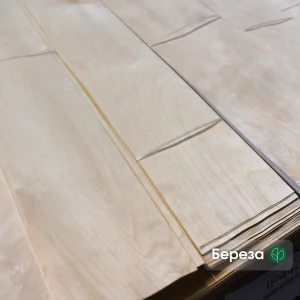
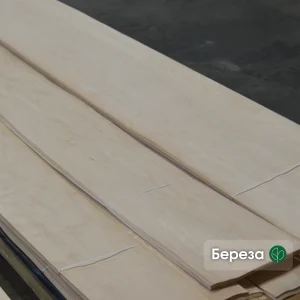
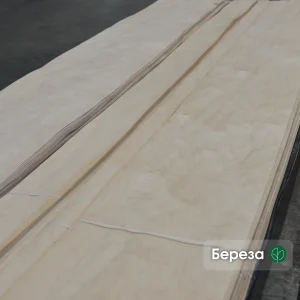
Natural rotary-cut birch veneer is a thin slice of solid wood obtained by peeling a log on special lathes. A continuous ribbon of wood is cut from a rotating log. This manufacturing method allows for the efficient use of raw materials.
Natural rotary-cut birch veneer is a thin slice of solid wood obtained by peeling a log on special lathes. A continuous ribbon of wood is cut from a rotating log. This manufacturing method allows for the efficient use of raw materials.
We offer craftsmen birch veneer with the following parameters:
The facing material is sold in bundles. The price for each bundle is calculated separately, depending on the grade and square metreage. Self-pickup and delivery across Ukraine are available.
Birch is a classic material for peeling, valued for its balance between aesthetics and strength. Craftsmen highlight the following key features of rotary-cut birch veneer:
Thanks to its uniform texture and light colour, this facing material is chosen for both modern and traditional projects. Birch veneer allows for the seamless creation of large components, such as cabinet doors and wall panels.
Birch veneer is produced by peeling solid wood and retains the structure of the solid wood. The formaldehyde content corresponds to the natural level of the wood (class E1 or E0).
Natural veneer features a unique pattern with knots, medullary rays, and other natural characteristics. Natural transitions of tones and halftones are possible. Birch has a high density (about 650 kg/m³). Natural veneer is chosen for projects where eco-friendliness and unique design are priorities.
Fine-line (reconstituted/engineered veneer) is made from rotary-cut veneer of softwood species. The raw material is dyed, glued into blocks, and re-sliced. The surface of such sheets has a repeating pattern and identical color. Thanks to numerous adhesive layers, fine-line is less prone to cracking when veneering radial (curved) surfaces. Choose fine-line if it’s important to ensure the visual identity of hundreds of products and optimize the budget through less waste.
The peculiarity of rotary-cut birch veneer is that the material has a specific pattern that differs radically from sliced veneer. Because the knife cuts a layer of wood parallel to the annual rings (as if unrolling a roll), the pattern comes out wide, blurred, and chaotic.
The texture of peeled birch veneer is well suited for painting or tinting: the absence of coarse fibres allows for a perfectly smooth finish.
Veneer grade is an indicator of the sheet’s surface quality, determined by the quantity, size, and nature of the wood’s natural characteristics (knots, curly grain, discoloration). Classification allows for precisely selecting material for a specific production task: from decorative finishes to hidden structural elements.
| Characteristic | Grade 1 | Grade 2 | Grade 3 |
|---|---|---|---|
| Appearance | Almost perfectly clean surface with a uniform color. | Allows for natural wood patterns that emphasize its naturalness. | Presence of a significant number of natural defects that do not affect the material’s structural integrity. |
| Tolerances | Only occasional sound, light-colored knots up to 3-5 mm in diameter are allowed. Cracks and rot are completely absent. | Sound knots up to 15-25 mm in diameter, small sound loose knots. | Knots (sound and loose/fallen out) with no quantity limit. |
| Discoloration | Not allowed. | Slight discoloration (false heartwood) on no more than 25% of the sheet’s area. | Significant color variations. |
| Application | Intended for face surfaces where aesthetics are a priority. | Furniture production for enamel painting, internal parts of cabinet furniture. | Veneering for painting, production of items in rustic, country, loft, or eco styles. |
The process of manufacturing rotary-cut veneer combines mechanical processing and thermal preparation.
The peeling technology allows for obtaining a significant volume of veneer from a single log. Rotary-cut veneer is considered one of the most cost-effective materials.
The texture of rotary-cut birch veneer is suitable for painting or tinting: the absence of coarse fibers allows for a perfectly even finish.
Birch (Betula) belongs to the diffuse-porous hardwoods. The main industrial reserves are concentrated in the temperate zone of the Northern Hemisphere. For the Ukrainian market, Silver Birch (Betula pendula) and Downy Birch (Betula pubescens), supplied from Polissia and the Carpathians, are of the greatest value. This wear-resistant and medium-density wood (650 kg/m³) has a Brinell hardness of 2.6 – 3.5. The solid wood is characterized by high resistance to fracture under load (bending strength — 110 MPa). Impact toughness is 90 kJ/m²: the material absorbs shocks excellently. Birch stands out for its laconic texture, which aligns with modern trends (Scandinavian style, minimalism). It has a white or slightly yellowish tint, sometimes with a faint pink undertone. The heartwood is almost indistinguishable in color from the sapwood. The texture is fine and uniform, with barely noticeable annual rings. The wood is fine-pored. The fibers are usually straight, but wavy areas can be found. The high toughness of the wood ensures excellent retention of screws and nails. Due to the absence of large pores, birch is a good canvas for painting, tinting to imitate expensive woods (walnut, mahogany), and varnishing.
Cooperation with WoodWay Expert goes beyond the usual purchase of lumber. We build partnerships because we understand the needs of the modern woodworking sector. Below are 7 reasons why furniture companies, architects, designers, and cabinetmakers choose us:
We cooperate with both retail and wholesale customers, ensuring fast access to high-quality facing materials for our clients.
Use one of the suggested options for submitting a request:
We have been operating in the Ukrainian market for over 30 years and are ready to handle tasks of any scale. Contact us—we are at your service!
For the Ukrainian market, 0.6 mm thick veneer is the most relevant. Such sheets do not let glue bleed through, and they can be sanded and varnished.
This is the highest quality category, where the surface of the sheet is practically perfect. Only occasional sound, light-colored knots up to 5 mm in diameter are allowed. Such veneer is used for the face surfaces of furniture that will be coated with a clear varnish.
Rotary-cut veneer is obtained by cutting a continuous ribbon from a rotating log, whereas sliced veneer is cut into individual sheets. Rotary-cut veneer has a chaotic, watercolor-like pattern.
Birch has a light color, making it a “blank canvas.” The wood can be tinted, stained, and painted with enamels.
For veneering on hot or cold presses, class D3 PVA glues are used. Birch has excellent adhesion, which guarantees a strong bond with the substrate (MDF, particleboard, plywood).
Yes, veneer is made from wood. It is an eco-friendly material approved for use in children’s furniture and residential interior finishes.