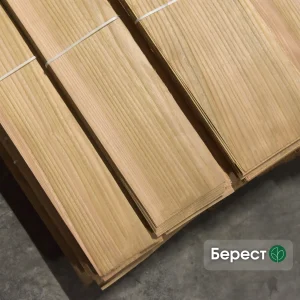
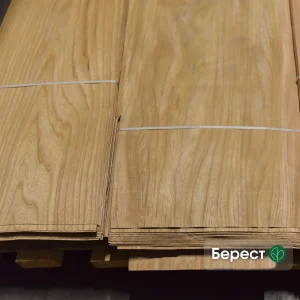
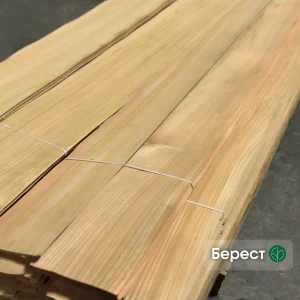
Sliced elm veneer (field elm, wych elm): grades, uses, advantages
Elm veneer features a distinctive grain pattern, making it ideal for bespoke and high-end design items. These thin sheets of solid wood are used to face particleboard, MDF, and plywood, which are then used to manufacture cabinet furniture fronts, interior partitions, and wall panels.
Parameters of the material available in stock:
- sheet thickness — 0.6 mm;
- length — from 0.5 to 3.8 m;
- width — from 9 cm;
- 1st grade;
- moisture level — 8–10%.
We sell sliced veneer in bundles. Wholesale supply is available. The price per bundle depends on dimensions and grade, and is calculated individually. Self-pickup is available. We ship across Ukraine via courier services.
Features of sliced elm veneer
- Distinct grain. Elm has one of the most recognizable grains among hardwoods. Thanks to clearly defined annual rings, in a tangential cut, it forms patterns of arches and flames.
- Rich palette. The color palette of elm ranges from light beige and golden-sand to rich dark brown with a reddish tint. This diversity allows you to integrate the veneer into any style: from understated Scandinavian to brutal loft or cozy country.
- Easy processing. Elm veneer is easy to finish. The wood cut evenly absorbs stains, which allows you to emphasize the expressiveness of the pattern. The finishing material is coated with oils and varnished.
- Eco-friendliness. Using veneer instead of solid wood allows for the rational use of valuable forest resources. Veneer-faced boards (MDF, chipboard) are much more stable than solid wood: they do not change geometry with humidity fluctuations.
5 features of 0.6 mm thick elm veneer
A thickness of 0.6 mm is considered the standard for natural sliced veneer. This indicator is a balance of aesthetics, reliability, and economic feasibility.
Here are the main reasons why furniture manufacturers choose facing material of exactly this thickness:
- Glue barrier. A 0.6 mm thick sheet is a physical barrier that prevents glue bleed-through to the face side of the finish.
- Sanding allowance. Manufacturing a quality product involves a sanding stage. Veneer with a thickness of 0.6 mm allows you to level minor differences at the joints of the matched faces, delicately calibrate the surface, and apply varnish.
- Pliability. Veneer with a thickness of 0.6 mm retains the natural flexibility of wood fibers. This allows the material to be used not only for flat facades but also for veneering curved elements, cornices, and complex profiles. Thinner material can crack, and thicker material can be too rigid.
- Rational use of wood. The slicing method allows you to get the maximum amount of usable material from one log. A thickness of 0.6 mm ensures a high product yield ratio. From 1 cubic meter of solid wood, approximately 850 sq. m. of 0.55 mm thick veneer is obtained.
- Structural stability. Sliced veneer with a thickness of 0.6 mm is less prone to internal stresses. The sheets adhere reliably to the substrate, do not delaminate over time, and behave stably under conditions of changing humidity in living spaces.
For assembling veneer lay-ups, craftsmen use gummed tape. Veneering panels provides a stable and aesthetic substrate for manufacturing cabinet furniture, room dividers, wall panels, and more.
Sliced elm veneer: grades
| Grades
|
Material features
|
| 1 (A)
|
This is a top-category material designed for visible surfaces where wood is the main accent. The grain is clear, distinct, with a regular pattern of annual rings. The coloring is uniform, without sharp color transitions. Only the natural change in shade characteristic of solid elm is allowed. The surface is clean. Knots, cracks, rot, or pitch pockets are excluded. A minimal number of “pin knots” (up to 2-3 mm in diameter) is allowed, which only emphasizes naturalness. It is used for the manufacture of premium furniture facades, wall panels, and doors.
|
| 2 (B)
|
This grade is chosen by designers who want to emphasize the natural origin of the material or work in a loft or rustic style. The grain is more active and chaotic. Significant fiber deviations can be observed, which adds uniqueness to the product. There is a pronounced play of colors. The presence of sapwood (lighter areas of wood) is allowed, which creates a contrasting pattern. There are sound (intergrown) knots of small diameter, small pitch pockets, and mineral streaks (dark lines). All these elements are part of the natural design and do not affect durability. The sheets are used to veneer internal parts of furniture, side panels, and eco-style furniture where natural imperfection is valued.
|
| 3 (C)
|
A budget-friendly option where performance functions take precedence over visual perfection. The grain is heterogeneous, with a large number of visual features. High contrast, significant stains, and color variations over the entire sheet area. Large knots (including black ones), pronounced sapwood, and significant mineral streaks are allowed. The material is stable but has a rustic look. Scope of application: rough veneering, backing of panels (balancing layer).
|
Where is elm veneer used?
- Cabinet furniture. The material is suitable for veneering the facades of wardrobes, dressers, kitchen cabinets, and living room furniture. Veneered products visually do not differ from solid wood, but they are significantly lighter and more stable in varying humidity conditions.
- Wall panels. The complex grain of elm with characteristic arches and cones makes the veneer an interesting option for creating accent wall panels. Decorating offices, hotel lobbies, or living rooms with such material adds status to the space.
- Interior doors. Door leaves veneered with elm have a premium look and become a central element of the interior. The material harmoniously combines with massive metal hardware and glass inserts.
- Decor items. Elm veneer is often chosen for the manufacture of exclusive accessories: souvenirs, cases, boxes, mirror frames, and picture frames. The flexibility of the material allows you to veneer even small parts with complex geometry.
- Interior partitions and mobile screens. Partitions veneered with elm wood are an effective solution for zoning space in studio apartments, modern offices, or galleries. They help to divide the room and highlight functional areas.
- Lighting fixtures. Elm veneer is used to make lampshades, bases for designer table lamps, and wall sconces that organically fit into eco, loft, or classic interiors.
Technology for manufacturing sliced elm veneer
The production of elm veneer requires special attention, as the wood is tough and has interlocking grain. To obtain a smooth 0.6 mm thick sheet, manufacturers adhere to a strict technological cycle. The process of converting a log into a decorative coating consists of the following steps:
- Preparation and sorting of raw materials. Healthy logs are selected for veneer. After debarking, the logs are sawn into flitches (blocks). At this stage, the future pattern is determined: depending on the cutting angle, it will be radial (linear) or tangential (with distinct arches). Read more about the types of cuts below.
- Hydrothermal treatment. The flitches are loaded into steaming chambers or boiled in special vats. This treatment softens the fibers and allows for a clean cut of a thin sheet.
- Slicing. The flitch is fixed on the moving bed of a veneer slicing machine. A sharp knife cuts sheets of a specified thickness (usually 0.6 mm). The texture of the resulting material depends on the direction of the knife movement relative to the annual rings.
- Drying. The resulting sheets pass through conveyor dryers. The temperature regime is controlled automatically to avoid warping. The target moisture level is 8–10%, which ensures the stability of the material during subsequent gluing to MDF or chipboard.
- Trimming and bundling. After drying, the veneer sheets are trimmed with a guillotine on all four sides, removing edge defects. Then the sheets are sorted by grade, size, texture, and stacked into bundles — flitches. One bundle usually contains from 24 to 32 sheets.
Since elm has an active grain, preserving the order of sheets in a bundle allows the craftsman to create “mirrored” (book-matched) effects or symmetrical layouts on facades and panels.
Types of veneer cuts
The type of cut determines not only the pattern but also the stability of natural sliced veneer. Let’s figure out the main characteristics of the varieties.
- Radial cut (Quarter sliced). This type of cut is considered the most stable and concise. The machine knife passes strictly perpendicular to the annual rings of the wood, moving through the core of the log. The veneer pattern consists of straight parallel lines located along the entire length of the sheet. The grain is uniform, without sharp color transitions. It is used to create minimalist furniture and panels where visual tranquility is important.
- Tangential cut (Plain sliced / Flat cut). The most popular type of cut that maximally reveals the natural beauty and character of the wood. The knife passes tangentially to the annual rings (parallel to them, but at a certain distance from the center). The veneer sheet has a distinct pattern in the form of cones, “flames,” or wide “arches” (cathedrals). The texture is dynamic, with changing shades. It is used in the creation of accent furniture, doors, and wall panels where it is important to emphasize the wood grain.
- Half-radial cut (Rift cut). An intermediate option that combines the characteristics of both previous types. The knife passes at an angle (usually 45–60 degrees) to the annual rings. The pattern looks like longitudinal lines, which closer to one of the edges of the sheet can turn into light curves or blurred arcs. Scope of application: cabinet furniture and decor elements where you need to show the naturalness of the wood and not overload the product with an active grain.
The type of veneer cut affects the ability to create a perfect “layon” (matched face). Radial veneer is easier to join without visible seams. Tangential veneer requires skill when matching the pattern, but allows you to create various compositions.
We help you select bundles with the right type of cut so that the finished product fully matches your vision.
Elm (Ulmus) wood: key parameters
Field elm, elm, or wych elm (Ulmus) is widespread in Eurasia, North Africa, and North and Central America.
The wood texture is coarse, uneven, with clear boundaries of the annual rings. In a tangential cut, the pattern is most pronounced and is formed by “flames” and arches. Due to the interlocked grain structure, the surface has a distinct natural luster.
It has a clear division into zones. The narrow sapwood is usually light yellow or cream, while the heartwood has rich shades from light brown to chocolate brown with a reddish tint.
Elm is one of the most wear-resistant species. Density is 650 – 700 kg/m³: it is heavy, strong, and dense wood. Hardness (Brinell scale) is 3.0 – 3.5, meaning the solid wood is moderately hard and impact-resistant. The wood of the tree is bendable, and resistant to abrasion and splitting (it is almost impossible to split along the grain).
Due to the interlocking grain, the wood can “resist” cutting tools. We recommend using only well-sharpened saws and cutters with carbide tips. Elm holds its shape perfectly after steaming, which allows you to create complex curved details for chairs, arches, and designer furniture.
Because of its coarse texture and large pores, the wood requires careful, phased sanding. You should start with a coarse grit, gradually moving to a fine one to achieve a satin finish. The wood accepts stains, oils, and waxes.
Why ordering elm veneer from WoodWay Expert is the right decision?
We have made sure that cooperating with us is equally comfortable for individual craftsmen and serial furniture manufacturers. Below are the key advantages why clients choose WoodWay Expert:
- Sale from one bundle. We work with orders of any scale, so we offer the opportunity to buy veneer in bundles.
- Individual approach to selection. Our managers will help you navigate the choice of grain (radial or tangential cut), select the optimal bundle sizes, and accurately calculate the required square footage.
- Constant availability in stock. Elm veneer is always in our stock inventory, which allows you to avoid delays and start executing your project without waiting for delivery.
- Delivery across Ukraine and pickup. You can independently pick up your order from the warehouse in Kyiv or use fast delivery across Ukraine via transport companies.
- Favorable conditions for wholesale buyers. For regular clients and large orders, we form personal price offers. The discount size is determined by the purchase volume.
- Convenient payment methods. We offer several payment formats: cash payment at the warehouse with the issuance of a cash receipt, as well as cashless payments for LLCs with VAT and individual entrepreneurs (FOPs).
- Additional service. WoodWay Expert is not just about selling veneer. Our specialists perform the assembly of “layons” (matched faces) and accept orders for veneering panel materials (MDF, chipboard, plywood).
Three ways to buy elm veneer in Kyiv and Ukraine
To purchase natural veneer, you can choose a convenient option:
- Personal visit to the warehouse (Kyiv). Come to us to choose the material yourself. You will be able to inspect the bundles and evaluate the pattern and color of the wood. Our experts will help you calculate the square footage and select the optimal sizes. Warehouse address: Kyiv, 7d Zdolbunivska St. (landmark — 17e Dniprovska Embankment).
- Placing an order via the website. In the online store catalog, select the elm veneer of the required length, leave a request through the cart or feedback form, specifying the necessary parameters and quantity. We carry out delivery across Ukraine in reliable protective packaging.
- Call a manager. Contact us at +380 (67) 180-38-13. Upon your request, the manager will send photos or videos of specific bundles to Viber, Telegram, or email, and will also help you accurately determine the volume of material, taking into account allowances for trimming and matching faces.
FAQ (Frequently Asked Questions)
Is it possible to buy elm veneer by the piece (in sheets)?
We sell natural veneer in bundles. Usually, there are 24–32 sheets in a flitch.
Can I order remote veneer selection if I am not in Kyiv?
Yes, we do remote selection. Our managers will take detailed photos and videos of specific veneer bundles under different lighting and send them to Viber, Telegram, or email.
What veneer thickness is considered optimal and why?
The standard for sliced veneer is a thickness of 0.6 mm. This thickness is sufficient for quality sanding. Glue does not seep through to the face side, and the material remains flexible for working with curved parts.
Which elm veneer to choose: 1st or 2nd grade?
If you plan to manufacture premium-class facades or wall panels, choose 1st grade (A). 2nd grade (B) is suitable for projects in a loft or rustic style, where knots and sapwood are allowed, emphasizing the natural origin of the material.
Does elm veneer fade in the sun?
Like any natural wood, elm is sensitive to ultraviolet light. Without a protective coating, the material can over time acquire a more yellow or amber hue. To preserve the original color, we recommend using varnishes with UV filters.
How does elm behave when toned (stained)?
Elm belongs to ring-porous species with pronounced large pores, due to which the wood actively absorbs pigments. At the same time, because of the fibrous and tough structure, elm veneer should be sanded before staining.