
Order
Place order
Clear the whole list?
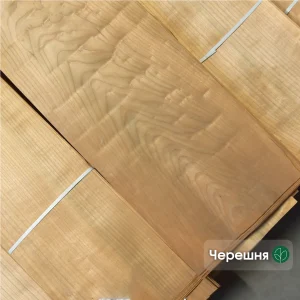
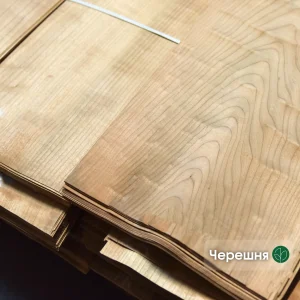
Natural cherry veneer is a thin sheet material, typically 0.5–0.6 mm thick, obtained by slicing layers of wood from a timber block. Cherry (Prunus avium) is classified as a highly valuable decorative species. This material is distinguished by its characteristic warm tones, ranging from golden-honey to rich red-brown.
Natural cherry veneer is a thin sheet material, typically 0.5–0.6 mm thick, obtained by slicing layers of wood from a timber block. Cherry (Prunus avium) is classified as a highly valuable decorative species. This material is distinguished by its characteristic warm tones, ranging from golden-honey to rich red-brown. Sold starting from 1 bundle, with the price calculated by a manager. Delivery across Ukraine and self-pickup are available.
We have facing material available in stock with the following specifications:
Using sliced cherry veneer instead of solid wood significantly reduces the cost of finished timber products. It perfectly maintains a premium appearance and structural stability. A single cubic metre of solid wood yields approximately 850 square metres of 0.6 mm thick veneer.
Choosing the right material depends entirely on your project’s priorities. You must decide between uniqueness and natural beauty, or pattern repeatability and budget minimisation.
Opt for natural cherry veneer when crafting bespoke furniture or outfitting classic interiors and studies. Fine-line remains the optimal choice if your budget is restricted and the project demands colour uniformity across vast surface areas.
The grade determines the aesthetic value and the appropriate application of the material. In professional circles, veneer grading is an integral metric based on visual traits, natural wood features, and the absence of processing defects.
This is top-tier material designed for facade surfaces and premium goods. It features a complete absence of knots, cracks, or blue stain, with a highly uniform colour throughout the sheet. The grain pattern is exceptionally clear without distortions. Minimal texture deviation typical of natural tree growth is permitted, but stark contrasts are excluded.
It is used for bespoke furniture, wall panelling in studies, musical instruments, and premium automotive trim.
This is the optimal choice for furniture components where moderate natural variation is acceptable. The veneer displays more pronounced natural inclusions. Isolated live (intergrown) knots up to 2–3 mm in diameter, slight colour variations, and minor medullary rays are permitted if they do not compromise sheet integrity.
Typical applications include furniture side panels, internal cabinet parts, and door leaves intended for tinting.
This budget-friendly option prioritises functionality over flawless aesthetics. It features pronounced texture and colour irregularities. Dark spots, black knots, and small closed cracks are permissible, alongside edge defects that are removed during jointing.
It is predominantly used as a backing or balancing layer for panels, drawer interiors, or beneath opaque finishes. The chosen grade directly impacts material yield: Grade 1 achieves about 85–90%, whilst Grade 3 may drop to 50–60% due to defect avoidance.
Sliced cherry veneer is the material of choice for diverse stylistic projects. This highly textured timber, complete with a warm colour palette, suits both classic aesthetics and austere modern designs. Utilising natural veneer grants products the luxurious look of solid wood whilst ensuring structural lightness and stability.
A thickness of 0.6 mm is perfectly sufficient to facilitate sanding and retain adhesive on the reverse side. It also provides ample flexibility when wrapping curved surfaces.
The production process for sliced veneer consists of several key stages:
We have over 25 varieties of sliced veneer in stock. The material is stored under proper conditions and has a moisture content of 8–10%.
The slicing method is a fundamental factor that defines the veneer sheet’s texture. Based on the cut type, craftsmen can precisely match materials to specific design briefs. This ranges from strict geometric lines to highly expressive, natural patterns.
| Parameter | Radial (Quarter Cut) | Semi-Radial (Rift Cut) | Tangential (Flat Cut / Crown Cut) |
|---|---|---|---|
| Ring Angle | 90° | 45°–60° | < 45° (tangent) |
| Shrinkage Coefficient | Low (stable) | Medium | Higher |
| Visual Effect | Strict lines, rhythm. The sheet surface displays parallel straight or slightly wavy lines along its entire length, creating a highly uniform texture. | Combined. Lines may be straight on one side of the sheet and transition into semi-arches towards the other. | Arches, flame figures. The sheet forms a pronounced V-shaped pattern, known professionally as a crown or arch. This highly decorative cut showcases the wood’s full natural beauty. |
| Characteristics | The knife passes through the log’s centre, perpendicular to the growth rings. This cut is considered the most resistant to warping. Radial cuts in cherry often reveal narrow, shiny medullary rays that add a distinct silken lustre. | An intermediate option where the angle of the growth rings to the cut plane ranges between 45° and 60°. | The knife passes at a distance from the log’s centre, tangential to the growth layers. |
| Material Yield | Lowest (around 10–15% of the log volume), which justifies its higher price point. | Medium. | Highest, making this type of veneer the most prevalent on the market. |
When ordering veneer for a single project, we strongly advise selecting bundles of the same cut type from a single batch. This guarantees exact shade matching and pattern symmetry when veneering paired components.
Cherry (Prunus avium), also known as European cherry, is a broadleaved hardwood species. It is widely distributed across Europe, including Ukraine, as well as Western Asia and North Africa. Timber sourced from Central and Southern European forests is deemed most valuable for veneer production due to climatic conditions fostering even growth rings.
Cherry is a medium-density hardwood. The solid wood is elastic and possesses good bending strength, though it exhibits moderate rot resistance in damp environments. At a standard 12% moisture content, its density is 580–610 kg/m³, with a Brinell hardness of 3.0–3.2.
Thanks to its long fibres, cherry bends beautifully following steam treatment. This makes it an exceptional timber for manufacturing bentwood components. The sapwood forms a narrow yellowish or cream band.
The heartwood’s colour ranges from a light pinkish-brown to a deep reddish hue with golden undertones. Crucially, the timber quickly darkens upon exposure to light. The texture is fine-pored with a smooth, satin-like surface.
The grain is usually straight, although highly decorative wavy sections occur, creating a stunning moiré effect on the veneer. It responds excellently to both manual and machine processing, providing clean cuts without splintering. It polishes to a smooth, mirror-like finish using fine-grit abrasives (P240 and above) and accepts all industrial adhesives effortlessly. Furthermore, the timber takes wood stains and varnishes without any issues.
WoodWay Expert is far more than a simple timber supplier. We build partnerships tailored to the real needs of furniture and joinery manufacturers, providing a comprehensive approach to veneer sourcing. Below are seven compelling reasons why furniture factories, design studios, and independent craftsmen choose us.
We offer a comprehensive range of services, from material selection to detailing. Our team is ready for tasks of varying complexity. Get in touch—we are here to help!
We have streamlined the selection and purchasing process to be equally convenient for large-scale furniture enterprises and bespoke craft workshops. To purchase our veneer, simply follow these steps:
Working with us is convenient, simple, and fast. We have extensive experience in the Ukrainian market and are ready to take on new inquiries.
A cherry veneer bundle typically contains between 24 and 32 sheets. The square meterage depends entirely on the dimensions and sheet count. It is calculated using the formula: (length x width) x number of sheets.
The most popular thickness is between 0.55–0.6 mm. This is the optimal metric for furniture production. It ensures an adequate margin for sanding whilst providing excellent adhesion to substrates like MDF or chipboard.
Yes, this is a completely natural characteristic of the species. Under the influence of ultraviolet light, cherry veneer undergoes a “ripening” process. Its light pink hues gradually transition into a deeper red-brown colour.
Botanically, they are closely related species (Prunus). In woodworking, “European cherry” typically refers to lighter, yellowish-tinged timber. Conversely, “American cherry” (specifically Black Cherry) denotes timber with a stronger red pigment and minute black gum inclusions.
For professional veneering, we highly recommend using D3 class PVA adhesives. Alternatively, urea-formaldehyde resins perform exceptionally well during hot pressing operations.
Pay close attention to pattern repeatability. In natural veneer, you will never find two truly identical sheets. Fine-line, on the other hand, possesses a perfectly uniform, repeating “graphic” pattern.
Yes, it is a classic material specifically suited for restoration. Because antique furniture was frequently crafted from solid fruitwood or veneer, modern Grade A sliced cherry veneer is perfect for replacing lost or damaged elements.