
Order
Place order
Clear the whole list?
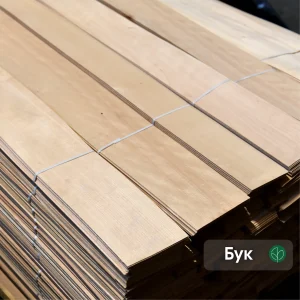
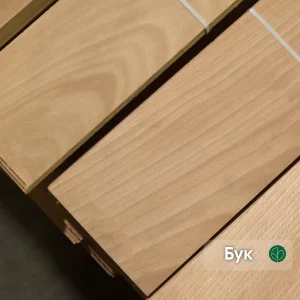
Natural sliced beech veneer is a thin layer of wood 0.6-2.5 mm thick, which retains the texture, natural color, and physical properties of solid wood. We recommend this material for projects that require a light surface with a delicate texture.
Natural sliced beech veneer is a thin layer of wood 0.6-2.5 mm thick, which retains the texture, natural color, and physical properties of solid wood. We recommend this material for projects that require a light surface with a delicate texture.
Our stock program features facing material:
We offer beech veneer for furniture and joinery applications available from 1 bundle. The price per bundle depends on square metreage and grade. Our manager will select the facing material based on grain texture, thickness, and dimensions. We ship across Ukraine via courier services.
Choosing the right veneer grade is the key to matching the project with the planned budget and aesthetic requirements. The facing material is classified based on clear criteria: surface quality, color stability, and the presence of natural wood features.
This is the highest quality material, designed for the front surfaces of premium furniture. The texture is uniform: annual rings are clearly defined, and medullary rays are evenly distributed. The color is as uniform as possible across the entire sheet area. There is no sapwood or sharp color transitions. The surface is free of knots, cracks, dark mineral streaks, and “false heartwood”. Only occasional “eyes” up to 1-2 mm in diameter, which are part of the structure, are allowed.
This grade combines high quality with a more pronounced natural wood character. It is the most popular choice for mass furniture production. The texture is uniform, but slight deviations in the grain direction are allowed. There may be a difference in shades between sheets in the same bundle, emphasizing its natural origin. Sound small knots (up to 5 mm) that do not compromise the integrity of the sheet are permitted. A slight amount of light sapwood may be observed.
A material where functionality comes first, but sometimes this finish is chosen for rustic projects. The texture is non-standardized, with potentially significant grain curves and sharp pattern changes. The coloring is contrasting. “False heartwood” of beech is often found — darker, red-brown areas that add specific visual noise to the wood. Knots (including dark ones), mineral streaks, and sapwood are allowed. Areas with features are technically stable, meaning the sheet remains intact and ready for gluing.
Please note. Steamed Grade A beech will always have a delicate pink tint, whereas darker spots (as a result of the tree’s age-related changes) appear more often in lower grades. If your goal is to get a uniform surface, we recommend sticking with Grade A.
The main difference between sliced beech veneer and its popular fine-line counterpart lies in its authenticity.
Natural veneer is solid wood. Each sheet in a bundle has a unique pattern of annual rings, medullary rays (the characteristic beech “specks”), and natural color transitions. It is stronger and withstands sanding better.
Fine-line is a reconstituted material made from cheap, fast-growing species (e.g., poplar). The raw material is dyed and glued into blocks to imitate a pattern. Fine-line is cheaper and has a perfectly repeatable print, but lacks the unique texture of real beech.
The production process of the facing material consists of the following stages:
Three main types of cuts, which differ in pattern, are used in the production of natural beech veneer. Different textures are achieved due to a specific knife position relative to the flitch’s annual rings.
| Characteristic | Quarter cut (Radial) | Flat cut (Tangential) | Rift cut (Semi-radial) |
|---|---|---|---|
| Knife position | Perpendicular to rings | Tangential to rings | At a 45-60° angle |
| Pattern | Parallel lines | Arches / Flames | Mixed |
| Stability | Maximum | Medium | High |
| Main feature | Medullary rays | Expressive naturalness | Versatility |
Beech wood (Fagus sylvatica) is one of Europe’s most important industrial resources. For its strength and versatility, beech has earned the name “iron tree” of European forests. Beech is the main forest-forming species in Western and Central Europe. The highest quality raw material entering the Ukrainian market comes from the Carpathian Mountains, as well as the forests of Germany, France, and Austria. Beech is a diffuse-porous wood species. The texture is fine and uniform. Annual rings are visible but do not have the sharp contrast seen in oak or ash. Medullary rays are the main visual marker of beech. On a quarter cut, they look like shiny narrow stripes, and on a flat cut, like small brown “specks.” The natural color is creamy white with a slight yellowish tint. After thermal treatment, the wood acquires a uniform pink or peach tone.
| Indicator | Value | Characteristic |
|---|---|---|
| Density | 680 – 720 kg/m³ | Heavy and dense wood |
| Hardness (Brinell) | 3.7 – 3.9 | High (almost equal to oak) |
| Flexibility | Exceptional | The best species for steam bending |
| Wear resistance | High | Excellent at withstanding intense friction |
| Shrinkage | High | Requires strict moisture control |
Thanks to its uniform structure, beech is easily cut in all directions. It provides a clean cut without splintering, allowing for complex milling and fine carving. After steaming, the wood bends well. It is from beech that the legendary bentwood chairs are made. The wood sands beautifully to a mirror-like shine. Due to the lack of large pores, beech absorbs oils and waxes evenly. Solid wood interacts with all types of carpentry glues: its high density ensures a monolithic glue joint.
Here are the main areas where beech veneer unlocks its potential best:
We understand that pattern repeatability is critical for mass production or custom projects. With us, you can select veneer bundles from the same batch, ensuring the visual integrity of a furniture set or wall panel.
Partnering with WoodWay Expert is not just about buying wood materials, but a partnership based on an understanding of the needs of modern woodworking. Here are 7 key reasons why furniture factories, designers, and craftsmen choose us:
For over 30 years, we have provided furniture factories, joinery workshops, and craft studios with high-quality facing materials, as well as additional manufacturing services. Our team is ready to handle tasks of any scale.
We strive to make the process of choosing and buying facing materials as convenient as possible for both large manufacturers and craftsmen. Choose the most comfortable ordering format for you:
Send an inquiry to promptly receive an estimate and photos of the selected material. Contact us—we are ready to assist!
We work with both large manufacturers and craftsmen. The minimum order is one bundle. We select material by square footage, shade, and texture. We offer a remote selection service.
The natural color of beech is light creamy, but in veneer production, logs are steamed/boiled. Hydrothermal treatment makes the wood more elastic for slicing and gives it a characteristic warm pink tint. Steamed beech veneer is more stable and less prone to internal stress.
Natural veneer is 100% solid wood. Unlike artificial fine-line, it has a unique pattern of annual rings, texture, and characteristic medullary rays (“specks”) that cannot be imitated.
Yes, a thickness of 0.6 mm is a global standard. The veneer is flexible enough for veneering complex shapes, reliably protects against glue “bleed-through” under press pressure, and leaves a sufficient wood allowance for sanding and varnishing.
Quarter-cut veneer has a pattern of straight parallel lines, while flat-cut veneer has sprawling arches or cones. At WoodWay Expert, you can order bundles with a specific cut type.
Yes, beech is a “base” for staining. Thanks to its light color and uniform texture, the wood is easily stained to match walnut, cherry, or mahogany.