
Order
Place order
Clear the whole list?
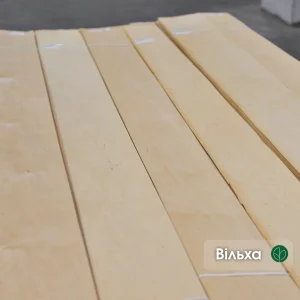
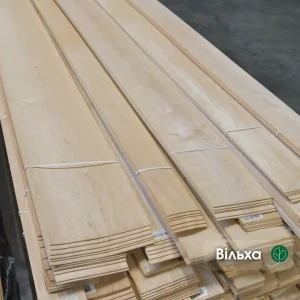
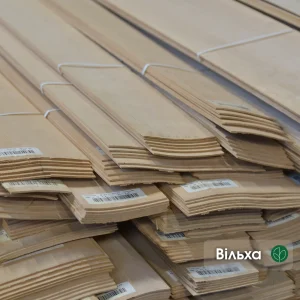
Sliced alder veneer is a thin layer of wood obtained through the transverse slicing of flitches. This facing material combines the authentic aesthetic of solid wood with economic benefits and eco-friendliness.
Sliced alder veneer is a thin layer of wood obtained through the transverse slicing of flitches. This facing material combines the authentic aesthetic of solid wood with economic benefits and eco-friendliness. Alder is a soft hardwood, highly valued in woodworking for its uniform structure, stability, and ease of tinting to match other timber. Sold starting from 1 bundle. The price per bundle is calculated individually and depends on the grade and square metreage.
We stock natural alder veneer with the following specifications:
The production of sliced alder veneer allows for the rational use of solid timber. From 1 m³ of raw material, you can obtain an average of 850 m² of veneer with a thickness of 0.55 mm. This yield is achieved through precise slicing machine settings and prior hydrothermal treatment, which reduces internal stress and minimises processing losses.
Beyond the high yield, using alder as a raw material is economically viable. The timber features a uniform structure, stable texture, and excellent workability, ensuring consistent sheet thickness and minimal defects. Let us examine the manufacturing technology of this facing material in more detail.
It is vital to understand the fundamental difference between natural sliced alder veneer and reconstituted veneer (fine-line). The choice depends entirely on project priorities: uniqueness and eco-friendliness versus predictability and low cost.
Using natural alder veneer is a priority for products where naturalness and durability are highly valued. Fine-line is only appropriate for budget mass-market items requiring 100% visual identity across a large volume of units.
Grading is based on the strict requirements of GOST 2977-82 (or internal manufacturer specifications adapted to European A, B, C standards). These regulate the quantity, size, and nature of natural wood features on the face surface. The concept of a grade relies entirely on assessing visual qualities.
| Characteristic | Grade 1 (A) | Grade 2 (B / AB) | Grade 3 (C) |
|---|---|---|---|
| Application | Premium material intended for visible furniture surfaces requiring flawless aesthetics. | Optimal choice for products where a natural wood appearance with minor features is perfectly acceptable. | Material with pronounced natural features, mainly used for hidden elements or crafting rustic style pieces. |
| Texture | Surface must be completely clean with only occasional tiny knots (2–3 mm) allowed. No blue stain, rot, or chemical colourations; cracks and fibre tears are strictly forbidden. | Healthy intergrown knots up to 10–15 mm and small dark knots up to 5 mm are permitted. Micro-cracks up to 1/10 of the sheet length are allowed and easily fixed. | Large knots (including loose ones if restored), cracks, and significant colour changes are permitted. |
| Colour | Maximum colour uniformity within a single bundle is an absolute requirement. | Slight shade variations and natural medullary rays characteristic of alder are entirely possible. | Pronounced heterogeneity of texture and colour, along with prominent mineral inclusions, are present. |
When choosing a grade, you must carefully consider the finishing technology. If opaque painting is planned, Grade 2 veneer is perfectly suitable. However, for transparent varnish or oil finishes, only Grade 1 should be selected to highlight the noble texture.
Thanks to its uniform structure, high adhesive grip, and even tinting capacity, sliced alder veneer is highly popular in the furniture industry. Below is a detailed overview of the primary application areas for this superb facing material.
This accessible and easy-to-work-with material is chosen for projects of varying complexity. We have extensive experience collaborating with manufacturers and are ready for new tasks.
The type of veneer cut determines not only the visual aesthetic but also the technical stability of the finished product. Woodworking recognises three main types of cuts, depending on the angle of the growth rings to the veneer plane.
During a radial cut, the knife passes through the core of the trunk, strictly perpendicular to the growth rings. The angle of inclination of the rings is between 60° and 90°. The resulting pattern consists of parallel straight lines, offering an incredibly uniform texture. The main advantage is the highest level of stability, as radial cut veneer has minimal expansion coefficients when humidity changes.
The knife passes tangentially to the growth rings, at a specific distance from the log’s centre. The angle of inclination is less than 45° (usually 0–30°). This creates clear cone or U-shaped patterns on the surface, formed by the growth rings. This provides the most natural and dynamic wood design, heavily favoured for its decorative appeal.
This is an intermediate option where the cut is made at an angle to the radius. The angle of inclination for the rings is between 45° and 60°. Straight lines blur slightly into gentle curves, but without forming fully closed arches. It offers an optimal balance of price and aesthetics, maintaining high canvas stability whilst delivering an interesting grain.
Alder (Alnus) is a versatile hardwood often called a “chameleon” in the woodworking industry due to its brilliant ability to be tinted. Thanks to its uniform structure and high stability, the solid wood is a fundamental material for veneering and furniture production. Alder is widely distributed across the temperate zone of the Northern Hemisphere. In Ukraine, the main commercial species are Black Alder (Alnus glutinosa) and Grey Alder (Alnus incana). It is a soft species (2.7 Brinell) with a highly uniform density (420 kg/m³), making it absolutely ideal for fine machining.
Freshly cut timber is almost white but oxidises instantly in the air, acquiring a characteristic reddish-yellow or saturated orange hue. Over time, beneath a layer of varnish, the colour beautifully stabilises to a warm honey shade. The texture is subtle, providing a wonderfully calm visual background with fine pores and predominantly straight fibres. Because it completely lacks resin canals and absorbs stains evenly, alder is highly regarded as the premier material for tinting.
This soft timber effortlessly mimics the premium grain of mahogany, cherry, or American walnut. The wood cuts, slices, and sands incredibly easily without any tendency to become fuzzy, allowing for a flawless, mirror-smooth finish. It also holds glued joints perfectly, which is absolutely critical when manufacturing veneered MDF and plywood panels.
WoodWay Expert is a highly reliable supplier of premium timber materials. Our esteemed partners include furniture manufacturers, interior designers, construction firms, and bespoke carpentry workshops. Here is exactly why they choose us:
Over 25 varieties of veneer are collected in one place. The material is stored under proper conditions and is ready for shipment.
The comprehensive selection and purchasing process is carefully designed to be equally efficient for serial manufacturers and individual workshops. You can easily use whichever method best suits your daily workflow.
We accommodate our clients’ needs and sell veneer starting from 1 bundle. Our managers will help you select the material, calculate the square metreage, and determine the exact cost.
The most popular thickness is 0.6 mm, which offers an optimal, reliable balance between strength and flexibility. This thickness allows for high-quality sanding after adhesion (removing up to 0.1–0.2 mm) without any risk of sanding through to the base.
Natural veneer features a completely unique growth ring pattern, fine pores, and subtle, beautiful colour transitions. Fine-line has a strictly repetitive pattern manufactured from glued layers of softwood. If sheets are absolutely identical, it is definitely a reconstituted material.
For manual veneering or cold pressing techniques, PVA dispersions (D3 class) are absolutely ideal. For industrial hot pressing applications, urea-formaldehyde resins are typically utilised for best results.
Alder has a very uniform density (~500 kg/m³), allowing it to absorb dyes incredibly beautifully. Following professional tinting, it is remarkably difficult to distinguish it visually from premium cherry, mahogany, or American walnut.
This is the strict normative indicator for sliced veneer according to GOST 2977-82. Higher moisture severely risks mould and delamination, whilst lower moisture makes the material far too brittle and prone to cracking.
For premium door leaves, Grade 1 (A) is always the preferred choice. It is crucial to monitor the meticulous matching of the veneer layout. Master craftsmen highly recommend using radial or semi-radial veneer for doors to ensure maximum stability.