Sawn Oak Veneer: Grades, Specifications, and Applications
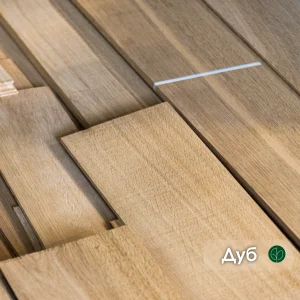
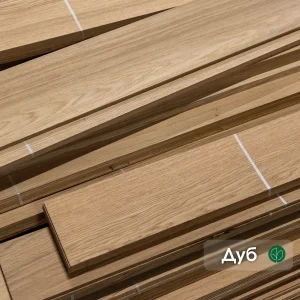
Sawn veneer, or oak lamella, is a facing material produced by sawing a board into thin planks. Sheet thickness typically ranges between 2 and 10 mm. Oak sawn lamella is in stock at our warehouse in Kyiv. Minimum order is 1 pack, with wholesale orders available. Warehouse collection and delivery across Ukraine via carrier services are available.
Unlike sliced veneer, sawn veneer skips the boiling or steaming stage, preserving the solid wood’s natural colour. Surfaces faced with oak lamella are visually and tactilely identical to solid wood.
Key features of sawn oak veneer:
- Wear resistance: The sheets withstand mechanical stress, making this material the optimal choice for the top layer of engineered flooring.
- Natural texture: The sawing process fully preserves the pattern of annual rings and medullary rays.
- Restoration potential: The lamella’s thickness allows for repeated sanding and finish renewal (varnish, oil, or wax), significantly extending the product’s lifespan.
- Eco-friendliness: This is a 100% natural product containing no harmful additives, ensuring it is safe for residential use.
- Dimensional stability: Unlike solid wood, lamella glued to a stable base (MDF, plywood, chipboard) is less prone to deformation during humidity changes.
To order oak timber, contact our manager or submit a request via the website. Our specialist will get in touch with you to clarify the details.
Oak Sawn Lamella: Stock Availability and Bespoke Production
Our company operates a stock programme alongside accepting bespoke orders for timber products. Sawn oak veneer with standard parameters is available directly from our warehouse:
- thickness: 2.5 mm or 4.5 mm;
- width: from 12 cm;
- length: from 0.5 to 3 m.
We can manufacture timber lamellas in other thicknesses to meet client specifications. The following size ranges are available:
- thickness: from 2 to 10 mm;
- width: 12–21 cm;
- length: 0.5–3 m.
The standard production time is 10 working days. The minimum order volume is 10 m² of material from a single wood species.
Grades of Sawn Oak Veneer
In the woodworking industry, grading is a system for visually assessing the quality of a timber product’s facing surface. The grade is determined by the presence of natural wood features: knots, sapwood, medullary rays, and colour uniformity.
Comparative Table of Oak Sawn Lamella Grades
| Parameter
|
1st Grade
|
2nd Grade
|
3rd Grade
|
| Colour uniformity
|
Uniform colour without abrupt transitions.
|
Natural colour variation.
|
Pronounced texture with contrasting colour transitions.
|
| Features
|
Only “pin knots” (light knots up to 2–3 mm in diameter) are permitted. Large knots, cracks, and pith are completely excluded.
|
Sound, intergrown knots up to 15–20 mm in diameter are allowed (depending on lamella width).
|
Large sound and “black” knots, medullary rays, and marks from fallen knots are allowed.
|
| Sapwood
|
Not permitted.
|
Up to 10% of the area.
|
Permitted without restrictions.
|
| Cracks
|
Absent.
|
Not permitted.
|
Stable cracks are permitted.
|
| Primary value
|
This is premium-class timber, featuring wood selected for maximum texture uniformity.
|
Highlights the material’s natural origins without overly active texture.
|
The most popular choice for eco, loft, and country style interiors. It often undergoes additional processing, such as brushing (removing soft fibres).
|
| Applications
|
Manufacturing premium-class facades, wall panelling, and musical instruments.
|
Production of mid-range and premium furniture, engineered flooring, and door leaves.
|
Solid and engineered flooring, decorative beams, and authentic furniture.
|
When ordering lamella, it is important to remember that the grade affects the price, not the physical strength. Even 3rd-grade timber, when properly processed and cracks are filled with special mastics, lasts just as long as premium-grade products.
Applications of Oak Sawn Veneer
Surfaces faced with oak sawn veneer retain the distinct grain, texture, and tactile qualities of solid wood. At the same time, veneered products offer greater dimensional stability and cost-efficiency than solid timber constructions. Key applications of oak sawn lamellae include:
- Flooring: Parquet and Engineered Wood Flooring. Oak sawn veneer serves as the wear layer (top layer) for flooring. In engineered boards, the oak lamella is bonded to a moisture-resistant plywood substrate, reducing the risk of deformation caused by temperature and humidity fluctuations. The oak grain suits both classic and modern interiors, and the surface can be stained, brushed, oiled, or lacquered.
- Stair Tread Cladding. Stairs are subject to continuous abrasion, impact, and mechanical stress. Due to its hardness and wear resistance, oak lamella is ideal for cladding steps and risers. The material delivers an authentic solid-oak appearance without the need for full solid timber blanks. For added protection, treads are finished with hardwax-oil or heavy-duty lacquer.
- Worktops and Table Tops. Oak sawn veneer (4–6 mm thick) is used to produce kitchen, dining, and office worktops. Thick lamellae preserve the natural wood grain and ensure high resistance to mechanical loads. Quality oil or lacquer coatings provide extra protection against moisture, stains, and daily wear.
- Furniture Fronts and Doors. The striking grain of oak makes it a preferred choice for facing cabinet fronts and door leaves. Bonding oak lamella onto MDF, particleboard, or plywood cores delivers the look of solid timber while reducing the consumption of valuable hardwood. Facing doors with sawn-cut veneer gives them a refined, premium finish.
- Internal Partitions and Wall Panels. Oak sawn veneer is applied to MDF, particleboard, or plywood substrates to manufacture decorative wall panels, slatted partitions, acoustic baffles, and mobile screens. These elements are widely used for zoning living rooms, offices, lobbies, and open-plan spaces.
In addition, the material is used to craft various interior decor items and lifestyle accessories. Oak lamellae are used for phone and tablet stands, key holders, coat racks, photo frames, desk organisers, jewellery boxes, and other products where natural grain, durability, and a premium aesthetic are essential.
Production Stages of Sawn Oak Veneer
The quality of sawn lamella relies directly on a properly organised production technology. Every stage is crucial, from raw material selection to batch formation.
- Board selection: Initially, high-quality timber—usually first or premium grade boards—is used to produce oak lamella. Raw materials are thoroughly inspected to ensure the timber lacks defects that could compromise the stability and appearance of the final veneer.
- Timber drying: Selected boards undergo kiln drying in specialised facilities. This technology reduces the oak’s moisture content to a joinery level of approximately 8–10%, the optimal metric for subsequent processing. Proper drying alleviates internal stresses within the wood fibres, substantially reducing the risk of warping or cracking.
- Workpiece calibration: After moisture stabilisation, the boards undergo mechanical calibration. Workpieces are levelled and adjusted to fit the saw cassette dimensions. This preparation ensures uniform sawing and consistent thickness for the resulting lamellas.
- Sawing: The prepared boards are then fed into Wintersteiger machines. Following preliminary jointing, the workpieces are cut into thin sheets of a specified thickness. Precision sawing technology yields exceptionally flat lamellas while minimising the loss of valuable oak timber.
- Sorting: In the final stage, the finished lamella is checked for dimensional accuracy and natural wood characteristics. Sheets are graded and bundled into packs for subsequent storage or dispatch.
Thanks to strict adherence to production technology, sawn oak veneer is a robust and stable timber material. It is widely used in furniture manufacturing, as well as the production of doors, staircases, and other interior elements.
Oak Timber: Technical Profile
Oak (Quercus) is the primary commercial hardwood species in the temperate zone of the Northern Hemisphere. For sawn veneer (lamella) production, the most commonly used species are Pedunculate Oak (Quercus robur) and Sessile Oak (Quercus petraea), which are widespread across Europe, including Ukraine.
The operational value of oak stems from its high density and tannin content, which acts as a natural antiseptic. The density of dry solid wood is 690 – 750 kg/m³, with a Brinell hardness rating of 3.7. This species boasts one of the highest abrasion resistance ratings among European woods.
The solid wood is characterised by high fibre toughness. During hydrothermal processing (steaming), the timber becomes pliable, enabling the production of complex bent-glued components. The heartwood features shades ranging from light brown to dark brown.
The sapwood is narrow, light yellow, and sharply demarcated. The texture is coarse and prominent. Radial cuts clearly display medullary rays, whilst tangential cuts reveal characteristic arch-like annual ring patterns.
The timber readily accepts most joinery adhesives (D3/D4 class PVA, polyurethane mixtures), though its large pores require careful monitoring of glue consumption. Oak is suitable for brushing (texturising). The solid wood absorbs hard wax oils beautifully and can be seamlessly coated with acrylic varnishes.
7 Reasons to Order Sawn Oak Veneer from WoodWay Expert
Our priority is the prompt supply of timber materials to furniture manufacturers, joinery workshops, and private craftsmen. Drawing on 30 years of experience collaborating with architectural bureaus, design studios, furniture factories, and craft workshops, we have established optimal conditions for realising projects of any complexity. Here is why professionals choose us:
- Constant warehouse availability. We maintain stable stocks of timber products in the most popular thicknesses (2.5 mm and 4.5 mm) directly at our warehouse. Clients can visit the warehouse personally to select materials and collect their order immediately after payment (open Monday to Friday, 08:00 to 17:00).
- Bespoke project manufacturing. We understand the importance of precise material parameters for exclusive products, so we offer bespoke lamella production with thicknesses from 2 to 10 mm. The minimum volume for a custom order is 10 m², with a production time of up to 10 working days. Please contact our manager for the current square metre price based on your technical requirements.
- Species assortment. Our catalogue features sawn veneer from over 15 wood species. If your project requires a timber species not in our regular assortment, we are ready to discuss custom manufacturing options.
- Collection and UK delivery. Orders can be collected directly from our warehouse. We also offer timber delivery via transport companies across Ukraine.
- Remote selection. Send us an enquiry, and we will select facing materials that meet your texture, shade, and area requirements. After processing your request, our manager will provide detailed photos and specifications of specific packs. Dispatch occurs after 100% invoice payment.
- Transparent payment methods. Cash payment with a fiscal receipt is available at the warehouse. Cashless payments are provided for legal entities and entrepreneurs (sole traders, LLCs with VAT).
- Sales by the pack and wholesale supply. Sawn veneer can be purchased in packs, and we also fulfil wholesale orders. The number of m² per pack depends on the quantity and size of the sheets. The price of sawn lamella is calculated using the formula: cost per 1 m² × (length × width × number of sheets).
We develop personalised commercial offers for wholesale clients. Discount rates depend on purchasing volumes and product categories.
How to Order Sawn Oak Veneer in Kyiv and Ukraine?
We have designed a highly flexible interaction system, ensuring you can purchase quality timber materials in the most convenient way.
- Personal warehouse visit. Visit our wholesale and retail warehouse-shop to personally verify product quality. You can independently select lamella packs with the right shade and pattern for your project. Our specialists will guide you through the assortment, calculate the square footage, and prepare an invoice. Location: 7D Zdolbunivska St., Kyiv (convenient access from 17E Dniprovska Embankment).
- Telephone consultation. If you cannot visit us in person, contact a manager on +38 (067) 180-38-13 (Telegram and Viber available). Leave a request or provide technical specifications, and we will send photos, videos, and specifications of packs matching your criteria. Following approval, the sawn veneer is prepared for dispatch.
- Website ordering. Select the required wood species and lamella thickness in our catalogue, then use the shopping basket or callback button. A manager will contact you to confirm the square footage, agree on a payment method, and provide photos of the oak sawn veneer being prepared for dispatch.