Clear the whole list?
Sawn Hornbeam Veneer
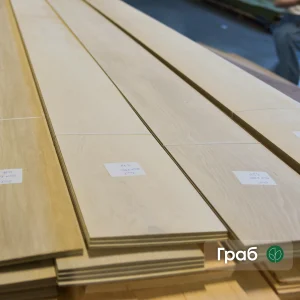
Sawn hornbeam veneer is a timber product with a thickness of 2 to 10 mm, obtained through the precision sawing of solid wood. We supply lamellas for wholesale and retail purchase (from 1 pack). Delivery across Ukraine and collection from our Kyiv warehouse are available.
Sawn hornbeam veneer 2.5 mm, 0.5–3 m
- Wood species: Hornbeam
- Thickness: 2.5 mm
- Type: Sawn
Sawn Hornbeam Veneer: Grades, Characteristics, Applications, and Technical Specifications
Sawn hornbeam veneer is a timber product with a thickness of 2 to 10 mm, obtained through the precision sawing of solid wood. We supply lamellas for wholesale and retail purchase (from 1 pack). Delivery across Ukraine and collection from our Kyiv warehouse are available.
Compared to sliced veneer, the sawn lamella retains the complete properties of solid wood, including its structure and colour. Hornbeam is often called “ironwood” due to its remarkably high density and wear resistance. This wood species offers several distinct advantages:
- High hardness and strength: Hornbeam surpasses oak in hardness metrics. This makes the lamella an optimal material for surfaces subjected to intense mechanical stress.
- Aesthetics: The light-coloured timber (almost white or with a greyish-cream hue) is frequently used as a neutral background. The uniform texture is often stained to imitate more expensive species (such as ebony) or left in its natural colour for Scandinavian-style interiors.
- Stability: Professional kiln drying ensures a workable joinery moisture content of 8-10%. Evenly dried timber is dimensionally stable and easy to work with.
- Eco-friendliness: The 100% natural wood meets strict safety standards for residential premises. Products made from wooden lamellas are fully recyclable.
Our sales manager will assist with selecting sawn veneer remotely: we provide photos and videos of in-stock stock prior to dispatch.
Dimensions of Sawn Hornbeam Veneer: In Stock and Made to Order
We operate an active stock programme and manufacture timber products to order. The following sawn hornbeam veneer specifications are currently available in our warehouse:
- Thickness: 2.5 mm, 4.5 mm.
- Width: from 12 cm.
- Length: from 0.5 to 3 m.
The parameters for bespoke hornbeam lamellas that we can manufacture to order are as follows:
- Thickness: 2-10 mm.
- Width: 12–21 cm.
- Length: 0.5-3 m.
Production time takes up to 10 working days. The minimum order quantity is 10 square metres of a single wood species.
Sawn Hornbeam Veneer Grades: Classification
When selecting a sawn lamella, the grade is a pivotal factor. This technical metric determines the surface quality of the sheet, including the presence of natural features (knots, sapwood, colour uniformity) and mechanical defects.
The grade does not affect the timber’s inherent strength. Hornbeam remains exceptionally hard across all grading classifications.
Characteristics of Hornbeam Lamella Grades
| Characteristic | 1st Grade (A) | 2nd Grade (B) | 3rd Grade (C) |
|---|---|---|---|
| Surface | Clean, uniform, and completely free of defects. | Minor natural colour variations are permitted. | Pronounced texture with natural imperfections. |
| Knots | Not permitted (or only isolated ‘pin knots’ up to 2-3 mm). | Small diameter sound, light knots are allowed. | Knots of various sizes are permitted, including dark and loose ones (requiring wood filler). |
| Colour | Uniform light cream or almost white. | Natural darkening is possible. | Contrasting streaks and significant shade variations are present. |
| Cracks | None. | Barely noticeable hairline cracks on the ends are possible. | End and surface cracks requiring restorative work are allowed. |
| Feature | This is a premium material for the most demanding applications. | A golden mean between price and aesthetics. The true character of the wood shines through here; soft colour transitions and small sound knots highlight the product’s natural feel. | A material with a highly pronounced texture. It is valued in design projects where emphasising the wood’s authenticity is crucial. |
| Application | Interior panels, furniture facades, musical instruments, and exclusive parquet. | Production of internal doors, staircases, and wall panels. | Loft, rustic, and country-style furniture, inner layers of engineered flooring, and decorative elements. |
When purchasing lamellas from WoodWay Expert, you receive a material that has undergone:
- Professional kiln drying to an 8-10% moisture content.
- Precise calibration to ensure uniform thickness across the entire length.
- Honest sorting that accurately reflects the stated price list.
Applications of Sawn Hornbeam Veneer
Sawn hornbeam lamellas have become an indispensable material in modern joinery. Surfaces clad in sawn veneer sheets are visually and tactilely indistinguishable from solid wood. Simultaneously, these products are far more accessible and stable than their solid timber counterparts.
The primary applications for this timber include:
- Flooring: parquet, engineered, and solid boards. Hornbeam lamellas are highly suitable for the top (wear) layer of flooring. Thanks to its high hardness coefficient (higher than oak on the Brinell scale), hornbeam flooring withstands significant mechanical stress. For engineered boards, the timber sheets are glued to moisture-resistant plywood, minimising deformation during humidity fluctuations. Light parquet flooring helps create visually airy interiors. Furthermore, the lamella surface can be stained to any desired colour.
- Staircase cladding. Stairs are notorious high-traffic zones. Utilising hornbeam lamellas to clad steps ensures robust resistance to abrasion, dents, and scratches, whilst maintaining the aesthetic integrity of the structure. The surface is additionally treated with hard wax oil or varnish for extra protection.
- Worktops and surfaces. Sawn hornbeam veneer with a thickness of 4–6 mm is frequently used to manufacture kitchen or office worktops. Due to the wood’s inherent toughness, these worktops easily resist impact damage. After being coated with high-quality oil or varnish, they also become highly moisture-resistant.
- Furniture facades and doors. Hornbeam features an almost imperceptible texture, making it an optimal choice for modern minimalist designs. The lamella is bonded to a core board (such as MDF or chipboard), creating the convincing illusion of expensive solid wood furniture. Cladding a door leaf with hornbeam lamella guarantees longevity and a highly presentable appearance.
- Internal partitions and wall panels. Slatted partitions (baffles) and decorative wall panels are exceedingly popular in contemporary interior design. MDF, chipboard, or plywood boards are clad with sawn veneer and then used to craft internal partitions and mobile screens. These non-structural installations are employed to zone offices, open-plan living rooms, hallways, and conference rooms. Wall panels decorated with uniformly textured light timber are a versatile technique for finishing walls in minimalist interiors.
Furthermore, artisans create a diverse range of interior decor and practical household items from veneer sheets. Lamellas are used to meticulously craft phone and tablet stands, key holders, clothes hangers, photo frames, desk organisers, jewellery boxes, and more.
Production of Hornbeam Lamella: Key Stages
Adhering strictly to the manufacturing process for sawn hornbeam veneer guarantees dimensional stability, high strength, and predictable material behaviour during use. Let us review how this timber product is made:
- Raw material selection: High or first-grade edged hornbeam boards are selected for lamella production. The overall quality of the timber product heavily depends on this raw material.
- Kiln drying: Selected boards undergo kiln drying to achieve a joinery moisture content of 8–10%, which is the optimal level for further processing. Following the correct drying schedule reduces internal stress within the dense hornbeam structure and minimises the risk of lamella deformation.
- Calibration of workpieces: The dried boards are subsequently calibrated and jointed. The workpieces are precisely adjusted to fit the multi-blade saw cassette parameters. Geometric accuracy at this stage directly influences the cutting quality and the yield percentage of the finished product.
- Sawing into lamellas: Modern Wintersteiger machinery is utilised to cut the boards. The precision sawing system ensures a minimal kerf and high dimensional repeatability, which is particularly vital when working with hard hornbeam. The equipment’s accuracy allows for a smooth lamella surface whilst reducing the loss of valuable raw material.
- Sorting and bundling: The finished sawn veneer is meticulously inspected for thickness, width, and visual characteristics. The material is graded according to texture, colour, and the presence of acceptable natural features. The lamella sheets are then securely stacked into bundles for storage or immediate dispatch.
Stringent quality control at every stage results in a cladding material that consistently meets the high requirements of furniture and joinery manufacturing.
Hornbeam Timber: A Brief Overview
Hornbeam (Carpinus betulus) is a deciduous species often referred to in the woodworking industry as “white beech” or “ironwood”. The timber is widely considered one of the most reliable materials for crafting wear-resistant products. Hornbeam is distributed across Europe (Central and Southern), Asia Minor, and the Caucasus.
In Ukraine, the main populations are concentrated in the Carpathians, Podillia, and central regions. Ukrainian hornbeam is particularly valued by craftsmen for its proper fibre structure.
The timber belongs to the diffuse-porous hardwood category, notably lacking a distinct heartwood. It is one of the heaviest and strongest species found in temperate latitudes.
The density of the dry solid wood is 750 – 800 kg/m³, with a Brinell hardness of 3.5 – 3.7. When steamed, hornbeam exhibits excellent plasticity, allowing the material to be used effectively for bentwood furniture components.
The solid wood is greyish-white or cream in colour. Over time, exposure to direct sunlight may give it a faint yellowish tint. The texture is fine and notably uniform, with thin medullary rays visible on the radial section.
Areas with interlocked grain (curly grain) are quite common. This structure makes the wood difficult to split but creates a unique “wavy” visual effect on the cut surface. The pores are small, evenly distributed, and practically invisible to the naked eye.
Tools with carbide tips should always be used when cutting and routing this timber. Thanks to its incredibly fine structure, hornbeam sands to a perfectly smooth, almost mirror-like finish.
It also accepts adhesives remarkably well. Due to its light colour, it is highly suitable for staining, allowing it to accurately imitate more expensive exotic species.
Why Buy Sawn Hornbeam Lamellas from WoodWay Expert: Business Advantages
The key priority of our business is the prompt supply of premium timber materials for furniture manufacturers, design studios, architectural firms, and joinery workshops. We have been successfully operating since 1996 and have established optimal collaboration terms for both wholesale and retail clients.
Here are the main arguments for partnering with our team:
- Constant product availability. You will not need to waste time waiting for deliveries, as the most popular timber thicknesses (2.5 mm and 4.5 mm) are always strictly kept in stock. By visiting our wholesale and retail depot on weekdays between 08:00 and 17:00, you have the opportunity to personally select each bundle of veneer. Orders are dispatched immediately following payment.
- Bespoke sawn veneer production. We fully recognise the uniqueness of every interior design solution. Therefore, we offer a bespoke lamella manufacturing service to your specified dimensions, ranging from 2 to 10 mm in thickness. The minimum volume for a special order starts from 10 sq. m (depending on the species), with a lead time of up to 10 working days. Please contact a dedicated account manager to calculate the current square metre price for non-standard items.
- Comprehensive assortment. Our extensive catalogue features timber products from over 15 wood species. If you are looking for rare timber that is not currently part of our standard stock programme, we are prepared to manufacture the required lamella to meet your bespoke request.
- Collection and nationwide delivery. Clients can utilise the convenient collection option from our warehouse. Additionally, we organise prompt order dispatch to any location in Ukraine via reliable haulage companies.
- Remote selection service. To save your valuable time, we offer a remote selection service. Simply send us your technical specification, and our specialists will assemble a set of lamellas that perfectly match your request in terms of shade, texture, thickness, and area. You will receive high-quality photographs and timber specifications via messenger or email. Following approval, we will issue an invoice. Dispatch is carried out subject to 100% advance payment.
- Flexible payment options. Various payment methods are available for your ultimate convenience. Orders can be paid for in cash at the warehouse (with a fiscal receipt provided upon completion). We also accept bank transfers (for Sole Traders or Limited Companies with VAT).
- Sales from a single bundle. Sawn veneer is conveniently sold in bundles. The price of each bundle inherently depends on the dimensions and the number of sheets. The cost is calculated using the formula: price per 1 sq. m. × (length × width × number of sheets).
A highly rewarding system of personalised offers is in place for regular wholesale clients. Discounts are calculated individually and depend on purchase volumes and the selected product category.
How to Order Sawn Hornbeam Veneer in Ukraine?
We offer high-grade sawn veneer available to buy straight from stock with delivery across Ukraine. To order cladding material:
- Visit the warehouse. We invite you to our wholesale and retail warehouse located at: 7d Zdolbunivska Street, Kyiv. Here you have the excellent opportunity to select veneer bundles by square footage, grain pattern, and shade. The exact price of the sawn lamella will be provided by the manager after accurately calculating the total square footage of all chosen bundles. For site access, navigate towards: 17e Dniprovska Naberezhna.
- Telephone a manager. Utilise our highly efficient remote warehouse service. Contact a manager on +380 (67) 180-38-13 or write to us via messenger (Telegram, Viber). Upon your request, we will prepare a detailed photographic and video overview of the products, and send a full technical specification (length, width, number of sheets per bundle).
- Order online. You can effortlessly use our website’s functionality: select the required wood species and lamella thickness, then submit an enquiry via the “Basket” or the quick request form. A specialist will promptly contact you to agree on the square footage and payment method. We happily provide photos of the products being prepared for dispatch.
Our team is always open to collaborating on projects of any complexity: from retail orders for independent craftsmen to bulk supplies for serial manufacturing. We look forward to hearing from you!
FAQ: Frequently Asked Questions about Sawn Hornbeam Veneer
How does sawn hornbeam veneer differ from sliced veneer?
Sliced veneer typically has a thickness of 0.5–0.6 mm, whereas hornbeam lamellas robustly range from 2 to 10 mm. This enhanced thickness allows the surface to be sanded and restored multiple times over its lifespan.
What colour is a sawn hornbeam lamella?
Hornbeam is firmly categorised as one of the lightest wood species available. The timber boasts a milky-white, pearl-grey, or light cream hue. Due to this pale palette, the species is frequently referred to as “white beech”.
Which products are best suited for 4.5 mm thick hornbeam lamellas?
This is the absolute optimal thickness for the top layer of engineered flooring, the production of wear-resistant worktops, window sills, and premium cladding for cabinet furniture facades. A thickness of 4.5 mm safely permits up to 4–5 deep sandings throughout the product’s lifespan.
How does hornbeam react to staining?
Hornbeam timber features very small pores and a uniform texture, meaning it takes wood stains exceptionally well. The solid wood serves as an excellent “canvas” for imitating expensive exotic species (such as black ebony). It is essential to use high-quality primers to prevent blotchiness caused by the wood’s high density.
What does “interlocked grain” mean in hornbeam, and is it considered a defect?
Interlocked grain refers to a beautifully wavy or tangled arrangement of wood fibres. For hornbeam timber, this is a natural characteristic, absolutely not a defect. It is minimal in 1st-grade wood, whilst in 2nd and 3rd grades, it creates a unique decorative effect highly valued in designer furniture making.
Are hornbeam lamellas suitable for making musical instruments?
Yes, hornbeam is traditionally and extensively used to manufacture piano components, sturdy guitar necks, and high-quality percussion instruments.
Which adhesive is best to use when working with sawn hornbeam veneer?
Due to the timber’s notably high density, it is highly recommended to use professional D3 class PVA adhesives (for furniture) or robust two-component polyurethane adhesives (for flooring and stairs). This ensures a highly secure and lasting bond with the substrate.