Sawn cherry veneer: features, dimensions, usage, availability, bespoke production
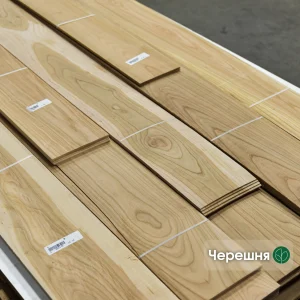
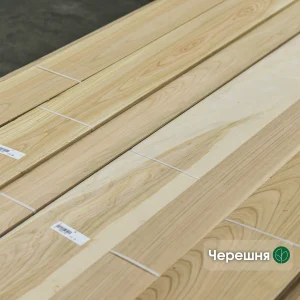
Sawn cherry veneer, or sawn cherry lamella, is a natural facing material produced by sawing solid timber. Compared to peeled or sliced veneer, the lamella is thicker, typically ranging from 2 to 10 mm. This material retains the physical and mechanical properties of the wood, allowing for the creation of stable and affordable structures. Minimum order is 1 pack. The pack price will be calculated by our sales manager. Delivery across Ukraine via carrier services. Collection available from our warehouse in Kyiv.
Sawn cherry timber features a pinkish-brown colour palette and significant wear resistance. This timber product is favoured by furniture makers, staircase manufacturers, and musical instrument artisans.
Key features of the material:
- Unique texture. Cherry wood possesses a smooth, uniform texture. Over time, under the influence of light, the timber develops a rich reddish hue.
- Mechanical strength. Sawn veneer can withstand substantial loads. Thanks to the production technology, the timber sheets maintain a stable shape, making them suitable for exposed surfaces subject to wear.
- Stability. Properly dried lamella, with a moisture content of 8-10%, minimises the risk of warping or cracking in the finished product during humidity changes.
- Restoration potential. The thickness of the lamella permits multiple sanding and refinishing processes. This significantly extends the service life of the products.
Choosing sawn cherry veneer is an investment in durability and classic style. This timeless aesthetic remains highly relevant for various interior projects.
Dimensions of sawn cherry veneer: stock availability and bespoke manufacturing
The company operates a stock programme and fulfills individual orders for timber with non-standard parameters. An assortment of timber products with standard specifications is consistently maintained in the warehouse.
Standard stock dimensions:
- Thickness: 2.5 mm or 4.5 mm.
- Width: from 12 cm.
- Length: 0.5–3 m.
In addition to the available material, you can order sawn veneer for bespoke projects. This collaborative format is highly convenient for joinery workshops, design studios, and craft workshops.
The following dimension ranges are available for bespoke production:
- Thickness: 2–10 mm.
- Width: 12–21 cm.
- Length: 0.5–3 m.
The manufacturing lead time for lamellae is typically up to 10 working days. The minimum order volume is 10 m² of timber of a single species.
Grades of sawn cherry veneer
In the woodworking industry, grading is a classification system based on visual characteristics. Natural features such as knots, texture uniformity, colour, resin pockets, and sapwood are considered alongside technical nuances. This division helps craftsmen select cherry lamellae that best suit the project’s aesthetic and budget requirements.
Despite visual differences, every grade of sawn lamella undergoes the same kiln drying cycle to 8-10% moisture content. Consequently, they possess identical physical and mechanical properties. The choice of grade depends on whether you require a uniform surface or wish to highlight the timber’s authenticity.
Comparison table of sawn cherry veneer grades
| Parameter
|
Grade 1 (A)
|
Grade 2 (B)
|
Grade 3 (C)
|
| Features
|
Premium quality facing material.
|
Optimal balance between price and timber aesthetics. Natural texture diversity is visible.
|
Material with pronounced natural grain. Often called ‘Rustic’ due to its high decorative value and rich details.
|
| Colour
|
Uniform
|
Minor variations
|
Contrasting (sapwood/heartwood)
|
| Tolerances
|
Absence of knots, sapwood, and mechanical damage.
|
Small ‘live’ (intergrown) knots and minor medullary rays are permitted. A small amount of sapwood may be present.
|
Presence of dark spots, knots (including loose ones for filling), and pronounced sapwood.
|
| Texture
|
Uniform. Only minimal changes in grain direction are allowed.
|
Pronounced natural
|
Rough, rustic
|
| Application sphere
|
Manufacturing premium segment furniture fronts, musical instruments, and decorative panels.
|
Production of parquet boards, internal elements of cabinet furniture, and classic style door leaves.
|
Loft, rustic, or country style products. Base for painting.
|
Classifying sawn veneer by grades ensures a predictable outcome when working with wood. It allows the craftsman to use resources rationally and create products with an individual character.
Application spheres for cherry lamellae in interiors
- Flooring. Sawn cherry lamella is used as the top working layer for engineered and parquet flooring. Timber sheets 3-6 mm thick are glued to a moisture-resistant plywood base. This results in flooring visually identical to solid wood but significantly more resistant to humidity fluctuations. The material’s thickness permits multiple sanding cycles, which is critical for high-traffic areas.
- Worktops and working surfaces. The timber is suitable for facing dining tables, kitchen island worktops, or study desks. Sawn lamella withstands accidental scratches well. Once varnished, the surface can endure significant operational use.
- Stair treads. Internal cherry stair treads are a symbol of status. Using lamellae for facing steps provides a highly durable and aesthetic surface.
- Furniture fronts. Cherry is a classic in furniture craftsmanship. Sawn veneer is used to decorate the fronts of wardrobes, chests of drawers, cabinets, and writing desks. Cherry furniture complements bedrooms, living rooms, studies, dining rooms, and libraries in classic, empire, baroque, neoclassic, and retro styles.
- Interior doors. The lamella provides door leaves with a premium appearance. It also guarantees high resistance to impacts and damage.
- Wall panels. Sawn cherry veneer is used to decorate wall panels and boiserie. The expressive pattern and warm palette of pink-amber tones fit logically into traditional interiors.
- Decorative partitions and screens. In modern design, cherry lamellae are actively used for spatial zoning. Slatted lamella structures look light and contemporary. Furthermore, interior walls and mobile screens are faced with cherry lamellae, allowing for easy layout changes.
Production of sawn cherry veneer (lamellae)
Manufacturing sawn cherry lamellae is a complex technological process. Every stage is strictly controlled to ensure the final product meets furniture industry standards.
The main stages of manufacturing sawn veneer are as follows:
- Raw material selection. The first step is selecting the boards. Boards of grade 1 and higher are chosen to ensure the absence of critical defects like large knots, heartwood cracks, or sapwood. This directly affects the aesthetic value and strength of the veneer sheets.
- Kiln drying. Thermal treatment in automated kilns to a joinery moisture level of 8-10% completely relieves internal stresses. Evenly dried and stable timber is the foundation of a high-quality lamella.
- Calibration of blanks. Before sawing, the dry boards undergo jointing and calibration. The dimensions of the timber are adjusted to fit the parameters of the saw cassette.
- Sawing. Wintersteiger machines are used to produce the timber sheets. The blanks are secured, settings are applied, and the solid wood is ripped into lamellae of the specified thickness. Thin-cutting saws ensure a smooth surface and minimise the loss of valuable cherry timber.
- Quality control and sorting. The finished veneer sheets are checked for grade and dimension compliance. The sorted lamellae are stacked in marked bundles, which are then placed on pallets for storage or transport.
Thanks to a systematic approach to the production cycle, the cherry lamella preserves the natural beauty of the wood whilst acquiring operational stability. The timber becomes a reliable foundation for creating durable interior solutions.
Cherry timber: characteristics and features
Cherry (Prunus avium) belongs to the category of valuable wood species. This fruit tree is widespread across Europe, Western Asia, and North Africa. The most valuable timber for industrial woodworking is grown in Central and Southern Europe, where the climate fosters a dense, uniform grain structure.
Cherry is classified as a medium-hard and moderately heavy wood. Its density ranges from 550 to 620 kg/m³, and its Brinell hardness is 3-3.5. While softer than oak, it is significantly harder than alder or coniferous species. This allows for easy processing of the solid wood while maintaining high surface wear resistance. Thanks to its high elasticity and toughness, this species is ideal for bentwood components and smoothly shaped furniture.
Freshly cut timber has a delicate pink or yellowish tint. Under the influence of UV light, the solid wood changes colour to a reddish-brown or golden-mahogany. The texture is fine, uniform, and smooth.
The fibres are typically straight, although logs with a wavy grain are sometimes found. The pores are minute and barely visible to the naked eye, ensuring perfect smoothness after sanding. Medullary rays are narrow yet distinct.
The material cuts excellently in all directions. The timber bonds well with joinery adhesives, such as PVA and PU glues. Cherry provides an optimal base for polishing.
It readily accepts stains, oils, and waxes. Due to the fine pores, varnish coatings apply in a smooth, even layer.
7 reasons to order sawn cherry lamellae from WoodWay Expert
Our company ensures that furniture manufacturers, joinery workshops, and private craftsmen can promptly receive high-quality materials. We have established partnerships with furniture factories, construction firms, architectural studios, and craft workshops. Here is why clients choose WoodWay Expert:
- Constant stock availability. A stock of standard 2.5 mm and 4.5 mm thick timber products is consistently maintained. You can visit, personally inspect the lamella bundles, evaluate the pattern and colour, and complete your purchase immediately. Orders can be collected from the warehouse after payment on weekdays from 08:00 to 17:00.
- Bespoke sawn lamella manufacturing. For projects requiring non-standard technical specifications, we offer bespoke lamella production. We accept requests for sawn veneer ranging from 2 to 10 mm in thickness. The minimum batch is 10 m² of a single species. Production takes up to 10 working days, and the manager will provide the exact price per square metre after clarifying the order parameters.
- Wide selection. Our stock programme features timber from over 15 different species. This allows you to find lamellae with the required texture, shade, and operational characteristics. If a specific species is absent from the standard range, we can arrange bespoke manufacturing, subject to technical feasibility.
- Self-collection and delivery across Ukraine. You can collect the material directly from our warehouse after purchase. For clients in other cities, delivery via transport companies is available throughout Ukraine. This approach ensures efficient cooperation with both local workshops and regional manufacturers.
- Remote material selection. Our managers will help you select lamellae online. Simply detailing your project’s characteristics: area, timber species, and texture type. We will send photos of available bundles and detailed specifications. Once agreed, an invoice is issued, and dispatch occurs after 100% payment.
- Convenient payment. Orders can be paid for in cash at the warehouse. Furthermore, cashless transfers are available for private entrepreneurs and companies, including VAT-registered entities.
- Bundle sales and wholesale supply. Sawn veneer is sold in bundles. The price of a bundle depends on its square meterage. The quantity of square metres in each bundle is determined by the dimensions and number of sheets. The cost is calculated using the formula: cost per 1 m² × (length × width × number of sheets). The company also fulfills wholesale supplies for enterprises.
Special cooperation terms are provided for regular wholesale customers. Bespoke commercial offers are formulated based on purchase volumes and product types.
Where and how to buy sawn cherry veneer in Ukraine?
You can purchase this facing material in several ways. Choose the method that best suits your needs: a personal visit to the warehouse or remote order placement.
- Visit the warehouse. At our wholesale and retail warehouse, buyers can personally inspect the available lamella bundles and evaluate the timber’s shade and texture. This approach helps you precisely match the material to your project’s requirements. Our specialists will consult on the range, suggest suitable options, and prepare an estimate. The warehouse address is Kyiv, Zdolbunivska St, 7d (entrance from Dniprovska Naberezhna, 17e).
- Contact a manager by phone. If a personal visit is not possible, you can finalise your purchase remotely. Simply call +380 (67) 180-38-13 or write to us on Viber or Telegram. A manager will select suitable options and send photos, videos, and specifications of available bundles, allowing you to assess the timber before ordering.
- Order via the website. Another convenient way to purchase sawn veneer is using the online form on our website. Simply select the timber species, specify the required lamella thickness, and add the item to your basket or leave a request via the contact form. Upon receiving your request, a manager will contact you, confirm the required area, agree on payment terms, and send photos of the prepared bundles if necessary.
We process orders of various scales. Contact us, and we will help you select the sawn veneer that optimally meets the technical and aesthetic demands of your project.