Clear the whole list?
Sawn Beech Veneer
Sawn beech veneer — light, even-grained lamellas 2–10 mm thick, kiln-dried for stability. Suits furniture, stairs, and bent elements. Sold from a single bundle; Kyiv pick-up, delivery across Ukraine.
Sawn beech veneer: specifications, features, grades, and applications
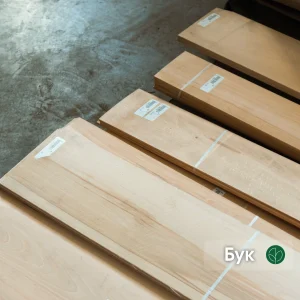
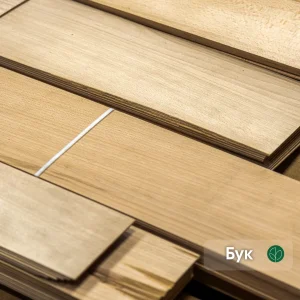
Sawn beech veneer (lamella) consists of thin timber sheets produced via longitudinal sawing. We supply beech sawn lamellas in thicknesses of 2.5 mm and 4.5 mm. Other timber thicknesses are available on custom order. Warehouse collection and delivery across Ukraine. Available for purchase from 1 pack.
Unlike planing or peeling, sawing requires no prior wood steaming, which entirely prevents internal micro-cracks. Consequently, the lamella retains the original structure, strength, and colour of the solid wood.
The use of beech lamella in woodworking is justified by several key advantages:
- Wear resistance. Due to its high density, the material withstands constant mechanical loads, pressure, and friction.
- Stability. Sawn veneer with a joinery moisture content of 8-10% is significantly less prone to deformation or cracking compared to solid boards.
- Aesthetics. The timber has a uniform texture with characteristic fine medullary rays. The colour ranges from pale yellow to pinkish-brown (after steam treatment, the material acquires a warm golden hue).
- Easy processing. Beech is highly amenable to sanding, tinting, painting, and varnishing.
- Flexibility. When steamed, beech wood becomes pliable, making the veneer indispensable for manufacturing bent-glued components.
Durable and dimensionally stable facing material enables the manufacture of reliable interior products.
Dimensions of sawn beech veneer: stock programme and bespoke production
Thanks to our stock programme, the most popular timber products are consistently available in our warehouse. We currently stock material with the following characteristics:
- thickness: 2.5 mm or 4.5 mm;
- width: from 12 cm;
- length: 0.5–3 m.
We also manufacture sawn veneer to bespoke specifications. This collaborative format is highly convenient for furniture factories, joinery workshops, and design bureaus. Material with the following characteristics is available to order:
- thickness: 2–10 mm;
- width: 12–21 cm;
- length: 0.5–3 m.
The lead time for bespoke beech lamella is 10 working days. The minimum order volume is 10 m².
Grades of sawn beech veneer
Grade is a measure of timber quality, determined by visual and structural features like knots, cracks, and grain direction. The grade directly influences the material’s application, aesthetic value, and cost. Sawn beech veneer is divided into three grades.
| Characteristics | Grade 1 (A) | Grade 2 (B) | Grade 3 (C) |
|---|---|---|---|
| Feature | The highest quality standard, designed for face surfaces. | The material retains strength but allows visual features that highlight natural origins. | Retains physical strength but features significant visual and structural characteristics. |
| Colour and texture | Even surface with a uniform wood pattern. Consistent colour, darkening after steaming. | Characterised by a contrasting texture. Slight colour variations are permitted. | Highly variegated colour, with a pronounced “false heartwood” and sapwood. |
| Knots | No knots, rot, or “false heartwood”. Only occasional “eyes” up to 1-2 mm are acceptable. | Sound knots up to 10–15 mm and minor areas of “false heartwood” are allowed. Dark loose knots are prohibited. | Various knot types allowed, including large black (loose) knots and major colour changes. |
| Cracks | None. | Through cracks are not permitted. Hairline cracks are possible. | End or surface cracks, usually filled during processing. |
| Application | Face components of exclusive furniture, premium engineered flooring, and wall panels. | Internal cabinet parts, rustic interior elements, and variegated worktops. | Unseen frame elements and bent-glued parts to be painted over. |
Where is sawn beech veneer used?
Owing to its high density and excellent wear resistance, sawn beech veneer is considered a highly versatile material. Its physical properties allow the lamella to serve as a full alternative to solid wood in furniture production, reducing costs without compromising quality.
The primary applications for beech lamella include:
- Floor coverings. Beech lamella measuring 3–6 mm thick often serves as the face layer for engineered and parquet flooring. The material withstands intensive daily loads and resists dents.
- Stair tread facing. Treads are subject to the highest levels of wear. Using sawn beech veneer guarantees structural longevity and creates aesthetic flights of stairs.
- Worktops and preparation surfaces. Sawn veneer is ideal for finishing kitchen islands and writing or dining tables. When treated with protective oils, a beech worktop gains superb water-repellent properties.
- Furniture facades. In cabinet production, beech lamella is used to face MDF or plywood. This creates wood-textured facades that are lighter and more resistant to humidity than solid wood.
- Doors and frames. Veneered doors retain their shape and provide excellent sound insulation. The timber sheets can be tinted to fit specific design projects perfectly.
- Interior partitions. Using lamellas for decorative slats (baffles) is a modern interior design trend. These non-structural installations help alter layouts and zone spaces effectively.
- Decorative wall panels. Finishing walls with wooden panels adds warmth and prestige to any interior. Panels faced with beech also contribute to improved sound insulation.
Additionally, veneer sheets are utilised to craft jewellery boxes, photo frames, and desktop organisers.
Production stages of sawn beech veneer
The quality of the finished material heavily relies on strict adherence to technology at every production stage. Let us examine the main steps in creating this facing material.
- Board selection. Initially, high-quality boards are selected. First or premium-grade timber is used to manufacture the lamella, yielding a stable material with a predictable texture.
- Timber drying. Following selection, the blanks are sent to drying kilns. Kiln drying reduces the wood’s moisture to a joinery level of approximately 8–10%. This controlled drying regime stabilises the solid wood structure and lowers the risk of deformation.
- Calibration of blanks. Before sawing, the boards undergo calibration. At this stage, the timber is levelled and adjusted to size according to the saw cassette parameters.
- Sawing. After jointing, the prepared boards are fed into a Wintersteiger multi-rip saw. The solid wood is sawn into lamellas of a specified thickness. Modern machinery ensures high cutting precision and maximises timber utilisation.
- Sorting. The finished lamella sheets are inspected for size, thickness, and appearance. The material is graded based on texture, colour, and natural wood features before being stacked into bundles.
Monitoring each stage ensures the lamella’s outstanding quality.
Beech timber: core characteristics
European beech (Fagus sylvatica) is amongst the most valuable hardwood species in the woodworking industry. Its natural habitat covers much of Western, Central, and Eastern Europe. Commercial plantations are concentrated in the Carpathians, Alps, and Balkans.
Beech belongs to the group of heavy and hard woods. The solid wood’s density at 12% moisture content is 680–720 kg/m³, with a Brinell hardness of 3.8. The material is exceptionally resistant to friction and prolonged static loads.
The timber absorbs impact energy beautifully and resists splitting under dynamic loads. Following hydrothermal treatment, beech becomes extremely flexible, making it the premier choice for bent-glued products.
The texture is fine, even, and dense, lacking a pronounced pattern of annual rings. The primary visual characteristic is the presence of broad medullary rays. On a radial section, they appear as shiny dark streaks, whilst on a tangential section, they resemble fine brown speckles.
Why is it beneficial to buy sawn beech veneer from WoodWay Expert?
Over thirty years of partnership history connects us with furniture factories, design bureaus, and craft workshops. Clients prefer our specialists due to several compelling reasons:
- Stock programme. We hold beech sawn veneer in thicknesses of 2.5 and 4.5 mm. Customers can inspect the timber, select bundles, and collect their order upon payment.
- Bespoke production. We manufacture batches of sawn veneer ranging from 2 to 10 mm in thickness for specific design briefs. The minimum volume is 10 square metres.
- Extensive selection. Our catalogue features over 15 wood species. If your required species is absent, we will consider manufacturing bespoke sawn lamella.
- Collection and nationwide delivery. You can collect goods directly from our warehouse. We also dispatch orders via transport companies across Ukraine.
- Remote timber selection. Submit a request, and our specialists will select lamella with the desired shade and pattern. You will receive detailed photographs of the selected bundles.
- Convenient payment. Cash payments can be made at the warehouse. Bank transfers are also available for registered businesses.
- Sales from 1 bundle. You can purchase sawn veneer by the bundle, starting from 1 unit. Square footage depends on dimensions and sheet count.
We also fulfil wholesale orders, preparing personalised discount offers for our regular partners based on volume.
How and where to order sawn beech lamella?
We offer three convenient formats for interaction:
- Warehouse visit. Assess the natural wood pattern and personally select bundles at 7d Zdolbunivska Street, Kyiv. Managers will assist with technical specifications and calculations.
- Contacting a manager. Reach out on +380 (67) 180-38-13 (Viber, Telegram) to provide your technical brief. You will receive photos of products ready for immediate dispatch.
- Online shop orders. Use our catalogue to specify your desired wood type and add items to your basket. Our specialist will call to confirm the details.
The WoodWay Expert team successfully supplies timber for both private workshops and factories, guaranteeing professional execution.