
Order
Place order
Clear the whole list?
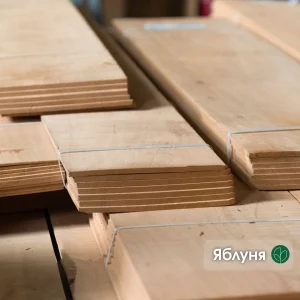
Sawn apple veneer, or apple lamella, is a premium decorative timber material. It is manufactured by sawing solid wood into thin sheets, typically 2 to 10 mm thick. We supply sawn lamellas in thicknesses of 2.5 mm and 4.5 mm. Sawn veneer in other thicknesses is produced to custom order.
Sawn apple veneer, or apple lamella, is a premium decorative timber material. It is manufactured by sawing solid wood into thin sheets, typically 2 to 10 mm thick. We supply sawn lamellas in thicknesses of 2.5 mm and 4.5 mm. Sawn veneer in other thicknesses is produced to custom order. Collection is available from our warehouse in Kyiv, alongside delivery across Ukraine. Available for purchase from 1 pack.
Unlike peeling or slicing techniques, sawing does not require prior steaming or boiling of the log. This ensures the material retains its original natural colour and the physical properties of the solid wood.
The key characteristics of sawn apple veneer are as follows:
Apple facing material is an exclusive product available in limited quantities. This timber is primarily used in the production of designer furniture, wall panels, marquetry, and fine joinery.
Our company supplies products from stock and manufactures bespoke timber to non-standard technical specifications. We consistently maintain a stock of apple wood veneer with standard characteristics:
We can also manufacture sawn veneer to individually specified dimensions. Bespoke timber is often requested by furniture manufacturers, joinery workshops, and design studios needing exact parameters. The following ranges are available for custom orders:
The production time for lamellas is typically up to 10 working days from order confirmation. The minimum batch size is 10 m² of veneer from a single wood species.
What is a timber grade? A grade is an indicator defining the visual and technical characteristics of the timber. Grading sawn veneer depends on the presence or absence of natural growth defects.
These defects include knots, cracks, sapwood, colour variations, and texture uniformity. The cleaner the sheet’s surface and the more consistent the pattern, the higher the grade and price.
Apple is a fruit-bearing species with a specific trunk structure and a complex, curly texture. It features a stark contrast between the darker heartwood and lighter sapwood. Flawless apple lamellas are much rarer than those from straight-trunk species like oak, making them highly prized.
| Characteristic | Grade 1 (A / Extra) | Grade 2 (B) | Grade 3 (C) |
|---|---|---|---|
| Feature | Highest quality for facing surfaces | Balance of natural aesthetics and practicality | Material for technical or creative work |
| Texture | Sheets feature a highly uniform shade and stable texture. Through-cracks, rot, fungal infections, or black, loose knots are not permitted. Only isolated, small, live intergrown pin knots (up to a few millimetres) are allowed. | Moderate natural defects that diversify the pattern without affecting physical strength are acceptable. Healthy medium-sized knots, noticeable colour variations (light sapwood streaks), minor surface micro-cracks on edges, and pronounced wavy grain are present. | Veneer with pronounced solid wood characteristics. Large knots (including dark or cracked ones), hairline cracks, significant sapwood, sharp colour contrasts, and local grain distortions around knots are permitted. |
| Usage | Used for the fascias of elite cabinet furniture, worktops, marquetry, and premium decorative wall panels. | Ideal for internal or side furniture components and the top layer of engineered flooring or parquet. Grade 2 is also popular in rustic, loft, or eco interior styles, where the natural, flawed look of the wood is appreciated. | Used as a technical (internal, hidden) layer in multi-layer glued structures. However, Grade 3 lamella is also in high demand in contemporary design for its character. |
Sawn apple lamella is a popular material in premium joinery. Due to its substantial thickness (2 to 10 mm), this timber is used where thin sliced veneer cannot withstand operational wear.
Sheets of apple lamella are used to create items that are visually and tactilely indistinguishable from solid wood. The main applications for this timber include:
Sheets of apple wood are also used to craft various interior decor and household items. Workshops use sawn veneer to create napkin holders, key racks, tablet stands, glasses holders, coasters, picture frames, vases for dried flowers, and wooden world maps.
Producing sawn lamellas from apple wood is a complex, multi-stage process. It requires strict adherence to technological standards to preserve the solid wood’s unique texture and ensure durability.
The key production steps are outlined below.
Strict quality control during production allows us to create a reliable finishing material for the premium furniture sector.
Apple (Malus) is a hard broadleaf species highly valued in joinery. Plantations of this fruit tree are concentrated in temperate climates across the Northern Hemisphere.
For commercial timber harvesting, trunks must reach 4–9 metres in height with a diameter of at least 0.3 metres. Because apple trees are primarily grown for fruit, obtaining high-quality, straight, and long sawlogs is challenging. Consequently, apple wood is classified as a rare, scarce, and expensive material.
Apple is a heavy and hard wood. The average density of the dry solid wood is 830 kg/m³ (ranging from 700–850 kg/m³ depending on growth conditions).
Its Brinell hardness is rated at 4.1–4.5, indicating exceptional resistance to scratches and impacts. The wood can be steam-bent, but its high density requires careful and slow shaping. It is highly viscous and holds metal fixings (screws, nails) securely.
The sapwood features a pale cream or light yellow hue. The heartwood colour ranges from light pinkish-brown to deep red-brown. Dark and light stripes, or “flames,” are common on the cut surfaces.
The texture is fine, dense, and uniform. The grain is generally straight, but curly grain is often found near the roots or branches. Pores are small, and medullary rays are thin and virtually invisible to the naked eye.
Sharp carbide-tipped tools must be used for cutting and routing. Apple is considered one of the best woods for woodturning. Intricate parts can be turned from the dense solid wood without chipping.
Despite its density, apple wood glues perfectly. It sands and polishes well, taking oils, waxes, and varnishes evenly.
The WoodWay Expert team ensures furniture makers, joiners, and craftsmen have rapid access to high-quality timber materials. We have collaborated with furniture factories, architectural studios, and bespoke joinery workshops for over 30 years.
Here are the key reasons clients choose us.
Wholesale buyers benefit from bespoke collaboration terms, personalised pricing, and the option to reserve material for future projects. This allows manufacturers to plan procurement reliably and optimise their raw material costs.
You can order facing materials in several ways, choosing the most convenient option for you:
We handle projects of all scales, from small orders for home workshops to high-volume manufacturing supplies. Get in touch, and we will source the perfect sawn veneer for your design project.
Apple is a scarce fruit-bearing species. The trunks are rarely long and straight, resulting in a low yield of usable timber and high sorting costs. Consequently, sawn apple veneer typically costs more than lamellas made from ash or maple.
We stock sawn veneer in thicknesses of 2.5 mm and 4.5 mm. Sales start from just 1 bundle, and wholesale volumes are available.
Sliced veneer is 0.5–0.6 mm thick and is steamed or boiled before cutting, which can alter the wood’s natural hue. Sawn lamella is 2 to 10 mm thick and cut from dry boards. This fully preserves its natural colour palette, withstands heavy mechanical stress, and allows for future restoration.
Thanks to its high density and unique aesthetics, it is widely used in the premium sector. Applications include hardwearing worktops, exclusive furniture fascias, marquetry, the top layer of engineered or parquet flooring, and stair cladding.
Transparent hard wax oils and varnishes provide the most striking visual effect. These finishes highlight the natural contrast between the pinkish-brown heartwood and pale cream sapwood. Apple wood is rarely stained, as its primary value lies in its unique natural colour.
Because the average density of apple wood reaches 830 kg/m³, joiners must exclusively use sharp carbide-tipped tools. It is also crucial to avoid pausing the router in one spot to prevent burning.
Yes, the material is perfectly safe for living spaces. Sawn lamella is 100% natural wood. The overall eco-friendliness of the finished item (like a bed or desk) will simply depend on the quality of the adhesive used for bonding and the safety of the chosen finish.