
Order
Place order
Clear the whole list?
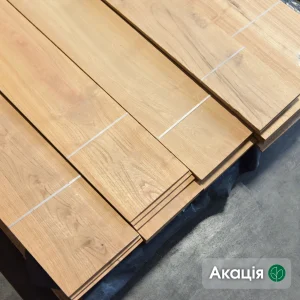
Sawn acacia veneer (lamella) — a hard-wearing finishing timber. Standard sheets 2.5 and 4.5 mm, custom 2–10 mm, width from 12 cm, length up to 3 m. Sold from a single bundle; Kyiv pick-up, delivery across Ukraine.
Sawn acacia veneer is a finishing material combining wood aesthetics and mechanical strength. Unlike sliced veneer, the lamella is manufactured by sawing solid wood to preserve fibre integrity and natural texture. Wooden planks 2 to 10 mm thick undergo kiln drying to 8-10% moisture content, guaranteeing material stability. Available for purchase from 1 pack. Orders can be collected from our warehouse in Kyiv. Delivery is available across Ukraine.
Core sawn veneer items are constantly available at our Kyiv warehouse. We also accept custom lamella production orders based on the client’s technical specifications.
In stock:
Custom sawn veneer production:
Standard sizes are kept in constant supply to ensure prompt order fulfilment. Custom manufacturing takes up to 10 working days, with a minimum order of 10 sq.m per wood species.
Acacia is one of the hardest timber species growing in Ukraine. Using lamellas from this wood offers several key advantages:
Sawn veneer offers an efficient use of timber, providing a high-quality surface finish for cabinet furniture, worktops, and engineered flooring.
Grade is determined by face quality, focusing on natural features like knots, sapwood, and colour uniformity. The grade impacts both visual appeal and cost.
| Characteristic | Grade 1 (Select) | Grade 2 (Natur) | Grade 3 (Rustic) |
|---|---|---|---|
| Colour uniformity | Highly stable colour without sharp transitions. | Natural colour variation allowed, emphasising natural origin. | High contrast between dark heartwood and light sapwood. |
| Knots, sapwood, and features | Completely free of knots, cracks, sapwood, and damage. | Occasional sound knots (up to 10-15 mm) and minor light sapwood (up to 10%) allowed. | Large knots, unlimited sapwood, micro-cracks, and strong texture changes allowed. |
| Usage | Exclusive furniture, interior panels, and elite parquet. | Standard furniture fronts, door frames, and flooring. | Loft, country, rustic, and eco-style designer furniture. |
| Key advantage | Premium material with flawless, carefully selected texture. | The perfect balance between price and natural aesthetics. | Affordable material with a highly expressive pattern. |
Acacia naturally possesses a complex structure with numerous knots. Consequently, Grade 1 lamella is rare and demands meticulous raw material selection.
Sawn acacia veneer is highly versatile for creating durable and aesthetic interiors.
Note that acacia tends to darken slightly under direct sunlight, which should be considered for bright rooms.
Producing sawn lamella is a highly technological process. Sheet quality relies heavily on strict drying regimes, calibration accuracy, and precise sawing parameters.
This comprehensive production cycle guarantees stable geometry and a high product yield. It ensures premium quality suitable for elite furniture and interior design.
Black locust (Robinia) is a highly valuable hardwood, outperforming oak and ash in mechanical properties. Its exceptional density and toughness make it the ultimate choice for maximum wear resistance.
Originally from North America, it thrives across Europe, particularly in Ukraine. Ukrainian acacia is prized for its optimal growth rates and dense annual rings.
Dry timber density is 770–810 kg/m³, with a Brinell hardness of 7.1. It strongly resists mechanical abrasion, indentation, biological decay, and splitting.
Freshly cut timber is greenish-yellow, maturing to dark golden or brown under UV light. The texture is prominent, featuring wavy or interlocking fibres.
Carbide-tipped tools are required for cutting. Due to tannins and oils, water-resistant D3/D4 PVA glues are strongly recommended.
We ensure furniture makers and construction firms receive top-tier timber materials without delay.
You can easily place an order using the method that best suits your project timeline.
We cater to both retail and wholesale clients, ensuring transparent pricing and punctual dispatch.
Sliced veneer is 0.5–0.6 mm thick, whilst sawn lamella (2–10 mm) preserves the fibre structure, solid strength, and allows repeated sanding.
Fresh acacia has an olive tint due to its unique chemistry. UV exposure matures it into a rich golden-brown or honey colour.
Grade 3 (Rustic) is ideal for loft or country styles. Its prominent knots and sapwood beautifully highlight the wood’s authentic character.
Given its high density and natural oils, use professional D3/D4 PVA or polyurethane (PU) glues on dust-free surfaces.
With proper treatment and varnishing, it boasts excellent moisture resistance, making it perfect for worktops and kitchen fronts.
For interior joinery, the standard is 8% (±2%). Kiln-dried lamella retains its shape perfectly.
Yes, Ukrainian-grown acacia is a 100% ecological product. It is entirely safe for crafting premium children’s furniture.