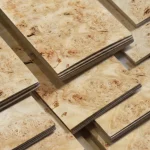
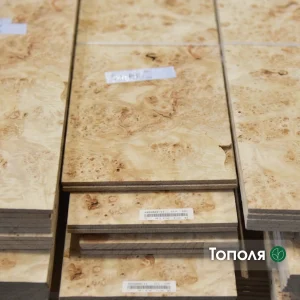
Burr Poplar Sawn Veneer

Sawn veneer (or lamella) from burl (black) poplar is a decorative timber cladding that combines the authentic beauty and stability of solid wood. Craftsmen use planks with a thickness of 2 to 10 mm to create furniture fronts, wall panels, coffee tables, and musical instruments.

Sawn poplar burr veneer 4.5 mm, 0.5–3 m

  • Wood species: Poplar Burr
  • Thickness: 4.5 mm
  • Type: Sawn
On request

Burl Poplar Sawn Veneer: Decorative Qualities, Grades, Dimensions, and Uses

Sawn veneer (or lamella) from burl (black) poplar is a decorative timber cladding that combines the authentic beauty and stability of solid wood. Craftsmen use planks with a thickness of 2 to 10 mm to create furniture fronts, wall panels, coffee tables, and musical instruments. You can buy sawn veneer from 1 pack. Collection from our warehouse in Kyiv, delivery across Ukraine. Remote material selection.

Designers and technologists value burl poplar for its unique texture, which forms due to the growth of dormant buds.

  • Decorative appeal. The chaotic interlacing of fibres and “bird’s eye” patterns create a 3D effect that is impossible to imitate.
  • Restoration potential. Sawn lamella features a substantial wear layer for repeated fine sanding and restoration, extending the product’s lifespan.
  • Stability. Thanks to kiln drying to a moisture content of 8-10%, the material does not warp or crack when the microclimate changes.
  • Eco-friendliness. Poplar timber is hypoallergenic and safe for use in residential spaces.

Using burl poplar lamella is an investment in the longevity and uniqueness of your piece. This decorative material allows you to realise exclusive, bespoke design projects.

Sawn Burl Poplar Veneer Dimensions

We maintain stock of timber products with the following dimensions:

  • Thickness: 2.5 mm and 4.5 mm;
  • Width: from 12 cm;
  • Length: 0.5–3 m.

If you require timber with specific parameters, we can manufacture it to order. Our production facilities allow us to obtain sheets:

  • Between 2 and 10 mm thick;
  • 12–21 cm wide;
  • From 0.5 m to 3 m long.

The lead time does not exceed 10 working days. The minimum order is 10 m². Please check the details with our manager.

Burl Poplar Sawn Veneer Grades

In the woodworking industry, burl (black) poplar is highly valued for its unique decorative appeal and complex texture. The grading approach for these timber products differs significantly from the classic standard.

What is a burl poplar lamella grade? It is a classification based on the density of burls (“eyes”), the intensity of the grain pattern, and the presence of specific natural voids.

It is vital to understand that the grade determines purely the aesthetic (visual) value of the face surface. Physical and mechanical parameters (stability, 8-10% moisture content, sawing precision) remain consistently high across all grades, as the material goes through a single technological cycle.

Classification of Sawn Burl Poplar Lamella by Grade

Parameter 1st Grade (Extra / A) 2nd Grade (Standard / B) 3rd Grade (Rustic / C)
Texture Features Highest concentration of burl formations. Tiny “eyes” and chaotically interwoven fibres densely and evenly cover almost the entire lamella. Natural voids, bark pockets, or micro-cracks are absent or minimal. The colour is highly uniform. Combined, calmer texture. Areas with dense burl clusters alternate harmoniously with straight or wavy fibres of standard poplar wood. Small, structurally stable natural cavities and minor bark pockets are permitted. Extremely natural and authentic appearance. Burl formations may be scattered or grouped in local islands. The main feature is prominent natural growth characteristics: large voids (cavities), deep bark pockets, through-cracks, and contrasting colour shifts.
Specific Uses Crafting exclusive premium furniture fronts, tops for high-end musical instruments, marquetry, and elite interior finishes (wall panelling, boiserie). Production of cabinet furniture, decorative wall panels, and bed headboards. The ideal choice for projects requiring a balance between a striking pattern and background wood. The perfect base for pouring clear or coloured epoxy resin. This is a best-seller for designer worktops and craft furniture in loft, industrial, and eco styles, where natural features are central to the design.

When working with burl poplar lamella (especially 2nd and 3rd grades), craftsmen strongly advise using primers or liquid resin before the final varnishing. This securely seals and strengthens the porous structure of the burls.

Uses of Burl Poplar Sawn Veneer (Lamella)

Burl (black) poplar is a timber with pronounced decorative characteristics. The primary value of the solid wood lies in its unique, chaotic fibre pattern and the presence of “bird’s eye” burls.

Using sawn veneer allows for the efficient use of this rare solid wood. We highlight the following main applications for burl poplar sawn veneer:

  • Exclusive worktops. Timber of the 3rd or 2nd grade (with natural voids and live edges) is chosen to create designer worktops paired with epoxy resin. The sawn veneer is glued to a stable core (like MDF or plywood), imitating a solid slab worktop whilst ensuring structural stability.
  • Furniture fronts. Cladding standard cabinet furniture with burl poplar lamella turns it into a work of art. The 1st and 2nd grades are typically used for wardrobe doors, chests of drawers, and cabinets. With a sheet thickness of 2 to 4.5 mm, the veneered surface looks almost identical to solid wood.
  • Internal doors. If your project calls for a feature door, choose sawn veneer from burl wood. The material is easy to apply and creates a piece with an unrepeatable pattern. To protect the door from mechanical wear, the surface must be varnished.
  • Wall panels (Boiserie). Large-format decorative wall panels for studies, libraries, or lounge areas are a popular way for designers to use burl poplar. Such wall finishes are relatively lightweight, reducing the load on suspension systems. The complex wood grain adds prestige to the interior.
  • Partitions. For zoning a space or altering a room’s layout, professionals use internal partitions made of MDF, chipboard, or plywood. The surface of these dividers can be beautifully finished with wood.

Additionally, burl sawn veneer is used to trim car interiors, yacht cabins, and craft various decor items (wall clocks, jewellery boxes, organisers, and statuettes). Burl poplar sawn lamella is the ultimate solution for projects where bespoke design comes first.

Production Technology for Burl Poplar Sawn Veneer

Manufacturing sawn veneer requires precision and industrial machinery. We strictly follow the technology to obtain high-quality cladding.

  • Timber selection. The first step is sorting the raw materials. We select boards of the 1st or higher grade to produce sawn lamella.
  • Kiln drying. The selected boards undergo kiln drying. This controlled hydrothermal treatment ensures an optimal joinery moisture content of 8–10%. Strict temperature regimes eliminate internal stress, yielding evenly dried and stable timber.
  • Calibration. The dry boards are planed to fit the dimensions of the saw cassette.
  • Sawing. Calibrated blanks are fed into industrial Wintersteiger machines, slicing the solid wood into sheets of a specific thickness. Advanced equipment ensures the correct geometry of each sheet and minimises manufacturing waste.
  • Quality control and packaging. Finally, the finished lamellas are checked for accurate dimensions and defects. The sorted wooden lamellas are packed in bundles and placed on pallets for storage or transport.

Multilevel quality control at every processing stage allows us to supply a stable, reliable product to the market. The finished lamella becomes the foundation for durable furniture fronts, engineered flooring, and exclusive joinery.

Burl (Black) Poplar Timber: Characteristics, Properties, and Processing

Burl (black) poplar (Populus nigra, commercial name — Mappa Burl) is a premium decorative timber. Black poplar grows across Central, Southern, and Eastern Europe (including Ukraine), as well as Western Asia and North Africa.

It is worth noting that burls (growths on the trunk yielding the unique texture) only form on a small percentage of trees. This makes solid burl wood and its veneer highly expensive raw materials.

Burl poplar is classified as a soft and light broadleaved species. The density is 385–480 kg/m³, and the Brinell hardness is approximately 2. Its natural wear resistance is low.

Due to the chaotic interlacing of fibres specifically in the burl areas, the material has reduced splitting strength compared to straight-grained poplar. Ordinary poplar bends well, but burl components are not suitable for steam bending due to a high risk of cracking along the “eye” clusters.

The texture is chaotic and wavy. The key feature is a dense cluster of dark spots (dormant buds), which contrast against the lighter main background. The sapwood is pale yellow or creamy-white, whilst the heartwood is light brown.

Burl speckles have a dark brown, sometimes black hue. Under UV light, the wood darkens, taking on an amber tone. The pores are tiny, remaining virtually invisible on a sanded cut.

The material is exceptionally easy to work with, but due to its low density and multi-directional fibres, it is prone to fuzzing and micro-tearing. Craftsmen recommend using sharp carbide-tipped tools at high speeds during cutting.

It requires multi-stage sanding with progressively finer grit (up to P320-P400). Because of its softness, there is a risk of creating dips if too much pressure is applied with the tool. Poplar glues perfectly with any joinery adhesives, though it absorbs wood stains unevenly.

Why Order Burl Poplar Sawn Veneer from WoodWay Expert?

We have been operating in the Ukrainian market since 1996. Over this time, we have established strong partnerships with furniture factories, architectural studios, and bespoke craft workshops. Clients choose us as their supplier for the following reasons:

  • Stock availability. We operate a comprehensive stock programme, maintaining popular 2.5 mm and 4.5 mm thicknesses at our wholesale and retail depot. On weekdays (08:00 to 17:00), buyers can visit personally to select bundles, pay, and collect the materials.
  • Bespoke sawing to client specifications. Because complex design concepts often require bespoke solutions, we offer a sawn veneer production service in an extended thickness range (from 2 to 10 mm). We accept orders starting from 10 square metres, with a lead time of 10 working days. A manager will calculate the cost once the request is processed.
  • Extensive range. Our product portfolio covers timber from over 15 wood species. If your project requires a specific or exotic timber not listed in our catalogue, we will source the raw material and manufacture the timber to your exact request.
  • Collection and nationwide dispatch. You can collect your order in person, or we can dispatch it across Ukraine via transport companies.
  • Remote selection. Leave an enquiry, and our specialists will find bundles that match your project’s shade, pattern, and area requirements. During the approval stage, you will receive detailed photographs of each selected bundle alongside technical specifications. Only after final approval will the manager prepare the invoice. Goods are dispatched after 100% prepayment.
  • Payment options. When purchasing at the depot, you can pay by cash (a receipt is issued). Corporate clients can use bank transfers (we work with limited companies including VAT, as well as sole traders).
  • Sales from 1 bundle. We sell sawn lamella by the bundle, starting from 1 unit. The square metreage of each pack depends on the dimensions and total number of sheets. To calculate the square metres in a bundle, use the formula: price per 1 sq. m. × (length × width × number of sheets).

We offer a personalised loyalty programme for regular wholesale clients. The manager calculates the discount percentage individually, based on the product type and order scale.

Where to Buy Bird’s Eye Poplar Sawn Lamella?

Our company’s workflow is fully adapted to the needs of both large-scale manufacturers and private joinery workshops. For your convenience, we offer the following ways to purchase sawn veneer:

  • Personal depot visit. The best way to evaluate the timber’s texture and colour palette is to inspect the products in person. Our specialists will advise you on the range, select the required bundles, and calculate the cost. Our depot address: Kyiv, 7d Zdolbunivska Street (convenient access for goods vehicles and cars from 17e Dniprovska Naberezhna).
  • Contact a manager. There is no need to travel to the depot. Call our specialist on +380 (67) 180-38-13 (Viber or Telegram) and leave a request. The manager will process your technical requirements and send photos of suitable available timber.
  • Online orders. You can quickly filter veneer by thickness and species, adding the required item to your basket. Once the request is received, a manager will call back to confirm the square footage and payment method, and will also send photos of the timber being prepared for dispatch.

Do you need materials for a one-off bespoke order? Are you looking for a wholesale supplier for serial production? The WoodWay Expert team is ready to tackle tasks of any complexity. Get in touch; we are open to partnership.

FAQ: Frequently Asked Questions about Burl Poplar Sawn Veneer

What is the optimal moisture content of sawn black burl poplar lamella for joinery?

The technological standard for furniture production and interior finishes is a joinery moisture content of 8–10%. The lamella undergoes a kiln drying cycle, which relieves internal stress and minimises the risk of warping during the finished product's lifespan.

Is sawn burl poplar lamella suitable for epoxy resin casting?

Yes, it is one of the most popular materials for crafting designer resin worktops. The 3rd grade (Rustic) lamella is best suited for this. It features natural voids, bark inclusions, and a waney edge, creating a stunning decorative effect with clear or tinted epoxy resin.

Why must burl poplar be primed before final varnishing?

Burl poplar has a porous structure with chaotic fibre directions in the "eye" zones. As a result, the material absorbs varnishes and paints unevenly. The technological standard dictates applying an isolating sanding sealer first to close the pores and ensure an even final coat.

What sizes of sawn burl poplar veneer are available in stock?

Our standard stock programme includes lamellas with a thickness of 2.5 mm and 4.5 mm. The length and width of the sheets are unstandardised and depend on the natural dimensions of the trunk. Bespoke sawing is available for thicknesses from 2 to 10 mm.

What influences the price of sawn burl (black) poplar veneer?

Pricing is based on three factors: Grade: 1st grade is the most expensive, whilst 3rd grade is more affordable. Sheet thickness: Thicker lamellas require more raw material to produce. Order volume: Discounts are available for wholesale buyers and regular partners.

Which adhesive should be used for veneering MDF with burl poplar lamella?

For a reliable bond between the lamella and the core (MDF, plywood, chipboard), we recommend using polyurethane (PUR) adhesives or high-quality PVA dispersions of the D3/D4 class.

What is the difference between 1st, 2nd, and 3rd grades of burl (bird's eye) poplar sawn veneer?

1st grade offers dense, even coverage with burls ("eyes") and no cracks or voids, making it ideal for premium fronts. 2nd grade combines burl zones with smooth fibres and allows for small, stable knots. 3rd grade features an uneven, wild texture with large natural voids, through-cracks, and bark, primarily used for epoxy resin casting.
View list
Compare