Ceiba-Faced Blockboard

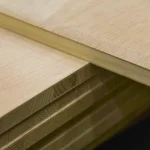
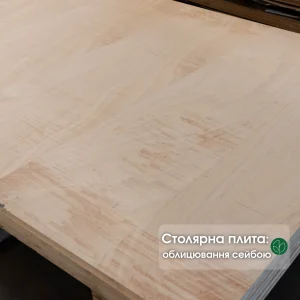
Veneered blockboard faced with ceiba veneer is a lightweight and dimensionally stable panel material ideal for furniture and wall panel manufacturing. The core consists of edge-glued pine blocks, while the finish features rotary-cut veneer from tropical ceiba wood.

Ceiba-Faced Blockboard, 13 mm, 2500×1250 mm

  • Wood species: Ceiba
  • Thickness: 13 mm
  • Type: Blockboard
1 081  / sheet
Moisture content
10-12%
Facing
Ceiba (fromager)
Dimensions
2500x1250 mm
Sheet area
3.125 m²

Ceiba-Faced Blockboard, 13 mm, 2800×2070 mm

  • Wood species: Ceiba
  • Thickness: 13 mm
  • Type: Blockboard
1 081  / sheet
Moisture content
10-12%
Facing
Ceiba (fromager)
Dimensions
2800x2070 mm
Sheet area
5.8 m²

Ceiba-Faced Blockboard: Specifications, Sizes, and Applications

We offer sheets in 13 mm and 18 mm thicknesses, available in 2500×1250 mm and 2800×2070 mm formats. Available for purchase starting from 1 sheet. You can pick up your order directly from our Kyiv warehouse, or we can arrange delivery across Ukraine via logistics carriers. Contact our managers for a remote consultation.

What is Ceiba-Faced Blockboard?

Blockboard is a composite panel material widely used in the furniture industry and interior design. Structurally, it is a multi-layered product that combines the strength of natural wood with the stability of engineered boards. The core is formed from wooden blocks or strips, most commonly pine. The wood is cut into 25 mm wide strips, precisely calibrated, and glued together. A special water-resistant adhesive is used for bonding, and the process is carried out under high pressure.

To prevent core deformation and ensure perfectly flat geometry, a stabilizing layer is applied to both sides of the glued core. Rotary-cut birch or alder veneer (lamellas) is used for this purpose. These wood species are characterized by high density and elasticity, making the structure exceptionally rigid. The final production stage involves facing the board with rotary-cut ceiba (fromager) veneer. This exotic wood species gives the panel unique properties, notably a lightweight nature and a uniform surface.

Thanks to this complex structure, blockboard eliminates the main drawbacks of solid wood. It is not prone to cracking, does not warp with changes in the microclimate, and is significantly lighter. At the same time, it remains eco-friendly and capable of withstanding high mechanical loads.

Sizes, Formats, and Custom Manufacturing of Ceiba Blockboard

To implement various projects—from crafting small furniture fronts to large-scale wall cladding—we offer the material in several dimensions. The WoodWay Expert assortment includes blockboards in two thickness options and two sheet formats. The choice of a specific size depends on the technical requirements and the estimated loads on the future product.

The following items are available in stock:

  • Thickness 13 mm, format 2500×1250 mm. The area of one sheet is 3.125 m². This is the optimal choice for lightweight structures, cabinet back panels, decorative partitions, and elements not subjected to extreme loads.
  • Thickness 13 mm, format 2800×2070 mm. A large-format sheet with an area of 5.796 m². The large dimensions help minimize the number of joints when cladding walls or manufacturing tall cabinets and flush-mounted doors.
  • Thickness 18 mm, format 2500×1250 mm. The sheet has an area of 3.125 m². The 18 mm thickness is an industry standard for furniture manufacturing. Such material is used to create load-bearing elements of cabinetry, countertops, shelves, and racks.
  • Thickness 18 mm, format 2800×2070 mm. The sheet area is 5.796 m². The combination of increased thickness and a large format makes this board a reliable solution for massive architectural elements, long bar counters, and oversized office furniture.

Properties and Advantages of the Material

Veneered blockboards faced with rotary-cut ceiba veneer combine advanced technology with natural aesthetics. The production process is strictly regulated, ensuring high performance characteristics for each sheet. Key advantages of the material include:

  • Optimal moisture content. During manufacturing, the wood undergoes a drying stage, reducing the moisture level to 10–12%. This is the canonical Moisture content: 10–12% for joinery materials, guaranteeing the dimensional stability of the finished product.
  • Moisture resistance. Thanks to the use of water-resistant adhesive mixtures and high-pressure pressing, the boards meet the moisture resistance parameters of the PN-76/D-97000 standard. They can be used in rooms with moderate humidity fluctuations.
  • Environmental safety. The material features an E1 formaldehyde emission class, meaning the boards are safe for human health. They are approved for use in residential spaces, including bedrooms and children’s rooms, as well as in public institutions.
  • Lightweight structure. Ceiba (fromager) wood belongs to lightweight tropical species. Combined with a pine core, this makes the blockboard significantly lighter than solid oak or ash boards of the same thickness. The reduced weight simplifies transportation, cutting, and installation, while also lowering the strain on hardware.
  • Thermal and sound insulation. The multi-layered natural wood structure excellently absorbs sound waves and retains heat. Wall cladding with these boards helps improve acoustic comfort and the indoor microclimate.

Facing Features: What is Ceiba (Fromager)?

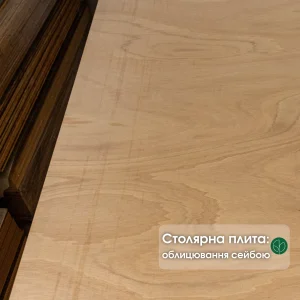
Ceiba, also known as fromager (Ceiba / fromager), is a tropical tree whose wood is highly valued in plywood and blockboard production. The rotary-cut ceiba veneer, which faces our boards on both sides, has a light, almost white or creamy shade. The wood texture is highly uniform, without pronounced contrasting grains or knots.

The surface of ceiba veneer is smooth and matte. These specific visual and physical characteristics make it an ideal base for further finishing. The material is highly workable. The surface can be easily painted with enamels, tinted with stains, or varnished. Furthermore, the uniform structure of ceiba serves as a flawless foundation for subsequent veneering with sliced veneer of precious wood species or laminating. Thus, you receive a lightweight, durable, and perfectly flat panel to bring any design concept to life.

Applications of Ceiba-Faced Blockboards

Due to its dimensional stability, light weight, and ease of processing, blockboard has a wide range of applications. It is in high demand among both large furniture factories and private craftsmen. The main areas of use include:

Furniture Manufacturing

The material withstands significant mechanical loads, making it suitable for crafting frames and fronts of cabinetry. The 18 mm thickness is ideal for creating wardrobes, cabinets, dressers, bookcases, and shelves. The board’s lightness allows for the creation of massive-looking structures that do not overload hinges and drawer slides. It is also used to manufacture countertops, bar counters, bed headboards, and elements of upholstered furniture.

Interior Finishing and Wall Panels

Large-format sheets (2800×2070 mm) are an excellent solution for creating wall and ceiling panels. The blockboard maintains a stable shape, resisting bending or warping over large areas. Veneered panels are used to decorate home offices, conference rooms, hotel lobbies, restaurants, and private living rooms.

Doors and Architectural Elements

Wear-resistant blockboard is utilized for manufacturing interior doors, where perfect slab geometry and low weight are crucial. The material is also used to create interior partitions, folding screens, window sills, staircase elements, arches, and decorative beams. Architectural elements made of blockboard serve for years, preserving their original characteristics.

Blockboard vs. Edge-Glued Panel: Which to Choose?

In woodworking, the choice between a blockboard and an edge-glued panel often arises. Although both materials are made of natural wood, they have significant structural differences. An edge-glued panel consists entirely of solid wood lamellas glued together. It lacks an external stabilizing facing.

A blockboard is a composite. It features a core made of an accessible species (pine), which is covered on both sides with strong rotary-cut veneer (birch or alder) and a finishing layer (ceiba). Thanks to this cross-banded structure, the board is significantly more stable than a glued panel. It reacts less to humidity changes and is not prone to warping or cracking. Additionally, using a pine core and ceiba veneer makes the board a lighter and more affordable alternative to solid edge-glued panels.

7 Advantages of Partnering with WoodWay Expert

WoodWay Expert has been supplying high-quality wood materials to the Ukrainian market for over 30 years. We understand the needs of modern manufacturing and offer comfortable conditions for every client. By choosing us, you gain a range of benefits:

  1. Expertise and experience. Over three decades in the market have allowed us to build an assortment exclusively from proven and reliable materials.
  2. Quality guarantee. All blockboards meet the stated specifications, feature a Moisture content: 10–12%, and have an E1 emission class.
  3. In-stock availability. Popular thicknesses (13 mm, 18 mm) and formats are always available at our Kyiv warehouse.
  4. Flexible sales terms. We do not limit clients in volume—purchases can be made starting from 1 sheet (individually), as well as in wholesale batches.
  5. Convenient logistics. You can pick up your order yourself or use the delivery service across Ukraine via logistics carriers.
  6. Professional consultation. Our managers will provide comprehensive remote information regarding availability, exact dimensions, and payment methods.
  7. Wide selection. In addition to blockboards, you can find materials for a comprehensive solution to your production tasks.

How to Buy Ceiba-Faced Blockboard in Ukraine?

  • To personally inspect and select the panel material, visit our warehouse in Kyiv.
  • If visiting is not possible, contact a manager by phone or via a convenient messenger to place an order remotely.
  • You can also order blockboards online by submitting a request through the website’s shopping cart.
  • We work with both retail buyers (starting from one sheet) and wholesale customers.

FAQ (Frequently Asked Questions)

What is the difference between a blockboard and an edge-glued panel?

A blockboard consists of a core (pine blocks) and stabilizing and finishing facings (ceiba veneer). It is lighter and more stable. An edge-glued panel is made of solid glued wood lamellas without external facing.

What is the moisture content of ceiba-faced blockboard?

During production, the material undergoes a drying stage, which helps reduce and stabilize the Moisture content: 10–12%.

Is blockboard safe for residential spaces?

Yes, the material has an E1 formaldehyde emission class. This means the boards are environmentally safe and suitable for furniture manufacturing and interior finishing in bedrooms, living rooms, or children's rooms.

What is the area of one blockboard sheet?

The area depends on the format. A 2500x1250 mm sheet has an area of 3.125 m². A 2800x2070 mm format sheet covers 5.796 m².

How can the surface of a ceiba-faced board be finished?

Rotary-cut ceiba veneer has a smooth, matte surface, making it an excellent base for further finishing. The material is easily painted, varnished, and is also suitable for veneering with precious wood species and laminating.

Is this board moisture-resistant?

Blockboards are manufactured using water-resistant adhesive and meet the moisture resistance parameters of the PN-76/D-97000 standard. They handle moderate indoor humidity fluctuations well.
View list
Compare